


Mercedes VIN Decoder
Our Mercedes VIN Decoder makes it easy to check any Mercedes-Benz specs and history instantly. See the specifications for free, and add the vehicle history at an affordable price. Got a classic? We also handle pre-1981 VIN numbers.
What is a Mercedes VIN Decoder?
A Mercedes VIN Decoder is an online service that interprets a 17-digit VIN, which is assigned to every Mercedes-Benz vehicle. By decoding your VIN, you can make informed decisions when buying a used car, verifying its history, or ensuring the vehicle’s specifications match your needs. This tool is invaluable for both Mercedes-Benz owners and potential buyers.
And hey, it’s not just about the newer models. Instant VIN Reports can even decode those classic Mercedes-Benzes with shorter VINs (pre-1981). So, whether you’re checking out a modern ride or a classic beauty, we’ve got you covered.
What is a Mercedes VIN (Vehicle Identification Number)?
A Mercedes VIN is a unique 17-digit alphanumeric code for every Mercedes-Benz vehicle ever manufactured. Checking your vehicle’s VIN first helps you avoid bad buys and surprise repairs. It shows you a lot about the history and specifications.
Here is some important information that you can get.
- Country/region of origin, manufacturer, and vehicle type
- Vehicle specifications, such as the engine type, transmission type, body type, and more.
- The manufacturing plant, model year, and serial number
How to Read a Mercedes VIN Number?
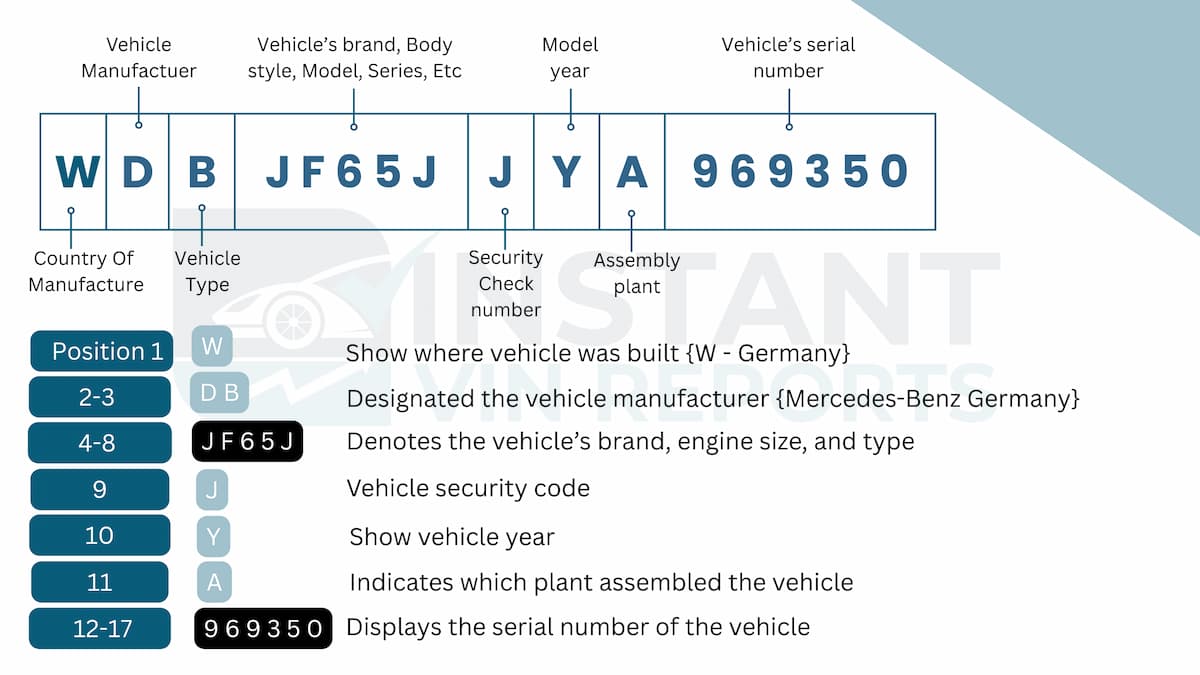
After 1981, all vehicles used a 17-character VIN, including Mercedes-Benz. The VIN is divided into three sections, each providing key details about the vehicle. Here’s how to read a Mercedes VIN number:
WMI (World Manufacturer Identifier)
The first three characters of a Mercedes-Benz VIN make up the WMI, which helps identify the manufacturer and the country where the vehicle was built. These three characters give key details about the manufacturer’s location, and they can tell you where the vehicle was assembled. This information is important for verifying authenticity.
- 1st Character: This character usually indicates the country or region of manufacture. For Mercedes-Benz, you’ll commonly see:
- W for Germany
- 1, 4, or 5 for the United States
- J for Japan
- S for the United Kingdom
- 9 for Brazil (certain cars and SUVs)
- 2nd Character: The second character is often D, representing Daimler AG, Mercedes-Benz’s parent company. However, this can vary depending on historical periods or special models.
- 3rd Character: The third character is used to specify the vehicle type, like whether it’s a sedan, SUV, or truck. Mercedes-Benz uses this to differentiate between vehicle categories in its own internal coding system.
Example WMI Codes for Mercedes-Benz:
- WDB: Mercedes-Benz vehicles manufactured in Germany
- W1K: Vehicles made in the U.S.
- WDC: Commercial vehicles like vans or trucks
VDS (Vehicle Descriptor Section)
The next five characters (4th to 8th character) describe the vehicle’s core attributes. This section provides information on body style, engine family, trim, and other key features that make each vehicle unique. However, note that these codes can vary depending on the model and the year of manufacture.
What you typically find in the VDS:
- Body Style/Body Class: Sedan, coupe, wagon, SUV
- Series/Line: Identifies the model family, such as C-Class, E-Class, or GLE.
- Restraints/Airbags: The safety features, such as airbags and seatbelts, that were fitted from the factory.
- Engine Family/Fuel Type: Information about the engine type, including petrol, diesel, hybrid, or electric.
VIS (Vehicle Identifier Section)
The final nine characters (9th to 17th character) are unique to each vehicle, including the model year, assembly plant, and serial number. It doesn’t contain detailed specifications like the engine type, but it’s critical for tracking individual vehicles, especially for things like parts ordering, recalls, and record-keeping.
- 9th Character: This character is used as a check digit to verify that the VIN is legitimate. It’s calculated using a specific algorithm developed by the U.S. Department of Transportation.
Â
- 10th Character: Indicates the model year. Each letter corresponds to a specific year. For instance, “S” corresponds to 2025, “T” to 2026, and so on. It’s crucial for determining the correct model year, which can differ from the production year.
Â
- 11th Character: This identifies the plant where the vehicle was manufactured. 11th Character: This identifies the plant where the vehicle was manufactured. Mercedes uses different plants, but the letter used for a plant is not a single, permanent rule across all WMIs. For VINs starting with 4JG (typically Mercedes-Benz SUVs), the 11th digit can be M or A (depending on the era/model) to indicate the Tuscaloosa plant.
Â
- 12th to 17th Characters: These last six characters are the production sequence. They don’t contain details of the equipment, but are used to distinguish the vehicle from others assembled in the same year. The final five characters are typically numeric (e.g., 12345).
Where can I find my Mercedes VIN number?
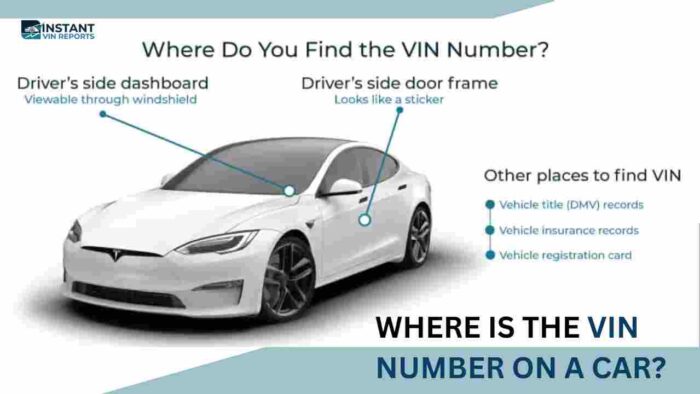
The VIN is typically located in several places on your Mercedes-Benz vehicle. You can check the Mercedes VIN in these spots:
- Windshield (driver’s side): Look through the glass at the base of the dashboard for a small metal/plastic plate with the VIN.
- Driver’s door jamb/B-pillar: Open the driver’s door and check the sticker on the door frame near the latch.
- Engine bay: The VIN can be stamped on the front of the engine block or shown on a plate in the bay.
- Chassis areas (varies by model): Sometimes stamped near the firewall, under the passenger seat, or in the rear wheel well.
- In your vehicle documents: Registration, title, insurance card/policy, owner’s manual, and service/maintenance records
What Information Can You Get from a Mercedes VIN Decoder?
When you use our Mercedes-Benz VIN Decoder, you get access to all the critical details that matter to both buyers and owners. Here’s what you’ll find:
Vehicle Specifications
When you run a Mercedes VIN with Instant VIN Reports, the results show key specs such as body style, engine, transmission, and more. It helps you confirm how the car left the factory and plan parts with confidence. For classic Mercedes (pre-1981), we include available build details too.
Accident & Damage History
If accidents were reported, you’ll see when and where they were logged. You may also spot other damage categories such as flood, fire, or structural issues. This way, you’re not surprised during inspection, service, or restoration.
Title Brand Check
The report flags title brands when available, such as salvage, rebuilt, lemon, or other marks. Clean title? Great. If something else appears, you’ll know before you agree on a price or sign anything.
Service & Maintenance Records
Service records show how a Mercedes-Benz has been cared for over time. A VIN check listed the service & maintenance records. This helps you to understand maintenance patterns and pair them with the other sections in the report.
Theft Records
View the recorded theft records tied to the Mercedes-Benz VIN number, listed with date, location, and source information when available. Very useful if the paperwork or seller story feels a bit off.
Ownership Records
Curious about the car’s past? When available, you will see the number of owners, approximate ownership lengths, and registration regions. This helps you piece together a Mercedes’ life and care pattern over the years.
Odometer Reading
In the Mercedes-Benz history report, you will get the mileage records with the date when available. If the numbers move backward suspiciously, that’s a rollback red flag you can address before you buy that vehicle.
Lien/Loan Records
Before any payment, check the lien/loan section in the Mercedes-Benz vehicle history report. If a lender still has a claim on the Mercedes vehicle, you’ll see it noted so you don’t inherit someone else’s problem.
Auction & Sales History
View past auction appearances tied to the VIN, including the location, date, sale status (sold, offered, no sales, and available image sets). This helps you see when and where the Mercedes was offered and how it looked at each appearance. Helpful for provenance and documentation.
Why Use a Mercedes VIN Decoder?
When it comes to buying or selling a Mercedes, knowledge is power. Our free Mercedes VIN Decoder helps you access important information that could save you time, money, and hassle. By simply entering the 17-digit VIN, you’ll get an easy-to-read breakdown of your vehicle’s specs, including details like the engine, trim, and original features.
For those who love classic cars, we can also decode older Mercedes (pre-1981), so you can learn about those models. If you’re interested in the car’s history, like accidents, title issues, and even auction and sales history with available photos, upgrade to the full records.Â
Who Can Benefit from Using a Mercedes VIN Decoder?
Different people use the Mercedes VIN Decoder for different reasons. Curious what you’ll gain as a buyer, seller, or dealer? Check the list below.
For Buyers
- Confirm identity. Check if the car is truly the Mercedes trim, engine, and model year as advertised. No guessing.
- Match the ad to factory data. Compare options (like 4MATIC, AMG package) with what the car was built with.
- Spot prior damage. History entries can reveal reported accidents and damage, so you don’t buy a headache.
- Check mileage patterns. See if recorded readings move sensibly over time. Odd drops can be a red flag.
- Recall awareness. Know if safety recalls exist, so you can ask if repairs were done.
For Sellers
- Build instant trust. A clean, readable VIN report eases buyer doubts right away.
- Set a fair price. Solid documentation supports your asking price, especially with rare options.
- Answer questions upfront. The information about trim, engine, and options is right there. Making it less back-and-forth.
- Fewer renegotiations. Fewer surprises after test drives means fewer last-minute price cuts.
- Faster sale. Clear info reduces delays, second looks, and endless messages.
For Dealers
- Accurate intake specs. Verify trim, engine, drivetrain, and body style from the VIN so the vehicle is described correctly in your DMS and listings.
- Title-brand screening. Check for salvage, rebuilt, flood, lemon, or other brands before purchase or retail.
- Odometer consistency. Review recorded mileage entries over time to spot possible rollback or data gaps.
- Accident/damage history. See reported collisions, airbag deployments, or total-loss records to judge reconditioning needs.
- Lien/loan check. Detect outstanding liens so payoffs are handled and ownership transfers are clean.
How to Use the Free Mercedes VIN Decoder?
To use the Mercedes VIN decoder, you’ll need the VIN (or classic chassis number), and follow these steps:
1) Find the VIN
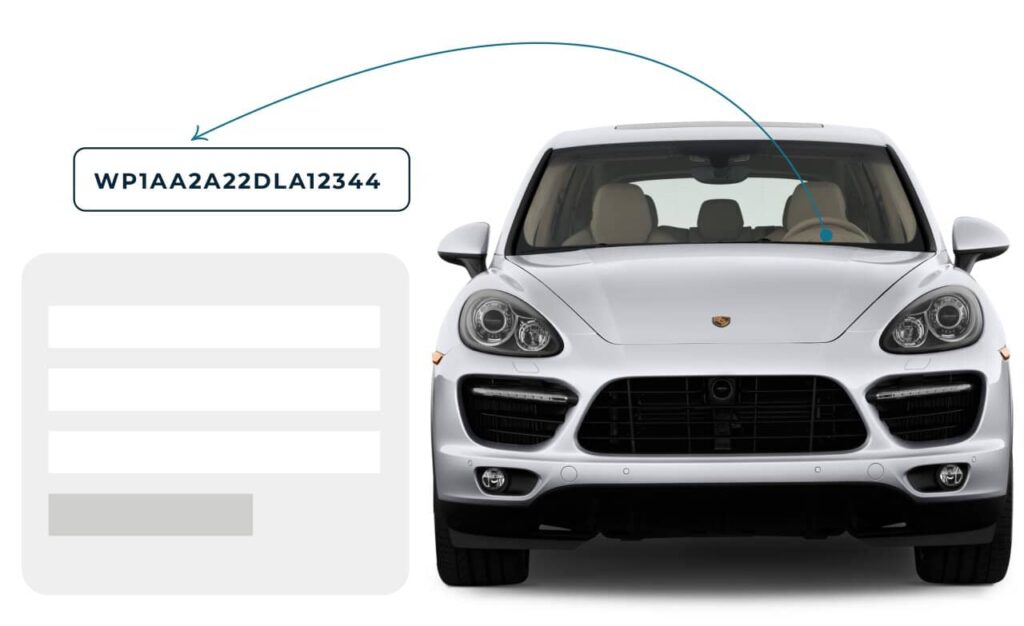
Locate the 17-character VIN on your vehicle. If you’re not sure where it is, check the dashboard or door frame (as mentioned earlier).
2) Fill in the Form
Enter the VIN into our form above. Double-check the characters to avoid any mistakes!
3) Get the Report
Click the ‘Search VIN’ button, and voila! You’ll instantly get a detailed report with everything you need to know about your Mercedes-Benz.
Free Mercedes VIN Decoder vs. Paid Mercedes VIN Decoder
Our free Mercedes VIN number decoder is perfect for quick verification. It returns specs and shows current listings and simple auction entries with mileage. The paid report goes further. It investigates the past, including the odometer consistency, title records, liens, accidents, theft, service/repair events, and more.Â
Here are the details of what you can get:
Â
| Feature | Free VIN Decoder | History Report (Paid) |
|---|---|---|
| VIN decoding for all vehicle types | ||
| Year, make, model, trim | ||
| Full vehicle specifications / detailed car specs | ||
| Market value snapshot | ||
| Sales listings (current/online ads) | ||
| Sales history (timeline of past listings/sales) | ||
| Auction records (when available) | ||
| Auction history with photos | ||
| Mileage during auction/sales (when available) | ||
| Odometer rollback checks | ||
| Ownership history | ||
| Vehicle usage type (personal, fleet, rental, commercial) | ||
| Title brand records (salvage, rebuilt, flood, lemon, etc.) | ||
| Lien & loan records | ||
| Accident & damage history | ||
| Theft / stolen records | ||
| Flood/hail/fire damage checks | ||
| Service/repair records | ||
| Warranty status & coverage | ||
| Recall information |
Decode VIN by Other Manufacturers
Frequently Asked Questions about Mercedes VIN Decoder
What is a Mercedes VIN?
Mercedes VIN is a unique 17-character code used to identify your vehicle. It contains detailed information about your car, from specs to history.
How does a Mercedes VIN decoder work?
A Mercedes VIN number decoder maps each VIN position:
- WMI (1–3) for maker/country,Â
- VDS (4–8) for vehicle details,Â
- check digit (9),Â
- model year (10),Â
- plant (11), andÂ
- serial (12–17).Â
Our Mercedes-Benz VIN decoder turns that into an easy report, showing the engine, trim, body, and drivetrain. You can also decode the classic Mercedes with fewer than 17 characters.
How to decode a Mercedes VIN?
To decode a Mercedes VIN, simply enter the VIN into a reliable VIN decoder tool, like Instant VIN Reports, and get a complete report on your car’s details.
Is using an online Mercedes VIN Decoder safe and legal?
Yes. The VIN is publicly visible (windshield, door jamb, paperwork), and the VIN decoder Mercedes simply interprets that identifier; it doesn’t expose private data.
Can I check a Mercedes VIN for free?
Yes. Our Mercedes VIN decoder free lookup shows specifications at no cost (e.g., engine, trim, body, model year). If you also want historical items, such as title brands, accidents, lien/loan checks, recalls, mileage records, and auction data, you’ll need to upgrade to the full report. This keeps the quick spec check free while giving you the option to see everything when it matters.
How to decode a 13 Digit VIN number?
Some classics use 13 digits (others may use fewer or more). Enter the number; our system will decode available fields and show specifications where data exists. For the full history on classics, purchase the report if coverage is available.