
Washington License Plate Lookup: Get Vehicle History in Seconds
Running a Washington license plate lookup is a smart step before buying or selling a used vehicle. It helps confirm that the car’s history matches the listing, verifies its legal status, and reduces the risk of costly surprises later.
What is a Washington License Plate Lookup?
A Washington license plate is issued by the Washington State Department of Licensing (DOL) for passenger vehicles, motorcycles, trailers, and commercial vehicles. In most cases, standard plates stay with the vehicle when ownership changes, while personalized plates usually remain with the owner.
A Washington license plate lookup allows buyers and sellers to review a vehicle’s background using the plate number. This helps ensure the vehicle details align with official state and national records before completing a sale or transfer.
Using a reliable Washington license plate lookup service, you can access key information such as the vehicle’s year, make, model, title status, mileage records, accident history, and other data that may reveal issues not disclosed in the listing.
Why Should You Run a Washington License Plate Search?
A Washington license plate search provides valuable insight into a vehicle’s past before any money changes hands. Using a trusted lookup tool can help reduce risk and improve confidence in a variety of situations.
Buying a Used Vehicle
Running a Washington license plate lookup can uncover important details such as title branding, ownership changes, and previously reported problems that may affect the vehicle’s value or safety.
Check Ownership and Title History
Review prior ownership records and confirm whether the vehicle has a clean title or carries brands like salvage, rebuilt, or lemon, which can impact registration and resale in Washington.
Spot Past Issues Early
Identify reported accidents, damage entries, or inconsistencies that may not be obvious during a test drive or visual inspection.
Information You Will Find in Our Washington License Plate Lookup Report
A Washington license plate lookup report provides both basic vehicle details and deeper historical records. It covers specifications, ownership changes, title brands, accidents, theft reports, liens, auction activity, recalls, and other data needed to evaluate a vehicle accurately.
Vehicle Specifications
This section outlines the vehicle’s core specifications, including year, make, model, engine configuration, transmission type, fuel system, drivetrain, and manufacturing origin. These details help determine whether the vehicle aligns with your performance needs, usage plans, and long-term ownership costs.
Ownership History
Ownership history shows how many times the vehicle has changed hands in Washington or other states, along with ownership durations and registration locations. Personal information, such as owner names and addresses, is excluded in compliance with privacy and federal data protection laws.
Title Status
Title status helps confirm whether the vehicle carries a clean Washington title or includes brands such as salvage, rebuilt, lemon, or other designations. Reviewing this section helps prevent registration issues, insurance complications, and unexpected reductions in resale value.
Theft Records
The theft records section checks whether the vehicle has been reported stolen in Washington or nationally. It includes reporting dates and locations when available, helping buyers avoid vehicles that could later be seized by authorities without compensation.
Accident Records
Accident records list reported collisions linked to the vehicle, including dates and locations when provided. Reviewing this history helps assess prior damage exposure and identify potential long-term mechanical or structural risks that may not be visible during an inspection.
Mileage Verification
Mileage verification compares odometer readings recorded over time to detect inconsistencies or potential rollbacks. This section highlights gaps or irregular patterns, helping confirm whether the reported mileage accurately reflects the vehicle’s actual usage history.
Auction Insights and Photos
Auction insights indicate whether the vehicle has passed through an auction sale. When available, this section includes auction dates, sale locations, condition notes, final prices, and photos captured during the auction process to provide additional context.
Lien or Loan Information
Lien and loan information reveal whether outstanding financial obligations are attached to the vehicle. Active liens can prevent a legal ownership transfer in Washington, making it essential to confirm that all loans or security interests have been satisfied.
Warranty Coverage
Warranty coverage shows whether any factory or extended warranties remain active. This section outlines coverage types, expiration dates, mileage limits, and included benefits such as powertrain protection, corrosion coverage, roadside assistance, or manufacturer-backed plans.
Damage Records
Damage records highlight reported damage caused by accidents, floods, fires, hail, or other events. Reviewing this section helps determine the severity of past damage and whether repairs were documented, completed properly, or may still affect reliability.
Maintenance Records
Maintenance records provide insight into how consistently the vehicle was serviced. You may see dates, service locations, and performed work such as oil changes, inspections, or repairs, which can indicate overall care and future dependability.
Recall Information
Recall information identifies manufacturer-issued safety recalls affecting the vehicle. This section includes recall descriptions, dates, and resolution status, helping ensure unresolved safety issues are addressed before purchase or continued operation.
How to Check a Washington License Plate?
To check the plate number and get a vehicle report by plate in Washington, follow these simple steps to get it done.
Find the License Plate Number
First of all, you will need to find the vehicle’s license plate number. You may check on the rear or front side of the vehicle. If you can’t find the plate, you may ask the seller directly.
Fill in the Form
After you get the license plate number, you can write it down on the form above. Then, click on the button to submit the form.
Get the Report
Wait for a few seconds to get the report generated. Then, you may proceed to payment to get the full vehicle history report.
Free Washington License Plate Lookup
You can use our free Washington license plate lookup and get the complete information on the car’s specifications and market value. With our free lookup service, here’s what you will be getting:
- Associated VIN number
- Year, Make, and Model
- Country of Origin
- Market Value
- Transmission Type
- Fuel Type
- Drive Type
- Body Type
- Trim Information
- MSRP
- Engine Specifications
- Dimensions
- Sales/auction history
- Market value
- Mileage
Washington Laws on License Plate
Washington law (RCW 46.16A.200) requires most vehicles to display two license plates, one on the front and one on the rear, mounted horizontally and kept clean and readable. Renewal tabs must appear only on the rear plate. Effective January 1, 2025, any plate cover, including clear covers, is illegal if it obscures or alters plate visibility.
Security of Information on Washington License Plate
Although proposed bills such as SB 6002 and HB 2332 seek to limit access to license plate reader data and require timely deletion, current rules still permit law enforcement agencies to share collected data, including with federal entities like U.S. Border Patrol.
Washington License Plate Design and Format
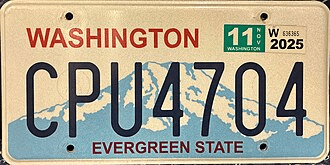
The plate features a flat, non-embossed design with navy blue lettering on a reflective white background, highlighted by a light blue Mount Rainier graphic and a dark blue border. “WASHINGTON” appears in red at the top, slightly left-aligned, with “EVERGREEN STATE” centred in red along the bottom.
Format and Serialization of Washington License Plate
The Washington license plate is issued by the Department of Licensing (DOL). It uses a seven-character alphanumeric format with three letters followed by four numbers (for example, ABC1234). These flat, non-embossed plates feature a Mount Rainier graphic and are issued as both front and rear plates.
License Plate Design in Washington
Washington license plates combine functional design with strong state identity, featuring Mount Rainier on standard plates and an expanding range of specialty options that highlight history, nature, and culture across the state.
- Standard Plate Design: Reflective white background with navy blue lettering, a Mount Rainier graphic, and a flat, non-embossed finish.
- Serial Format: Uses a seven-character format with three letters and four numbers (ABC1234) for standard passenger vehicles.
- Throwback Plate: Introduced in late 2025, this design features a solid black background with white lettering, inspired by early Washington plates.
- Pickleball Plate: Celebrates Washington’s official state sport with themed graphics and specialty branding.
- Additional Specialty Plates: New designs include pollinators, Mount St. Helens, Smokey Bear, and Keep Washington Evergreen, supporting state programs and causes.
Types of License Plates in Washington
Washington offers a wide range of license plate options issued by the Department of Licensing, covering standard passenger vehicles, personalized designs, specialty causes, military service, and non-passenger vehicle types across the state.
Standard License Plates
- Issued for most passenger vehicles.
- Feature the Mount Rainier mountain background.
- Require both front and rear plates for most vehicles.
Special Design and Specialty Plates
- Wildlife and Nature: Orca, Eagle, Bear, Elk, Deer, Steelhead, Washington State Parks.
- Universities and Colleges: UW, WSU, EWU, CWU, WWU, and other schools.
- Organizations and Interests: Professional sports teams, wine, and square dancing.
Military and Veteran Plates
- Plates honoring active service members and veterans.
- Represent military branches, medals, and service status.
- Issued with eligibility verification through the DOL.
Personalized (Vanity) Plates
- Custom letter and number combinations.
- Up to 7 characters for passenger vehicles.
- Up to 6 characters for motorcycles.
- Available on standard and many specialty plate designs.
Non-Passenger and Special Use Plates
- Collector or Antique Plates: For qualifying older vehicles.
- Motorcycle and Trailer Plates: Rear plate only, smaller size.
- Exempt (XMT) Plates: Government, city, or police vehicles.
- Disabled Parking Plates: Issued with an approved disability permit.
Washington License Plate Cost
License plate costs in Washington depend on plate type and vehicle category, with base plate fees added to annual registration, weight fees, and local transportation taxes that can significantly increase total yearly costs.
- Original Plate Issuance: Around $50, plus registration and vehicle fees.
- Motorcycle Original Plate: Around $20.
- Replacement Plate (lost or damaged): About $30.
- Motorcycle Replacement Plate: About $27.25.
- Plate Transfer Between Vehicles: Around $10.
- Personalized Plates: Additional annual fee on top of base costs.
- Specialty Plates: Extra fees vary by design and supported program.
License Plate Lookup by States
Our license plate lookup service is available statewide; you can check license plates from other states, including:
FAQs About Washington License Plate Lookup
Can I get the VIN from the Washington license plate lookup?
Yes, a Vehicle Identification Number (VIN) can be retrieved from a Washington license plate through third-party vehicle history services such as Instant VIN Report. While the Washington State Department of Licensing offers plate searches, direct access is generally limited to approved or qualified businesses.
What privacy protections exist for Washington license plate information?
Washington does not currently have a single, comprehensive statewide law governing Automated License Plate Readers (ALPRs). Although the federal Driver’s Privacy Protection Act (DPPA) restricts access to personal vehicle data, retention and usage policies are often set individually by local agencies.
Can I look up Washington license plates for commercial vehicles?
Washington commercial vehicle license plates can be searched, but access to detailed or non-public records is restricted. Authorised businesses and government agencies may use the Department of Licensing’s contracted plate search system, while third-party services can provide general vehicle history reports.
What are the limitations of Washington license plate lookup services?
The scope of Washington license plate lookup services is limited by privacy protections, the separation of public and restricted data, and system constraints. Detailed vehicle records are controlled under the DPPA and Washington statutes governed by RCW regulations.
Can someone find out where you live based on your license plate?
You cannot access personal owner details through a license plate lookup due to strict privacy protections. Federal and state laws, including the Driver’s Privacy Protection Act, restrict public access to DMV records to safeguard sensitive personal information.