
Check the Vehicle’s Complete Report With Virginia License Plate Lookup
Planning to buy a used car in Virginia? Use our Virginia license plate lookup tool to access a full vehicle history report. Check title status, service records, odometer readings, accident history, and more before completing a purchase.
What is a Virginia License Plate Lookup?
Virginia license plates are issued for passenger cars, motorcycles, trailers, commercial vehicles, and specialty vehicles. Plates are generally assigned to the vehicle owner and managed by the Virginia Department of Motor Vehicles (DMV).
A Virginia license plate lookup allows buyers and sellers to verify a vehicle’s history using the plate number. A detailed report can include year, make, model, engine specifications, title and lien status, accident history, mileage records, and other relevant data to help prevent costly mistakes or misleading sales.
Why Run a Virginia License Plate Search?
Running a Virginia license plate search helps uncover critical vehicle information before a sale or purchase. It reduces risk, confirms official records, and provides clarity whether you are buying, selling, or reviewing auction or private-party listings.
Buying a Used Vehicle
A Virginia license plate lookup helps identify essential details about a used vehicle.
Check Ownership and Title History
Review past ownership records and confirm whether the title is clean, rebuilt, salvaged, or branded before completing a purchase.
Spot Past Issues Early
Identify reported accidents, damage records, or mileage inconsistencies that may not be obvious during a basic visual inspection.
What Information Will You Find in Our Vehicle History Report in Virginia?
A Virginia vehicle history report provides a complete overview of a car’s past, from basic specifications to detailed records, including title status, accident history, lien data, and auction activity.
Vehicle Specifications
Check the complete vehicle details, including engine type, drivetrain, fuel system, transmission, and country of manufacture. These specifications help Virginia buyers and sellers assess whether the car meets daily driving needs, performance expectations, and long-term maintenance.
Ownership History
You can review the full ownership timeline for the vehicle, including the number of previous owners, the length of each ownership period, and the state or county of registration. Personal information, such as names or addresses, is excluded due to privacy protections under Virginia law.
Title Status
Title information reveals whether the vehicle has a clean Virginia title or a branded status such as salvage, rebuilt, flood, or lemon. Checking this section helps prevent registration issues and highlights potential legal or resale challenges before completing a sale.
Theft Records
This section indicates if the vehicle has ever been reported stolen in Virginia or other states. It includes the dates and locations of reported thefts, helping buyers avoid vehicles that could be subject to seizure or other legal complications.
Accident Records
Accident history includes reported collisions, dates, and locations when available. Reviewing this section allows you to understand prior damage, assess structural or mechanical risks, and determine whether past incidents could affect long-term reliability or resale value.
Mileage Verification
Mileage verification compares odometer readings over time, helping to identify inconsistencies or potential rollback. Early and recent mileage records are reviewed to ensure accuracy, giving buyers confidence that the vehicle’s reported mileage reflects its actual use.
Auction Insights and Photos
This section shows whether the vehicle has been sold at a public or dealer auction in Virginia. Details may include auction dates, sale locations, final sale prices, condition reports, and photos capturing the vehicle’s appearance at the time of the auction.
Lien or Loan Information
The report highlights any outstanding loans, liens, or financial claims on the vehicle. Open liens can prevent a clean transfer of ownership in Virginia, so confirming that all debts are cleared is critical before completing a purchase or sale.
Warranty Coverage
Warranty information outlines any active factory or extended coverage, including mileage limits, duration, and warranty type. This may include powertrain, corrosion, roadside assistance, or extended manufacturer-backed plans, helping buyers know what repair costs may still be covered.
Damage Records
Damage records show if the vehicle has suffered accidents, floods, fire, or other incidents. This information helps evaluate the severity of previous damage and whether repairs were completed correctly, giving insight into the car’s safety and structural integrity.
Maintenance Records
Maintenance history provides a timeline of services performed, including oil changes, inspections, and major repairs. Tracking this information gives buyers confidence in how well the vehicle was cared for by previous owners and its potential reliability.
Recall Information
Recall details indicate whether the vehicle has been affected by manufacturer safety recalls. Reports include the date of the recall, the nature of the issue, and whether it has been repaired or remains open, ensuring the vehicle meets Virginia safety standards.
How to Look Up a Virginia License Plate?
To look up the Virginia license plate, you can use our Virginia license plate lookup and check the thorough information of the vehicle. Follow these steps to get it done.
Find the License Plate
Firstly, you will need to find the license plate of the vehicle you are checking. You may ask the seller directly or find it on the bill of sale.
Enter the License Plate Number
Once you have the license plate number, you can click on the form above and enter the license plate number and select the State. Then, click on the “Search” button to retrieve the vehicle information.
Get the Detailed Vehicle History Report
Wait for seconds for the report to be generated. You can view the basic vehicle specification from the preview page, then proceed to payment to get the full vehicle history report that includes title info, theft records, accident, ownership and more.
Can You Look Up a License Plate for Free in Virginia?
Yes, you can access limited vehicle information at no cost using a free Virginia license plate lookup. A free VA plate search provides basic details to help you review a vehicle before purchasing, including:
- Associated VIN number
- Year, Make, and Model
- Country of Origin
- Market Value
- Transmission Type
- Fuel Type
- Drive Type
- Body Type
- Trim Information
- MSRP
- Engine Specifications
- Dimensions
- Sales/auction history
- Market value
- Mileage
Virginia License Plate Laws
Virginia law mandates that most vehicles display both front and rear license plates. Plates must be securely attached, clearly visible, and free from covers or frames that obscure letters, numbers, or the state name. Only motorcycles, trailers, and autocycles are required to display a rear plate.
Security of Information on Virginia License Plates
Vehicle records in Virginia are treated as confidential, with strict rules governing automatic license plate reader (ALPR) data. Law enforcement must delete non-hit ALPR data within 21 days, cannot share it for non-criminal purposes, and is prohibited from using ALPRs to monitor lawful activity.
Virginia License Plate Design and Format
Virginia license plates have a white background with blue lettering, usually showing “VIRGINIA” at the top and often the slogan “Virginia is for Lovers.”
Format and Serialization of Virginia License Plates
Standard passenger plates follow a 7-character format (ABC-1234), while specialty plates and older designs may use 6-character sequences (ABC-123) or custom, branded layouts, covering more than 200 unique types.
License Plate Design in Virginia
Virginia license plates feature a clean, recognisable design that balances readability, state branding, and personalization options for drivers across standard and specialty plates.
- Slogan: The standard plate prominently displays “VIRGINIA IS FOR LOVERS” at the bottom with a small red heart.
- Colors: White background with dark blue lettering; the heart adds a pop of red in standard designs.
- Typography: Uses a distinct, state-specific font to ensure clarity and uniformity.
- Serial Format: Standard plates follow an ABC-1234 format, with letter sequences progressing backward through the alphabet (e.g., V, U, T, S).
- Specialty Plates: Over 250 designs include universities, charities, military, and environmental causes.
- Personalization: Custom letter/number combinations are allowed (up to 7 characters) for an additional $10 per year.
- Antique Plates: Vehicles 25 years or older can use a white-on-black design, distinct from standard plates.
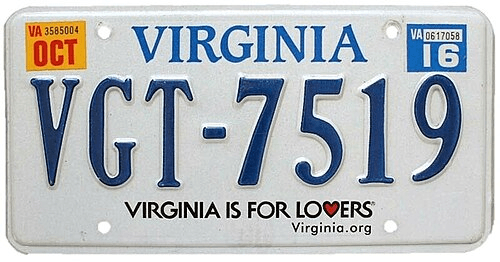
License Plate Types in Virginia
Virginia offers a wide variety of plate types that reflect personal, organizational, and legal needs, ranging from standard passenger plates to specialty and commemorative designs.
- Standard Issue: The default “Virginia Is for Lovers” plate issued for passenger vehicles.
- Special Interest/Specialty Plates: Over 200 designs supporting causes, charities, universities (e.g., VT Hokies), and sports teams (e.g., Washington Capitals).
- Personalized Plates: Available on standard or specialty plates, allowing drivers to choose custom letter/number combinations.
- Military/Veteran Plates: Over 50 plates honor active-duty members, veterans, retirees, and their families.
- Antique Plates: For vehicles 25 years or older; these often provide inspection exemptions.
- Disability Plates: Grant designated parking privileges for qualifying individuals.
- Other Types: Temporary plates, combination plates, and historic/commemorative plates like the Great Seal or Scenic designs.
License Plate Cost in Virginia
Virginia license plates are generally included with vehicle registration, but specialty and personalized options carry additional annual fees. Costs vary based on plate type, personalization, and local personal property taxes.
- Standard Plates: Fees are included in your vehicle registration; standard registration typically ranges from $30 to $40.
- Specialty Plates: Many specialty or cause-based plates add around $25 per year, with portions supporting the designated organization.
- Personalized Plates: An extra $10 annually for custom text or number combinations, in addition to any specialty plate fee.
- Local Taxes: Registration costs may also include annual personal property taxes, which vary by city or county.
License Plate Lookup by States
You can check license plates from other states, including:
FAQs About Virginia License Plate Lookup
Can I look up a VA plate with just the number?
Yes, you can perform a Virginia (VA) license plate lookup using just the plate number, but publicly available searches only provide vehicle details, not the owner’s identity. Free online tools, specialized services, and official DMV history requests can reveal make, model, year, title, and accident history.
Can a plate checker reveal owner information?
No, public plate checkers cannot access personal owner information, such as names or addresses, because of the federal Driver Privacy Protection Act (DPPA). Access to this data is limited to law enforcement or authorized entities, while online tools usually only show vehicle specifications and the VIN.
Is it illegal to take a picture of someone's car without their permission?
In the U.S., including Virginia, it is generally legal to photograph a vehicle in public areas since cars have no reasonable expectation of privacy. License plates are public information, but you should avoid trespassing on private property to take photos.
Can I check for liens or outstanding loans on a Virginia vehicle?
Yes, a Virginia vehicle history report can show if there are any active liens or financial claims tied to the car. Checking liens ensures that ownership can legally transfer without delays or unexpected debts attached to the vehicle.
How do I look up accident history for a car in Virginia?
You can view a vehicle’s accident history in Virginia by using its VIN or license plate with a trusted vehicle history service like Instant VIN Report. The report also include past collisions, damage records, insurance claims, and maintenance entries to help you assess the car’s condition.
How is a Virginia license plate linked to vehicle information, and who can access it?
In Virginia, each license plate is tied to official DMV records, including the vehicle’s make, model, and registration history. Public access is limited to vehicle information only, while owner details are restricted to authorized personnel, such as law enforcement or insurance companies, under the DPPA.