
Pennsylvania License Plate Lookup for Vehicle History Checks
Buying a used car in Pennsylvania and want to avoid surprises? A Pennsylvania license plate lookup helps you review a vehicle’s background before you commit. You can uncover accident records, title brands, auction history, and other details that may not be disclosed upfront.
What is a Pennsylvania License Plate Lookup?
A Pennsylvania license plate is issued by the Pennsylvania Department of Transportation (PennDOT) for passenger vehicles, trucks, motorcycles, trailers, and specialty vehicles. Plates are linked to a vehicle’s registration and title records, but they do not stay with the vehicle for life.
A Pennsylvania license plate lookup allows buyers and sellers to search a vehicle’s history using its plate number. This helps confirm whether the information in a listing matches official PennDOT and national records before completing a transaction.
By running a license plate lookup in Pennsylvania, you can access a vehicle history report showing details such as model year, make, engine information, title status, lien records, accident history, mileage readings, and prior usage. This reduces the risk of disputes, fraud, or costly mistakes later.
Why Run a Pennsylvania License Plate Search?
Using a Pennsylvania license plate search provides valuable insight into a vehicle’s past before money changes hands. Below are common situations where a plate lookup is especially useful.
Buying a Used Vehicle
Before purchasing a used car in Pennsylvania, checking the license plate helps reveal important history that may not be obvious during a test drive or visual inspection.
Review Ownership and Title History
A lookup shows how many times the vehicle has changed owners and whether the title is clean or branded as salvage, rebuilt, flood, or other non-standard classifications.
Detect Past Issues Early
Plate searches can uncover reported accidents, damage records, or mileage inconsistencies that may affect the vehicle’s value, reliability, or insurability.
What Information Can You Get from the Pennsylvania License Plate Lookup?
You can see many important pieces of information, like accident history, auction records, mileage history, and many more. Here’s the information you can get:
Vehicle Specifications
This section details the vehicle specifications, such as engine type, fuel, and transmission. It also includes the country of origin and MSRP. These help assess whether the vehicle fits your budget and daily usage needs.
Ownership History
The license plate lookup offers access to the vehicle’s ownership history. This section helps you find insight into past owners, including how long they kept the vehicle. It also reveals the locations where the vehicle was previously registered.
Title Status
Check the vehicle’s legality and safety through a title check in the vehicle report. Check for title brands like “salvaged,” “rebuilt,” or “lemon” to ensure the vehicle has a clean title. A clear title means that the vehicle is fully legal to be driven on the road.
Theft Records
This section checks whether the vehicle has been reported stolen. You’ll find details on the date and location of the theft. If you purchase a stolen vehicle, it can be seized by authorities, and you won’t get your money back.
Accident Records
Accident records provide a history of reported collisions involving the vehicle. It shows how many accidents the vehicle was involved in and when they occurred. This helps assess the vehicle’s overall condition before purchase or sale.
Mileage Verification
Mileage verification ensures that the vehicle’s recorded mileage is accurate. This section shows historical mileage data and highlights any discrepancies. It helps detect odometer tampering or rolled-back readings before you finalise the deal.
Auction Insights and Photos
This part confirms whether the vehicle was ever sold at auction. You’ll find auction dates, locations, vehicle status, and final sale prices. In addition, up to ten photos are included to show the vehicle’s condition during the auction.
Lien or Loan Information
Lien information reveals any outstanding financial claims on the vehicle. If a lien exists, it could prevent the transfer of ownership. Make sure all debts are cleared before purchasing to avoid financial complications.
Warranty Coverage
This section shows the status of factory or extended warranties. It includes details like mileage limits and expiration dates. Warranties for roadside assistance, corrosion protection, and other services are listed for clarity.
Damage Records
Check for records of damage caused by accidents, natural disasters, or other factors. You’ll see details about the extent of the damage and whether repairs have been made. Examine this section to ensure you do not need to deal with any other repairs.
Maintenance Records
Review the maintenance history to see how well the vehicle has been cared for. This section includes service dates, locations, and the parts that were maintained or repaired. A well-maintained vehicle typically means fewer long-term issues.
Recall Information
A recall was done to fix the serious issues in a vehicle. In the report, you’ll see the complete recall history. In this section, you’ll find the date, reasons, how the vehicle’s recall was fixed, and the final status (closed/opened).
How to Check a License Plate in Pennsylvania
Checking and getting a reliable vehicle history report in Pennsylvania is easy. You just need to follow these simple steps to get it done.
Get the License Plate Number
First of all, you need to have a license plate number. You may check on the rear or front side. If you can’t find it, ask the seller.
Enter the License Plate Number
Once you have the license plate number, simply enter it into the form. Select the state, and then click on the “Search” button to submit the form.
Access the Report
Wait for a few seconds to get the report generated. Examine the preview page and proceed to payment to get the vehicle report.
Free License Pennsylvania License Plate Lookup
You can get a free license plate lookup in Pennsylvania and get the basic yet compact details of the vehicle’s crucial information. Here’s what you’ll be getting from our free lookup:
- Associated VIN number
- Year, Make, and Model
- Country of Origin
- Market Value
- Transmission Type
- Fuel Type
- Drive Type
- Body Type
- Trim Information
- MSRP
- Engine Specifications
- Dimensions
- Sales/auction history
- Market value
- Mileage
Pennsylvania Laws on License Plates
In Pennsylvania, most vehicles are required to display two license plates, one on the front and one on the rear. Passenger vehicles must be registered with PennDOT before being driven on public roads.
New residents are generally required to register their vehicle within 20 days of establishing residency, while non-residents have limited exemptions depending on vehicle use and length of stay.
Security of Information in Pennsylvania License Plates
Vehicle and plate information is stored and managed by PennDOT, with controlled access for law enforcement and authorised agencies. Automated License Plate Recognition systems are used under state and local regulations to support traffic enforcement and public safety, while maintaining data privacy standards.
Pennsylvania License Plate Design and Format
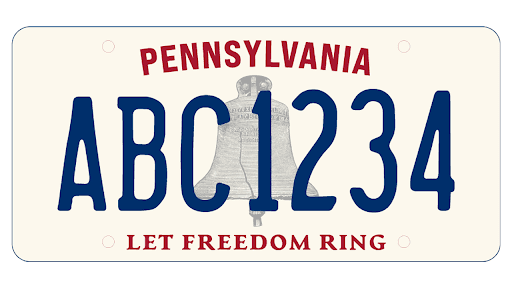
Since mid-2025, Pennsylvania has issued a new standard license plate with a white background, dark blue lettering, a state outline, the Liberty Bell, and the slogan “Let Freedom Ring.” Older plate designs remain legal, but PennDOT now issues only the updated version.
Format and Serialization of Pennsylvania License Plate
Starting in June 2025, Pennsylvania began issuing its standard “Liberty Bell” license plates with a white background, blue text, and the phrase “Let Freedom Ring.” Most passenger vehicles follow a seven-character format, usually three letters and four numbers (e.g., ABC 1234), with some variations separated by a keystone.
License Plate Design in Pennsylvania
Pennsylvania introduced a new standard license plate design in mid-2025. The plate features a white background with dark blue lettering, a state outline, and the Liberty Bell, marking the nation’s 250th anniversary. Older blue, white, and yellow plates remain valid, but PennDOT now issues only the updated design.
- Color scheme: White background with dark blue letters and numbers.
- Graphics: Liberty Bell centered, with the state outline in the upper left.
- Text and slogan: “Pennsylvania” arched at the top and “Let Freedom Ring” at the bottom for passenger vehicles.
- Truck plates: Display the word “Truck” in place of the slogan.
Types of License Plates in Pennsylvania
Pennsylvania offers several license plate types to match different vehicle uses, owner preferences, and eligibility requirements. Each plate is issued by PennDOT and may feature unique designs, formats, or fees beyond the standard option.
- Standard issue: The default passenger plate, featuring the Liberty Bell design introduced in mid-2025.
- Personalized plates: Custom letter and number combinations chosen by the vehicle owner.
- Specialty plates: Issued for specific vehicle types or groups, such as antique vehicles, veterans, or environmentally friendly cars.
- Special fund plates: Plates that support approved causes, charities, or programs.
- Military plates: Available to eligible service members and veterans.
- Organization plates: Represent recognised professions, associations, or groups.
Cost of License Plates in Pennsylvania
License plate costs in Pennsylvania vary based on plate type, registration class, and whether the plate is new or a replacement. Fees are set by PennDOT and may change with updated registration schedules.
- Standard license plate: $13 for a new plate, $14 for a replacement.
- Personalized plate: $100 or more, depending on the plate type, with free replacements.
- Specialty and vintage plates: Typically range from $10 to $22 or more, including military plates.
- Passenger vehicle registration: $48, which includes a standard plate.
- Motorcycle registration: Ranges from $21 to $39.50
License Plate Lookup by States
Our license plate lookup service is available statewide; you can check license plates from other states, including:
FAQs About Pennsylvania License Plate Lookup
How do I find out who owns a license plate in PA?
You generally cannot identify a Pennsylvania vehicle owner by license plate due to DPPA privacy laws. However, third-party services can provide vehicle history details, not personal owner information, unless law enforcement is involved for legal reasons such as a hit-and-run investigation.
Can I look someone up by their license plate?
No, you cannot legally identify someone using a license plate number. The Driver’s Privacy Protection Act restricts access to personal data, allowing only authorised parties, such as law enforcement or licensed investigators, to obtain this information for approved purposes.
How can I look up the owner of a vehicle?
To research a vehicle, use the VIN or license plate through state DMV tools or paid vehicle history services. Direct owner details are restricted under the DPPA, and for accidents or urgent situations, contacting the police or your insurance provider is the proper step.
Can a plate checker reveal owner information?
The Driver’s Privacy Protection Act prohibits unauthorised access to personal information tied to motor vehicle records, including names, addresses, Social Security numbers, and driver’s license details.
Is there a way to find out who owned a car before you?
Locating a previous owner typically involves reviewing vehicle documents, running a VIN search through the DMV or NMVTIS, or accessing vehicle history reports. While personal details are protected by law, ownership history without names may still be available through approved services or existing records.