
Verify Ownership and Theft Records With Florida License Plate Lookup
According to the National Insurance Crime Bureau (NICB) report, Florida ranked 4th in the U.S. for total reported vehicle thefts in 2025, with 27,142 thefts. Before you proceed to purchase or sell used vehicles in FL, check the car’s past with the Florida license plate lookup and get a vehicle report.
What is a Florida License Plate Lookup?
A Florida license plate search is a service that lets buyers and sellers check a vehicle’s background using the plate number. It helps confirm that the details in a listing match official records before a sale.
With a trusted license plate lookup service, you will get a vehicle history report. The report shows the year, make, model, engine data, title, lien records, accident history, mileage readings, and other key information to avoid risky or costly mistakes.
How to Look Up a Florida (FL) License Plate
Follow these steps to start your search.
Find the License Plate
Locate the license plate number on the vehicle or ask the seller. It may also appear on the bill of sale or listing.
Enter the License Plate Number
Enter the plate number into the search form above and select Florida as the state. Then click the “Search” button.
Get the Vehicle History Report
Wait a few seconds for the report to load. You can preview vehicle specifications for free, then continue to get the full report with title, theft, accident, and ownership records.
Why Run a Florida License Plate Search?
One of the reasons for checking the license plate is to get a vehicle history report in Florida. The report is useful for both sellers and buyers to understand the real vehicle’s condition before any transaction happens.
Buyers
A vehicle history report can help you examine if the vehicle is fully legal and matches your needs and budget.
Check the Title
On the report, you will see the actual title of the vehicle. The title determines the vehicle’s safety and legality; if the vehicle is marked as salvaged, run away.
See if it Matches Your Needs
Get the complete information on the vehicle’s specifications, MSRP, and market value. It helps you examine if the vehicle matches your needs and budget.
What Information Can You Get From a Florida Plate Lookup?
A Florida vehicle history report provides detailed information about a vehicle. It covers both basic data, such as specifications, and deeper records like accidents, auctions, title history, liens, recalls, and more.
Vehicle Specifications
Look up the vehicle's make, model, year, engine, and other available specifications using its Florida license plate. Compare these details with the vehicle and listing to check for inconsistencies.
Ownership History
Review reported ownership changes, registration locations, and ownership periods when available. Personal information, such as owners' names and addresses, is not included in IVR vehicle history reports due to privacy laws.
Title Status
Check available title history records, including salvage, rebuilt, flood-related, and other title brands. These details can help Florida buyers identify potential title issues before purchasing a used vehicle.
Theft Records
Check available theft and recovery records associated with the vehicle. NICB reported 27,142 vehicle thefts in Florida in 2025, highlighting why checking a used car's history is an important step before purchase.
Accident Records
Review reported accidents linked to the vehicle, including available dates, locations, and damage details. Florida recorded 381,423 traffic crashes in 2024, according to the Florida Department of Health. A plate lookup can help identify relevant records when available.
Mileage Verification
Review recorded odometer readings associated with the vehicle and compare them for inconsistencies. Unusual changes may indicate a reporting error or possible mileage rollback. Verify readings against service records and inspection documents.
Auction History and Photos
Find available auction records associated with the vehicle, including sale dates, locations, condition notes, and photos. Previous auction images may reveal damage or repairs that are not visible in the current listing.
Lien Information
Check available vehicle history records for reported liens or financial claims. Before buying, confirm outstanding liens with the appropriate Florida authority or lienholder to help avoid ownership transfer issues.
Warranty Coverage
Review available factory or extended warranty information, including coverage periods and mileage limits. Contact the manufacturer or warranty provider to confirm whether coverage remains active.
Damage Records
Check for reported flood, fire, collision, and other damage. Because Florida is exposed to hurricanes and flooding, review available damage records and arrange an independent inspection if water damage is suspected.
Maintenance Records
Review available service history, including maintenance dates and reported repairs. These records may help you understand the vehicle's condition, although not every service visit will appear in the report.
Recall Information
A recall is issued when a manufacturer finds a safety issue. This section shows recall dates, the reason for the recall, its status, and what was done to fix the problem. Make sure that the recalls are completely resolved before you get the vehicle.
What a Florida License Plate Lookup Cannot Reveal
A Florida license plate lookup provides vehicle history information, not protected personal details or real-time tracking data.
- Owner's Name or Address: Protected personal information.
- Phone Number or Email: Private contact details are not provided.
- Driver's License Number: Restricted personal data.
- Live Vehicle Location: Real-time tracking is not available.
- Insurance Policy Details: Private insurance information is not included.
Privacy laws, including the Driver's Privacy Protection Act (DPPA), restrict access to personal information. Instant VIN Reports are intended for vehicle research, not FCRA-regulated eligibility decisions.
Can You Find the Owner of a Florida License Plate?
No. Public license plate lookup tools do not reveal an owner's name or address. Access to personal information is restricted by privacy laws, including the Driver's Privacy Protection Act (DPPA).
Our vehicle history report can show the number of previous owners, how long each owned the vehicle, purchase dates, and registration locations. However, it does not disclose owners’ names, contact information, or home addresses.
Case Study: The Hidden History Behind a $14,945 BMW
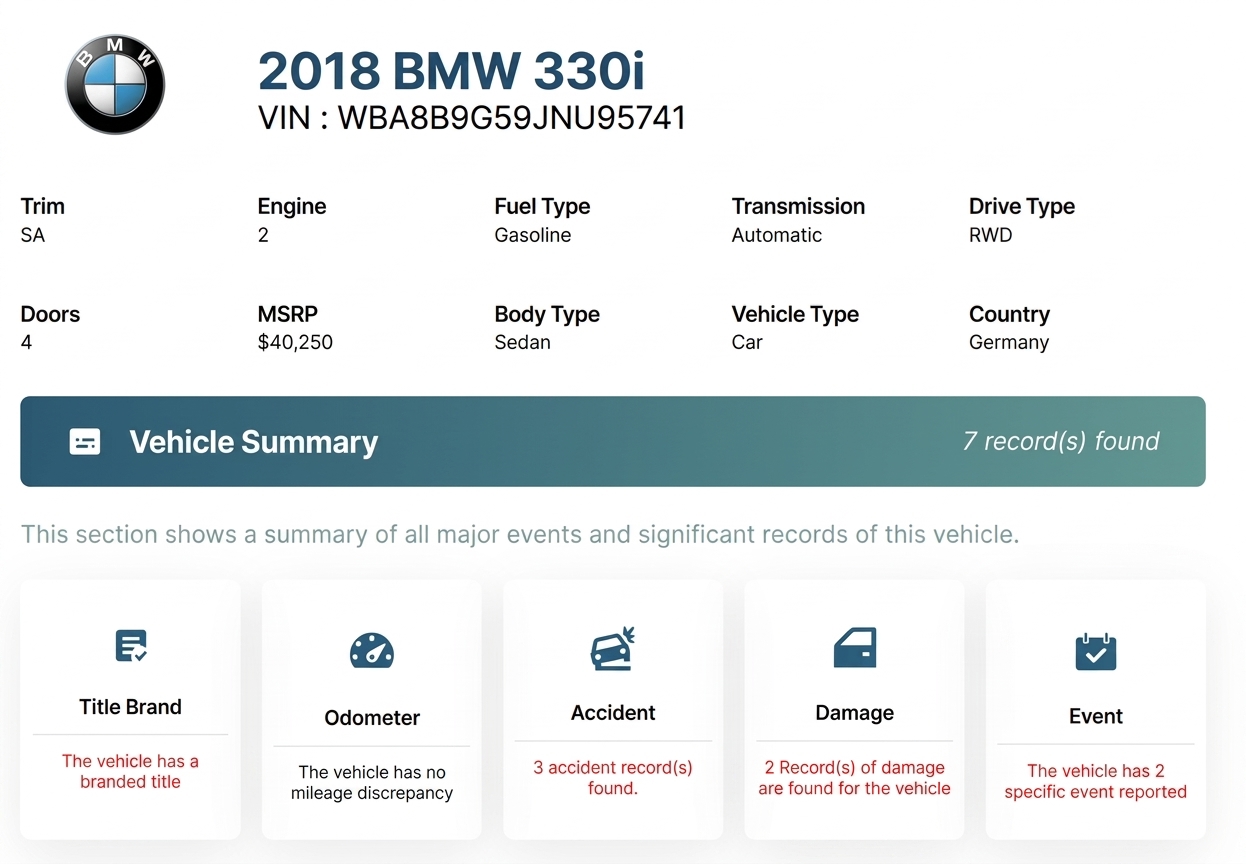
The online listing looked good. The vehicle history report revealed serious red flags. Dave found a used BMW on an online listing for $14,945, with 83,405 miles. So he decided to check its VIN before committing to the purchase.
VIN Checked: WBA8B9G59JNU95741
Without a VIN Check
- Dave finds a used BMW online listed for $14,945.
- The listing advertises a 2018 BMW 330i with 83,405 miles.
- The car has attractive features and a price that fits his budget.
- The listing's photos and specifications do not reveal the vehicle's full title, accident, or auction history.
- Dave could commit to buying the car without knowing its background.
With a VIN Check
- Vehicle: 2018 BMW 330i.
- Title status: Rebuildable Florida title, indicating the vehicle's title history needs careful review.
- Accident history: Three reported accidents dated June 23, 2020, February 6, 2026, and June 11, 2026.
- Auction history: A recent insurance-company auction dated October 12, 2026, lists Progressive Casualty Insurance as the seller.
- Damage records: Front-end damage reported in the auction record.
- Mileage history: The report lists a latest recorded mileage of 47,815 miles, which should be compared with the 83,405 miles shown in the listing.
The Difference a VIN Check Makes
Dave has more information to make an informed decision before spending $14,945 on a used car.
Florida Vehicle Risks Every Used Car Buyer Should Know
Florida’s vehicle risk data highlights potential problems that buyers should investigate before purchasing a used car, from accident damage to flood exposure. See the details in the table below:
Risk indicator | Latest available data | Potential risk |
|---|---|---|
Accidents | 395,175 crashes reported in 2023, the latest annual total verified here by FLHSMV | Hidden damage, safety concerns, and reduced resale value. |
Vehicle theft | 27,142 vehicles reported stolen in 2025, down 29% from 2024 | Theft-related ownership, recovery, and insurance complications. |
Odometer fraud | An estimated 109,000 vehicles in Florida had suspected odometer rollbacks in December 2025 estimate. | Overpaying for a vehicle or underestimating wear and maintenance needs. |
Salvage and rebuilt titles | No comparable statewide count verified for this overview | Previous severe damage, repairs, and potential safety concerns. |
Flood damage | Florida has experienced substantial hurricane-related vehicle damage. | Corrosion, electrical faults, and concealed water damage. |
Emissions | Florida does not operate a statewide periodic vehicle emissions inspection program | Mechanical or emissions-system problems may go undetected by an inspection program. |
How to Reduce These Risks Before Buying
- Run a VIN or license plate lookup: Review available vehicle history, title records, accidents, mileage, recall, and auction & online listing activity using Instant VIN Reports.
- Verify title and theft records: Review available title brands and theft records, and confirm the vehicle's legal status with the relevant authorities.
- Inspect the vehicle: Arrange an independent pre-purchase inspection, including checks for structural damage, flood exposure, and mechanical problems.
- Compare mileage records: Check historical odometer readings against service documents, inspection records, and auction listings to identify inconsistencies.
- Verify the VIN: Ensure the VIN on the dashboard and driver's door matches the vehicle documents and the report.
Florida License Plates: Styles and Cost
Florida license plates serve as vehicle identification and registration. The plate you choose affects the appearance of your vehicle and may add fees to your registration.
Florida License Plate Styles
Florida's official list of standard options and specialty plate information is available through the Florida Department of Highway Safety and Motor Vehicles (FLHSMV). Here are some of them:
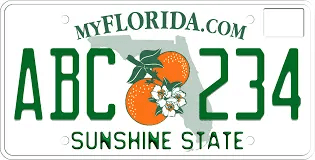 | Sunshine StateFlorida's familiar design features green lettering and an orange graphic, with “Sunshine State” along the bottom. It is one of the state's standard plate options. |
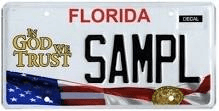 | In God We TrustAn alternative standard design with the phrase “In God We Trust.” It uses Florida's standard plate format and registration requirements. |
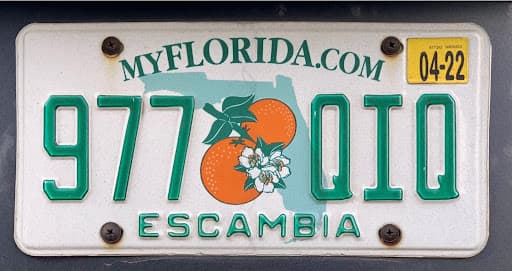 | County designationCertain participating counties offer a plate displaying the county name. Availability depends on the county. |
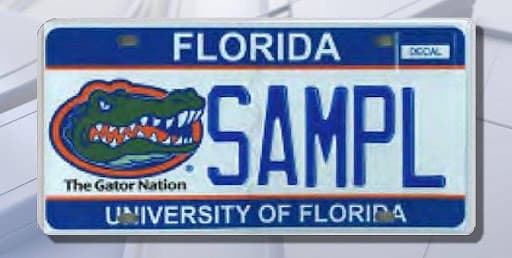 | Collegiate and specialty designsDesigns represent universities, sports teams, environmental causes, charities, military service, and other organizations. Many have an additional annual use fee. |
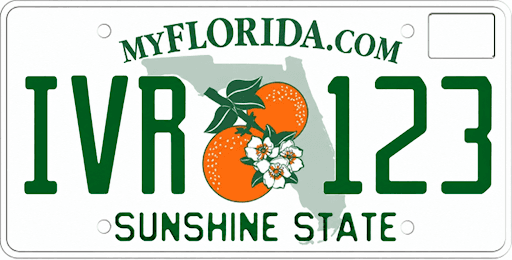 | Personalized platesEligible standard and specialty plates can be personalized with an approved character combination, subject to availability and applicable fees. |
Florida License Plates Costs and Fees
Florida license plate costs depend on the registration type, plate design, and applicable additional fees. Use the official links below to verify each fee.
Fee | Amount | Official form or source |
|---|---|---|
Initial registration fee | $225 | |
Metal plate issuance / 10-year replacement fee | $28 | |
Personalized plate annual use fee | $10 | |
Personalized plate processing fee | $5 | |
Specialty plate processing fee | $5 | |
Specialty plate annual use fee | Varies by plate | |
Replacement plate, decal, or parking permit | $28 plus applicable service charges, where required | |
Temporary license plate | Depends on the transaction |
Important: These are separate fees, not a complete registration total. Vehicle registration taxes, title fees, county service charges, mailing fees, and plate-specific charges may also apply. The $225 initial registration fee generally applies to a first Florida registration when no exemption is available.
How Your Personal Information is Protected in Florida
Federal and Florida laws provide different protections for personal information, regulating how certain data is collected, used, stored, and shared. Here’s how your personal information is protected in Florida.
Federal Privacy Laws
Federal laws establish nationwide standards for protecting personal information, depending on the type of data and the organization handling it.
Federal Trade Commission Act (FTC Act)
Prohibits deceptive privacy practices and certain failures to protect consumer information.
Gramm-Leach-Bliley Act (GLBA)
Requires covered financial institutions to protect customers’ nonpublic financial information.
Fair Credit Reporting Act (FCRA)
Regulates consumer reporting agencies and the use, accuracy, and disclosure of consumer reports.
Florida State Laws
Florida laws provide additional protections for personal information, including data security requirements, breach notifications, and certain consumer privacy rights.
Florida Information Protection Act (FIPA)
Requires covered organizations to safeguard electronic personal information and report qualifying data breaches.
Florida Digital Bill of Rights (FDBR)
Gives eligible consumers rights to access, correct, delete, and obtain copies of personal data, and opt out of certain data uses.
Note: Legal requirements vary depending on the organization, type of information, and applicable exemptions.
Official Florida Resources
- License Plates & Registration — Learn about Florida plate types, registration requirements, temporary tags, and plate records.
- Registration and Plate Fees — Review initial registration, plate issuance, title, and related fees.
- Personalized Plate Availability — Check whether your preferred license plate combination is available.
- Temporary License Plates — Understand temporary tag eligibility, validity periods, and issuance requirements.
- Replacement License Plates — Learn how to replace lost, stolen, or damaged plates and understand the applicable fees.
Florida License Plate Lookup by City
Instant VIN Report can check all FL license plates in all cities across the state, including:
FAQs About Florida License Plate Lookup
Can you look up a license plate in Florida?
Yes. You can use our Florida license plate lookup to find available information about a vehicle, including its make, model, year, and reported history. Instant VIN Reports helps you review available vehicle history information using a license plate or VIN.
Can anyone look up a Florida license plate?
Yes. Anyone can search for available vehicle information through an online license plate lookup service like Instant VIN Reports. However, access to personal information about the registered owner is restricted by federal and state privacy laws.
What's the difference between a basic license plate lookup and a full vehicle history report?
A basic lookup provides basic vehicle details such as the vehicle's make, model, and year. A full vehicle history report can include additional records, such as reported accidents, title brands, mileage history, auction activity, liens, and recalls. The information available depends on the vehicle and the records.
How do I check for salvage titles or flood damage on a Florida car?
Use the vehicle's VIN or license plate to search for available title and damage records. Instant VIN Report can help identify reported salvage or rebuilt titles, flood damage, and other vehicle history details when those records are available. You should also arrange an independent inspection because not all damage is reported in vehicle history databases.
Can I check for liens or outstanding loans on a Florida vehicle?
Yes. You can check available vehicle history records for reported liens using the vehicle's VIN. You can also contact the Florida Department of Highway Safety and Motor Vehicles (FLHSMV) or the appropriate county office to verify title and lien information. Confirm any outstanding lien directly with the relevant authority before purchasing the vehicle.
What's the best way to get a vehicle history report for a Florida used car?
The best way to get a vehicle history report for a Florida used car, start with the vehicle's license plate or VIN and use a vehicle history report service, such as Instant VIN Reports, to review available records. Check reported accidents, title history, mileage, theft records, and other relevant details before buying.
Can you look up a Florida license plate using a VIN?
Yes. A VIN can be used to search for vehicle specifications and available history records. VIN-based searches can help identify information associated with a specific vehicle, including reported title changes, accidents, and mileage. Check that the VIN matches the vehicle and its documents before relying on the results.
Are online license plate lookups legal in Florida?
Yes. Online license plate lookups are generally legal when used for lawful purposes. However, the federal Driver's Privacy Protection Act (DPPA) and applicable Florida laws restrict access to and use of certain personal information contained in motor vehicle records.
Are Florida license plates considered public records?
Some motor vehicle records in Florida are available for public inspection, but access to personal information is restricted by state and federal law. A license plate number does not give the public unrestricted access to the registered owner's personal details.
Do Florida license plate lookup tools show owner names?
Most consumer vehicle history lookup tools focus on vehicle information rather than the registered owner's name or home address. Personal information in motor vehicle records is protected by privacy laws, and access is generally limited to legally permitted purposes.
Can someone get your address from a Florida license plate?
A member of the public generally cannot obtain your home address through an ordinary online license plate lookup. Access to protected motor vehicle records is restricted under the DPPA and Florida law. Certain authorized individuals and organizations may access this information for specific legally permitted purposes.
How do I check the status of a Florida license plate?
To verify a plate's registration status, contact FLHSMV or your county tax collector's office. You may need identification or vehicle documentation to access specific records. A third-party vehicle history report can provide additional background information, but it does not replace official confirmation of registration status.
How long does it take to receive license plates in Florida?
The timing depends on whether you are registering a newly purchased vehicle, transferring an existing plate, or requesting a replacement or specialty plate. Dealers may issue an authorized temporary tag while registration is processed. Contact FLHSMV or your county tax collector's office for current processing times and requirements.
Is it illegal to drive without a license plate in Florida?
Yes. Vehicles that are required to be registered in Florida must display a valid license plate or an authorized temporary tag as required by law. Driving without the required plate or using an invalid tag may result in penalties. Check current Florida registration requirements for your specific situation.