
Get a Reliable Vehicle Report With Hawaii License Plate Lookup
Vehicle theft remains a concern across the islands, especially for used cars that change hands through private sales. A Hawaii license plate lookup helps buyers check a vehicle’s background and confirm that it is legally registered and not a stolen vehicle.
What is a Hawaii License Plate Lookup?
A Hawaii license plate is issued for passenger vehicles, motorcycles, trailers, mopeds, commercial vehicles, and approved specialty vehicles. Plates are managed at the county level through Hawaii’s motor vehicle offices, such as Honolulu, Maui, Hawaii County, and Kauai.
A Hawaii license plate lookup allows buyers and sellers to review a vehicle’s background using the plate number. This helps confirm whether the vehicle details shown in a listing match official records before any money changes hands.
With a reliable Hawaii plate lookup, a vehicle history report may include the year, make, model, engine details, title status, lien records, theft checks, mileage history, accident data, and other records that help reduce risk during a transaction.
Why Should You Run a Hawaii License Plate Search?
A Hawaii license plate search gives you essential vehicle details before you buy or sell. Using a trusted lookup service helps you avoid costly surprises and verify that the vehicle’s history aligns with what is being advertised.
Buying a Used Vehicle
Running a license plate lookup in Hawaii helps uncover ownership history, title status, and potential red flags that may not be disclosed by the seller.
Check Ownership History
Review the title is clean or branded, such as salvage or rebuilt. Be sure to only purchase a vehicle with a clean title.
Spot Past Issues
Identify reported accidents, damage records, or data inconsistencies that may not be visible during a test drive or inspection.
Information You Will Find in Our Hawaii License Plate Lookup Report
In a Hawaii license plate lookup report, you can access detailed information about a vehicle, starting with basic specifications and extending to deeper records such as accident history, auction data, title status, lien details, recalls, and more. This helps you make informed decisions before buying or selling.
Vehicle Specifications
This section shows key vehicle details, including engine type, fuel system, transmission, body style, and country of manufacture. These specifications help you confirm whether the vehicle suits your daily needs, driving conditions in Hawaii, and overall budget.
Ownership History
A Hawaii license plate lookup highlights the vehicle’s ownership timeline. You can see how many owners the vehicle has had, how long each owner kept it, and where it was previously registered. Personal details such as names and addresses are not displayed due to privacy laws.
Title Status
Before purchasing, it is important to verify the vehicle’s title status. This section shows whether the title is clean or carries brands such as salvage or rebuilt, helping you avoid legal issues or registration problems after the sale.
Theft Records
This check confirms whether the vehicle has ever been reported stolen. The report may include the date and location of the theft. Buying a stolen vehicle can result in seizure by authorities, with no guarantee of recovering your money.
Accident Records
Accident records display reported collisions along with dates and locations, when available. Reviewing this section helps you assess whether the vehicle has been involved in past accidents that could affect its safety, value, or long-term reliability.
Mileage Verification
Mileage records are compared over time to identify inconsistencies. You can review past mileage readings with corresponding dates, helping you spot potential odometer rollback or irregular reporting before committing to a purchase.
Auction Insights and Photos
This section confirms whether the vehicle has been sold through an auction. It may include auction dates, auction house locations, vehicle condition at sale, final price, and available photos taken during the auction process.
Lien or Loan Information
Lien records reveal whether the vehicle has outstanding loans or financial claims attached to it. Open liens can prevent ownership transfer, so it is important to ensure any liens are resolved before completing a transaction.
Warranty Coverage
Here, you can see whether factory or extended warranties are still active. The report may list mileage limits, expiration dates, and coverage types such as manufacturer warranties, corrosion protection, roadside assistance, or third-party plans.
Damage Records
Damage records show whether the vehicle has suffered damage from accidents or natural events such as floods or fires. Reviewing this information helps you determine whether repairs were made and if the damage could affect future performance.
Maintenance Records
Maintenance history reflects how well the vehicle was cared for by previous owners. You may find service dates, locations, and details of repairs or routine maintenance, offering insight into the vehicle’s overall condition.
Recall Information
Recall data shows whether the manufacturer issued safety recalls for the vehicle. You can review recall dates, the reason for each recall, how the issues were resolved, and the recall status (closed/opened).
How to Check a License Plate Lookup in Hawaii?
To check the license plate in Hawaii, you can follow these simple steps and get the vehicle report.
Find the License Plate Number
To begin, you need to find the license plate number. You can examine the rear/front side of the vehicle. Ask the seller if you cannot find it.
Fill in the Form
Click on the form above, then write down the license plate number. After that, click on the SUBMIT button to submit the form.
Get the Report
Wait for seconds until the report is generated. Examine the review page and proceed to payment to get the full vehicle history report in Hawaii.
Can You Lookup a Hawaii License Plate for Free?
You can access limited vehicle details at no cost using a free Hawaii license plate lookup. A free Hawaii plate search lets you review basic information about a vehicle before buying, including:
- Associated VIN number
- Year, Make, and Model
- Country of Origin
- Market Value
- Transmission Type
- Fuel Type
- Drive Type
- Body Type
- Trim Information
- MSRP
- Engine Specifications
- Dimensions
- Sales/auction history
- Market value
- Mileage
Hawaii Laws on License Plates
Most passenger vehicles are required to have two plates, one on the front and one on the rear, and both must be clearly visible and properly mounted at all times.
Driving with a missing plate, an unreadable plate, or a plate assigned to another vehicle is illegal in Hawaii. Violations can result in fines, citations, or the vehicle being cited or removed from the road, depending on the situation.
Security of License Plate Information
Under the Driver’s Privacy Protection Act (DPPA), only authorised parties such as law enforcement, insurers, courts, or government agencies can access sensitive details like the owner’s name or address. Members of the public cannot retrieve private personal information simply by running a license plate lookup.
Hawaii License Plate Design and Format
The Hawaii license plate has a specific design and format that is set by each state’s county government. License plates in Hawaii are issued by individual county governments, including the City and County of Honolulu, Maui County, Hawaii County, and Kauai County. Vehicle registration is handled at the county level rather than by a single statewide DMV, so drivers must work with their local motor vehicle licensing office for plates and registration matters.
Format and Serialisation of the Hawaii License Plate
Hawaii license plates follow county-specific formats and prefixes, depending on where the vehicle is registered. Standard passenger plates typically use letter-number combinations such as ABC 123 or 123 ABC, with older formats still seen on the road.
Government and special plates may include county identifiers or unique serial patterns. As of 2025, new plates display the ʻokina in “Hawaiʻi” to reflect correct Hawaiian spelling. Personalised plates allow up to six letters or numbers and may include a hyphen.
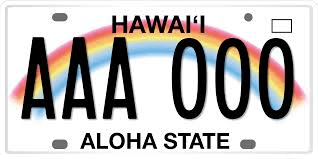
License Plate Design in Hawaii
Hawaii license plates are known for their bright colours. Many designs reflect local heritage, from ocean voyaging traditions to everyday island symbols, while still following county-based serial systems and registration rules.
- Standard Rainbow Plate: Features the iconic rainbow design used statewide. Newer versions display “Hawaiʻi” with the ʻokina, reflecting proper Hawaiian language spelling.
- Design History and Updates: The rainbow plate has remained in use for decades. Updates focus on cultural accuracy, such as adding the ʻokina, rather than full redesigns.
- Specialty and Organisational Plates: Offer designs that highlight Hawaiian culture, history, and community causes, usually with additional fees that support local programs.
- Hokuleʻa Plate: Honours the Polynesian voyaging canoe and traditional navigation, celebrating Hawaii’s deep ocean heritage.
- Shaka Plate: Features the iconic hand gesture recognised as an official state symbol, representing Hawaii’s friendly island spirit.
- Cause-Based Plates: Support organisations like the University of Hawaiʻi, the Bishop Museum, and other non-profits, with a portion of fees directed to these groups.
County Letter Codes and Identification
Hawaii uses county-specific letter patterns to help identify where a vehicle is registered. These prefixes vary by island and are part of the standard plate numbering system.
- Hawaiʻi County (Big Island): Plates commonly begin with H or Z (for example, H1234).
- Kauaʻi County: Plates usually start with K (for example, K1234).
- Maui County: Plates often begin with M or L (for example, M1234 or L1234).
- City and County of Honolulu (Oʻahu): Plates use other letter combinations, typically excluding H, K, L, M, and Z (for example, A1234 or W1234).
Types of License Plates in Hawaii
Hawaii offers a wide range of license plate types that reflect local culture, support community programs, and clearly identify vehicle use. Plate options vary by purpose, vehicle class, and eligibility, with additional fees applying to many special designs.
- Standard Plates: Feature the rainbow design with the “Aloha State” message. Newer plates include the ʻokina in “Hawaiʻi” and are issued for most passenger vehicles.
- Personalized (Vanity) Plates: Allow custom letter and number combinations on standard backgrounds for most vehicle types, with added fees and approval required.
- Specialty and Organisational Plates: Support cultural, environmental, and community causes, with part of the fee going to the featured organisation.
- Veteran and Military Plates: Available for eligible service members and veterans, including WWII, Pearl Harbor Survivor, and Purple Heart plates. Some offer reduced fees.
- Disability and Accessibility Plates: Issued for disabled drivers and disabled veterans, allowing access to designated parking areas.
- Special Identifier Plates: Use prefixes to identify vehicle types, including Rental (Z), Truck (T), Trailer (W), and Motorcycle (X).
- Government Plates: Use unique formats to identify official vehicles, such as “C&C,” “CofH,” and “State.”
License Plate Cost in Hawaii
Hawaii license plate fees are made up of state, county, and highway charges, with additional costs based on vehicle weight and plate type. Total fees vary depending on whether the registration is new or a renewal.
- Base Registration Fees: $46 state fee, $20 county fee, and $7 highway beautification fee.
- First-Time Registration Costs: About $88.50, plus a $5 plate fee and a $0.50 emblem fee, excluding weight taxes.
- Annual Renewal Fees: Around $73.50 per year, plus weight-based taxes and a $0.50 emblem fee.
- Specialty and Personalized Plate Fees: Vanity plates cost about $60 initially. Specialty plates usually cost $30.50 upfront with a $25 annual renewal, with part of the fee supporting the related organisation.
License Plate Lookup by States
Our license plate lookup service is available for all states across the country. Check which state you live in:
FAQs About Hawaii License Plate Lookup
Is there an official free license plate lookup from the Hawaii DMV?
Yes. You can run a basic, free Hawaii license plate lookup to see limited vehicle details such as the make, model, and year, through services like Instant VIN Report. However, access to owner details or official records requires going through the relevant county motor vehicle office or approved legal channels, as federal privacy laws protect personal information.
What details can a Hawaii license plate lookup provide?
A Hawaii license plate lookup can show general vehicle information, including the make, model, year, colour, and sometimes the VIN. Personal owner details such as name or address are restricted under the Driver’s Privacy Protection Act (DPPA) and are only available with legal authorisation.
Can I find out who owns a car by the license plate in Hawaii?
No. As a member of the public, you cannot identify a vehicle’s owner in Hawaii using only a license plate number. The DPPA limits access to owner information, allowing it only for law enforcement or authorised parties with a valid legal purpose, such as accident investigations or insurance claims.
How do I check for salvage titles or flood damage on a Hawaii vehicle?
To check whether a Hawaii vehicle has a salvage or flood history, use a VIN check to screen for theft or salvage records, then obtain a detailed vehicle history report for title brands and flood damage. A physical inspection is also important. Look for signs such as musty odours, corrosion, or moisture under carpets.
What's the best way to get a full vehicle history report for a used car in Hawaii?
The most reliable way to get a complete vehicle history report in Hawaii is to run a VIN lookup through a trusted service, which provides detailed records on accidents, title status, liens, and past damage.