
Check a Vehicle’s Past With a Kansas License Plate Lookup
Easily perform a Kansas license plate lookup to get a detailed report on a vehicle’s history. The report includes crucial details such as accidents, title status, auction history, and more to help you make an informed decision.
What is a Kansas License Plate Lookup?
A Kansas license plate is issued by the state for various types of vehicles, including passenger cars, trucks, motorcycles, trailers, and specialty vehicles. It serves as the official identifier that links a vehicle to its registration and title records.
A Kansas license plate lookup allows you to check the vehicle’s history using the plate number before buying or selling. Through the service, you can get the car report in Kansas. The report includes model year, make, engine type, title status, accident history, and mileage, helping to mitigate legal and financial risks.
Why You Should Search the Kansas License Plate?
Looking up a Kansas license plate before completing a vehicle transaction is essential for confirming important details that might not be immediately apparent. Below are some scenarios where performing a plate lookup is highly beneficial.
When Buying a Used Vehicle
Before purchasing a used car, especially a privately sold or older model, knowing the vehicle’s history is crucial.
Review Title and Ownership Records
A plate lookup shows the number of title transfers. It also confirms whether the vehicle has a clean title or any issues, such as being rebuilt or salvaged.
Identify Past Problems
The search can highlight any accidents, damages, or inconsistencies in mileage that may not be apparent during an inspection.
Information Included in Our Kansas License Plate Report
A Kansas vehicle history report includes both basic vehicle information and in-depth historical records. This report helps you make a more informed decision before finalising any vehicle transaction.
Vehicle Specifications
This section provides core vehicle details, such as engine type, fuel system, transmission, and country of origin, helping you determine if the vehicle fits your driving needs and preferences.
Ownership History
The ownership history section shows how many times the vehicle has changed hands, along with the duration of each ownership period and registration locations. Personal information is kept private, as required by law.
Title Status
The title status section highlights whether the vehicle holds a clean title or if it has been branded as salvage, rebuilt, or lemon. Always check the title status to avoid potential legal issues later.
Theft Records
Here, you can find whether the vehicle has been reported stolen. If available, the report includes the date and location of the theft. Purchasing a stolen vehicle can lead to the authorities seizing it, even if you were unaware of the theft.
Accident Records
The report will list any accidents the vehicle has been involved in, including dates and locations. Reviewing accident records helps you assess whether previous collisions may have affected the vehicle’s condition or value.
Mileage Verification
Mileage inconsistencies are flagged when comparing records from different time points. The report ensures that the vehicle’s mileage has not been tampered with, giving you confidence in the accuracy of the vehicle’s odometer.
Auction Insights and Photos
If the vehicle was previously sold at auction, this section provides detailed information, including auction dates, locations, sale prices, and vehicle condition. Photos taken during the auction may also be included when available.
Lien or Loan Information
This section highlights any outstanding financial claims or liens attached to the vehicle. It’s crucial to check for any active liens before purchasing to ensure the title can be transferred without issues.
Warranty Coverage
The report includes information on whether any factory or extended warranties are still active, along with coverage details and expiration dates. This section may also include any manufacturer-backed plans like roadside assistance.
Damage Records
If the vehicle has been involved in accidents, floods, fires, or other damaging events, this section will show the details. It can help you determine whether the necessary repairs were made and if the vehicle is still safe to drive.
Maintenance Records
This section offers insight into the vehicle’s service history, including dates, locations, and types of maintenance performed. You can also check if any upcoming service schedules have been missed.
Recall Information
Check the recall details with the report. This section includes the nature of the issue, recall dates, and whether the problem has been resolved, will be provided in this section. This ensures that the vehicle is up to date on any safety or mechanical concerns.
How to Use the Kansas License Plate Lookup Tool?
To check the license plate in Kansas, you can use our license plate lookup service. Here’s how you can do it:
Find the License Plate Number
Check the front or rear side of the vehicle. If you can’t find the license plate number, you may ask the seller.
Fill in the Form
Click on the form above to write down the license plate number. Then, click on the button to submit the form.
Get the Report
Wait for seconds until the report is complete. Then, proceed to payment to get the full car report in Kansas.
Free License Plate Lookup in Kansas
Use our free license plate lookup in Kansas to get the complete information on the vehicle’s specifications, last recorded mileage, and market value. In addition to that, here’s what you will be getting from our free license plate lookup.
- Associated VIN number
- Year, Make, and Model
- Country of Origin
- Market Value
- Transmission Type
- Fuel Type
- Drive Type
- Body Type
- Trim Information
- MSRP
- Engine Specifications
- Dimensions
- Sales/auction history
- Market value
- Mileage
Kansas Laws on License Plates
In Kansas, every registered vehicle must display a valid license plate issued by the Kansas Department of Revenue (DOR), Division of Vehicles. Most passenger cars and trucks only require one plate on the rear of the vehicle unless a different rule applies under state law.
It’s illegal to drive without a proper Kansas plate or use a plate that isn’t assigned to your vehicle. Failure to comply may result in fines and other penalties under state vehicle laws.
Security and Privacy of Plate Information in Kansas
Kansas license plates are tied to your vehicle’s registration and title records in the Kansas Department of Revenue. This includes important data like vehicle specifications, title status, and registration history. However, sensitive personal information such as the owner’s name, address, or contact details is protected under privacy laws.
Kansas License Plate Design and Format
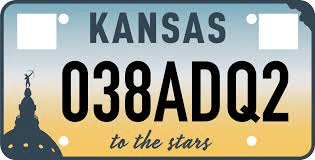
The Kansas license plate design and format are established by the Kansas Department of Revenue to ensure readability and compliance with state standards. In 2024, Kansas transitioned to a new license plate design called “To the Stars.”
Formatting and Serialisation
The new plates are blue and yellow and use a seven-character format, such as 1234ABC. This change was made to improve readability compared to older versions. Furthermore, the state offers personalized options up to seven characters, as well as specialized plates for different vehicle categories.
License Plate Design in Kansas
The new standard license plate for Kansas was selected by a public vote in 2023 and introduced in 2024. This design features a blue-to-yellow gradient and displays an image of the Kansas Statehouse dome within the state’s outline. Additionally, it includes the official state motto, “To the Stars,” which is also known as Ad Astra per Aspera.
- Standard Plate Design: Newer standard plates are transitioning to a design highlighting the Statehouse dome with a gradient background and “To the Stars” motto through a phased replacement program.
- Specialty and Optional Plates: Kansas offers multiple specialty plate options, including themed designs like In God We Trust plates and more. A new blackout-style plate (all black background with white letters and a state silhouette decal) will be available in July 1, 2025.
License Plate Types in Kansas
Kansas offers a diverse range of license plates, including standard plates, special interest designs, military and veteran plates, and commercial plates. Most types can be personalized for an additional fee, allowing for further customization.
Standard & Personalized Plates
- Standard Passenger Plates: The current standard plate design features the Statehouse dome with the state motto, "Ad Astra per Aspera."
- Personalized Plates: Most standard, blackout, and specialty plates can be personalized with up to 7 characters for an additional fee.
Special Interest & Themed Plates
- Collegiate Plates: Plates featuring university designs, such as for the University of Kansas (KU) or Wichita State University (WSU).
- Sports Teams Plates: Plates available for Kansas City teams, including the Kansas City Royals and Sporting KC.
- Community & Cause Plates: Includes designs like the Wichita Flag, Sedgwick County Zoo, Choose Life, and Support the Troops plates.
- Blackout Plates: A sleek all-black design with white text, available for an extra fee.
Military & Veteran Plates
- Branch of Service Plates: These plates are available for various branches of the armed forces.
- Veteran Plates: Includes plates for Disabled Veterans, Ex-Prisoners of War (POW), and Korean War Veterans.
- Gold Star Plates: Available for families of fallen soldiers, including the Gold Star Mother Plate.
Non-Passenger & Commercial Plates
- Antique Plates: For vehicles that are at least 20 years old and not used daily.
- Street Rod Plates: For modified classic vehicles.
- Commercial Plates: Available for heavy trucks, semi-trucks, and fleet vehicles, including apportioned and fleet plates.
- Municipal Plates: For government-owned vehicles.
License Plate Costs in Kansas
The cost of a Kansas license plate varies depending on several factors. Primarily, there is a base registration fee, which is typically $30 for lighter cars and $40 for heavier vehicles. In addition to this fee, owners must pay vehicle property taxes and potential charges for title transfers or specialty plates, such as the K-State design.
- Vehicle Weight: Vehicles under 4,500 pounds cost $30, while vehicles over 4,500 pounds cost around $40.
- Property Taxes: Kansas requires vehicle owners to pay annual personal property taxes at the time of registration. The amount depends on the vehicle’s value, age, and local tax rates.
- Specialty Plate Fees: Specialty plates carry additional one-time fees on top of regular registration. For example, K-State plates usually have a $45 fee, while Choose Life plates typically cost $40.
- County Fees: County treasurer offices may charge additional service or processing fees. These costs can vary by county, so it is best to check with your local office for exact amounts.
License Plate Lookup by States
Our license plate lookup service is available statewide; you can check any other license plate from different states!
FAQs About Kansas License Plate Lookup
Can you look up a license plate in Kansas?
Yes, it is possible to look up license plates in Kansas, although federal laws like the DPPA limit the disclosure of an owner’s private details. Access is usually granted only to authorized groups, such as the police or insurance companies, for specific legal needs. You may use our Kansas license plate lookup and get the vehicle history report.
Can I check a plate number anonymously?
No, it is generally illegal to check a person’s ownership details anonymously using a license plate because of the Driver's Privacy Protection Act (DPPA). While only law enforcement and authorized groups have access to this private information, individuals can still obtain limited vehicle history from paid websites. Furthermore, you can use our VIN lookup tool to get the complete records of the vehicle.
Can a license plate lookup reveal an address?
Yes, a license plate lookup can reveal an owner’s address, but this access is typically restricted to authorised entities such as law enforcement or insurance companies. The general public is usually denied this information due to federal privacy laws like the DPPA. These regulations protect personally identifiable information (PII), which includes sensitive data like home addresses and driver's license numbers.
What does a black Kansas license plate mean?
Since July 2025, Kansas has offered a popular "Blackout" license plate that consists of white lettering on an all-black background. This distinctive design is available for both cars and motorcycles. However, applicants are required to pay a special royalty fee, with the proceeds going toward the state's license plate replacement and vehicle division funds.
Can anybody look up license plates?
No, federal laws like the DPPA prevent ordinary people from looking up a car owner's personal information. Although authorized groups like the police have the right to access these records, the public is generally restricted to seeing the vehicle’s make and model.