

California License Plate Lookup: Get Vehicle History Instantly
Ranked as the 6th highest state for vehicle theft in 2023, a California license plate lookup is crucial for every used vehicle buyer. Look up the CA license plate and get the vehicle history report to ensure it’s 100% legal.
What is a California License Plate?
A California license plate is issued for passenger vehicles, commercial vehicles, motorcycles, trailers, mopeds, and certain specialty vehicles, and unlike many states, California keeps the plate assigned to the vehicle for its entire lifespan, including older and antique models.
A California license plate lookup is a service that allows buyers and sellers to check a vehicle’s background using the plate number, helping confirm whether the listing details match official records before a sale takes place.
With a trusted CA license plate lookup, a vehicle history report can show details like year, make, model, engine data, title and lien records, accident history, mileage readings, and other important information that helps avoid costly mistakes and questionable deals.
Why Should You Run a CA License Plate Search?
A license plate lookup in California service helps provide useful details about a vehicle before money changes hands. That is why it is always recommended to use a trusted CA vehicle license plate lookup provider, and here are the reasons why:
Buying a Used Vehicle
Sellers can use a license plate search to support their listing with accurate information. Clear records help build trust and may speed up the sale process.
Support Your Listing With Facts
Providing a complete and legit vehicle report helps answer buyer questions and strengthens the credibility of your listing.
Earn Buyer’s Confidence
Clear records reduce doubts, helping buyers feel more comfortable and safe help you speed up the buying process.
Selling a Vehicle
Sellers can use a license plate search to support their listing with accurate information. Clear records help build trust and may speed up the sale process.
Support Your Listing With Facts
Providing a complete and legit vehicle report helps answer buyer questions and strengthens the credibility of your listing.
Earn Buyer’s Confidence
Clear records reduce doubts, helping buyers feel more comfortable and safe help you speed up the buying process.
Verifying Auction or Private-Party Listings
Not all listings show the complete story. A plate search helps check if the details match the vehicle being sold, especially in auctions or private sales.
Confirm Listing Accuracy
You can compare the result from the California license plate lookup tool with the listing to ensure the details of the vehicle match what it has been advertised.
Avoid Misleading Descriptions
Spot missing or altered information that could signal hidden problems or misrepresented vehicles.
Avoiding Fraud and Hidden Problems
Running a license plate lookup in California helps you spot red flags like stolen records or major damage. This reduces the chance of fraud or future legal trouble.
Check the Legality
Unknowingly purchasing a vehicle can get you in trouble. By looking up the California license plate number and getting the report, you can make sure that the vehicle wasn’t stolen.
Examine Hidden Damages
Not all damages are visible during a manual inspection. Check the license plate number and examine the vehicle report to ensure that the vehicle is free from any damage caused by accident or natural disaster.
Information You Will Find in Our California License Plate Lookup Report
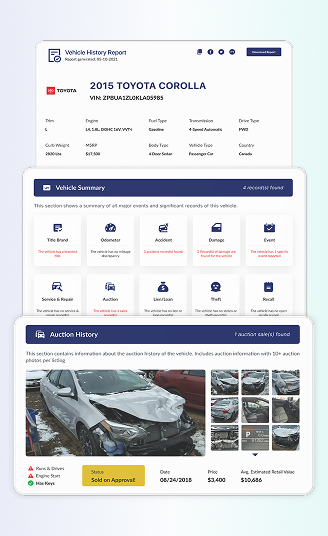
In the CA license plate lookup report, you can find detailed information about the vehicle. Starting from the basic information like specifications and more comprehensive information of the vehicle, like accident history, auction records, title records, lien information, recall, and more.
Vehicle Specifications
This section helps you to see the complete vehicle specifications. By showing details like engine type, fuel, transmission, and country of origin. These basics help check whether the vehicle fits daily use, your expectations, and your budget.
Ownership History
The California license plate lookup helps you find the owner’s information. This section highlights the past ownership of the vehicle. See the history of ownership, including the year of purchase, how long they kept the vehicle, and the past location of the vehicle. Private details like name, address, and contact information are not shown due to privacy laws.
Title Status
Verify the vehicle’s title status before you decide to purchase the vehicle to avoid legal complications. Check if the vehicle carries title brands like salvaged, rebuilt, or lemon, and ensure that the vehicle has a clean title.
Theft Records
Checks if the vehicle was reported stolen. Our vehicle history report gives you detailed information, like the date and the location where the vehicle was stolen. Be aware that if you purchase a stolen vehicle, and it is seized by authorities, you won’t get your money back.
Accident Records
Displays reported accidents with dates and locations. It also shows how many times the vehicle was involved in a collision. Ensure that the vehicle you plan to purchase/sell has no accident history.
Mileage Verification
Compares recorded mileage over time to spot inconsistencies. See the complete records from the first time the vehicle was driven, along with the date, and the last recorded mileage, to avoid getting a vehicle that has its odometer rolled back.
Auction Insights and Photos
Confirms if the vehicle was sold at auction. You can see the comprehensive information on the date of the auction, the auction house location, the status of the vehicle, and the final price of the vehicle. In addition, you’ll get up to ten pictures of the vehicle during the auction.
Lien or Loan Information
Reveals unpaid loans or financial claims linked to the vehicle. Open liens may affect ownership transfer. Make sure that the attachment lien/loan is resolved right before any transaction happens.
Warranty Coverage
Shows whether factory or extended warranties are still active. In this section, you will see the limit of mileage and the month of each covering warranties like roadside assistance, corrosion protection, manufacturer’s warranty, and extended warranties.
Damage Records
Check the damage records of the vehicle that was caused by either natural causes, like fire or flood, or man-made damage like an accident. See and examine if the vehicle has damage and make sure those are fixed.
Maintenance Records
Check if the vehicle was properly maintained by the previous owners. You can get the complete records of the maintenance or service done on the vehicle, like the date, location, and what parts are serviced or maintained.
Recall Information
A recall is when the vehicle is retracted by its manufacturer if there are underlying serious safety issues. Check if the vehicle was recalled, examine the date of recall, the status (open/fixed), the causes, and the action taken by the manufacturer to fix the recall.
How to Look Up a California License Plate?
To look up the California license plate, you can use our California license plate lookup and check the thorough information of the vehicle. Follow these steps to get it done.
Find the License Plate
Firstly, you will need to find the license plate of the vehicle you are checking. You may ask the seller directly or find it on the bill of sale.
Enter the License Plate Number
Once you have the license plate number, you can click on the form above and enter the license plate number and select the State. Then, click on the “Search” button to retrieve the vehicle information.
Get the Detailed Vehicle History Report
Wait for seconds for the report to be generated. You can view the basic vehicle specification from the preview page, then proceed to payment to get the full vehicle history report that includes title info, theft records, accident, ownership and more.
How to Look Up a California License Plate?
To look up the California license plate, you can use our California license plate lookup and check the thorough information of the vehicle. Follow these steps to get it done.
- Associated VIN number
- Year, Make, and Model
- Country of Origin
- Market Value
- Transmission Type
- Fuel Type
- Drive Type
- Body Type
- Trim Information
- MSRP
- Engine Specifications
- Dimensions
- Sales/auction history
- Market value
- Mileage
California Laws on License Plates
In California, every vehicle should have a valid license plate. The plate is issued by the California Department of Motor Vehicles (DMV). Most vehicles need two plates. One on the front and one on the back, and both plates must be clearly visible at all times.
Driving without a proper license plate or using a plate that belongs to another vehicle is illegal and can result in tickets, penalties, or even the vehicle being towed.
Security of Information
California license plates are linked to the vehicles and owners on the California DMV systems. It includes crucial information like the vehicle’s data, registration details, and ownership history; however, this sensitive information is protected by privacy laws.
Please note that not everyone has access to see the full license plate information. Law enforcement agencies and authorised parties may view this data for legal or safety reasons. The general public cannot see private information like the owner’s name or address just by looking up a plate.
License Plate Costs in California
The plate fee itself is typically around $28, but total registration costs vary based on factors such as the vehicle’s value, model year, location, and local taxes. If you wish to choose a speciality or personalised license plates, it requires an upfront fee of about $50, along with recurring annual renewal fees on top of standard registration costs
Speciality and Arts License Plates
Aside from the standard license plate, the California DMV also offers speciality and arts license plates. Car owners who want a custom look or wish to support specific causes, programs, or communities.
Standard Specialty Plates
Such as legacy or veteran plates usually cost about $50 extra when issued. These plates also have an annual renewal fee of around $40.
Personalized Plates
Costs more at the start. The initial fee is usually between $103 and $130, with a yearly renewal fee that starts at about $83 and may be higher.
California Laws on License Plates
In California, every vehicle should have a valid license plate. The plate is issued by the California Department of Motor Vehicles (DMV). Most vehicles need two plates. One on the front and one on the back, and both plates must be clearly visible at all times.
Driving without a proper license plate or using a plate that belongs to another vehicle is illegal and can result in tickets, penalties, or even the vehicle being towed.
Format and Serialisation
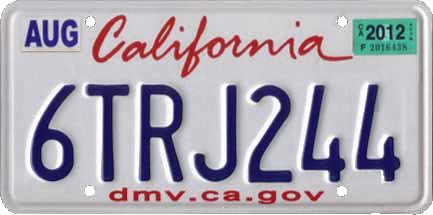
The California license plate design and format features a basic design with a white background and blue lettering, a red “California” is placed at the centre top, and “dmv.ca.gov” at the bottom. In 2026, the formatting for California license plates is changing from 1ABC123 to a mirrored 123ABC1 (three numbers, three letters, one number).
License Plate Design
California license plates come in standard types and also in special styles that drivers can choose from. The main options include the regular standard license plate design, specialty plates, and more.
Standard Design Plates
The standard design license plate is the most common design in the United States, and it also shows the state names from which the plates are coming.
Custom Designs
Custom license plates have special graphics or messages. The DMV offers plates that show support for causes, organisations, or interests, such as environmental groups or charities. Some plates can include a personalised message or number that you can request; however, it must be approved by the DMV.
Types of License Plates in California
California offers different types of license plates that you can choose from. These plates help you and the authorities to identify the vehicle, identify registration status, and show that you support important causes. Either way, you can choose the license plate based on your needs and preferences.
Format and Serialisation
California offers different types of license plates that you can choose from. These plates help you and the authorities to identify the vehicle, identify registration status, and show that you support important causes. Either way, you can choose the license plate based on your needs and preferences.
Specialized License Plate
A specialised license plate or “special interest” plate is used to support causes or groups. For example, in California, there are plates for environmental programs, arts, parks, agriculture, and veterans’ organizations. Please note that you will be charged a higher fee compared to the standard license plate, as the money will also be donated.
Disability Plates
The California DMV also released disability license plates and placards to people with qualifying disabilities. It allows special parking privileges and helps people with mobility challenges. You must meet specific requirements to qualify for these plates.
Military and Veterans License Plate
These include plates for military veterans, Purple Heart recipients, Legion of Valour, and other recognitions. The military and veteran license plate recognizes service rather than simply identifying a vehicle.
Decal Authorized Vehicles (motorcycles, etc.)
Some vehicles, like motorcycles or trailers, have different plate formats or decals instead of regular plates. These decals or smaller plates show valid registration for the specific vehicle type and follow California standards.
Green Vehicles
California also offers plates for certain types of green or environmental vehicles. These plates help promote low-emission vehicles and may allow benefits like access to carpool lanes. The plate for green vehicles has its own design.
License Plate Lookup by States
Our license plate lookup service is available statewide; you can check any other license plate from different states!
FAQs About CA License Plate Lookup
Is a free California license plate search legal?
Yes, it is legal to search a California license plate, but only for purposes allowed under the Driver’s Privacy Protection Act (DPPA), such as safety checks, recalls, legal matters, or use by authorised parties. Personal details such as names or home addresses are not publicly accessible.
Can I look up a California license plate?
Yes, you can look up the California license plate for general information about the vehicle, like the year, make, and model, via the California license plate lookup service. However, private information like names. Contact and addresses are not shown.
Can you publicly run a license plate?
Yes, you can run a license plate search through Instant VIN Report License Plate because license plates are public identifiers. They are used by law enforcement through ALPR systems and by authorised parties for official checks, while personal use by officers is usually restricted by policy.
How do I find out who owns a vehicle in California?
To identify a vehicle owner in California, you must submit Form INF 70 to the DMV using the VIN or license plate. Due to strict privacy laws, you must demonstrate a specific legal need to access anyone's records but your own."
Can a vehicle history report be obtained with a California license plate number?
Yes, you can get California vehicle history reports via Instant VIN Report using just a license plate. While plates are great for finding accidents or VINs, using the VIN directly is more accurate for official records since plates can transfer between vehicles.
What is the process for registering a vehicle and getting a CA license plate?
Yes, to register a vehicle and receive California plates, visit the DMV or AAA with your title, ID, insurance, and smog certificate. Submit form REG 343 and pay the required registration, tax, and CHP fees to obtain your new plates and registration card.
Do you need a front license plate in California?
Yes, under California law (CVC 5200), most vehicles must display both front and rear license plates. Motorcycles and trailers are exempt, but for others, missing a front plate can result in traffic stops, citations, and fines since police use them for identification.
Can I Run a Reverse License Plate Lookup in California?
Yes, a reverse license plate lookup is allowed in California, but it is strictly limited by state and federal privacy laws such as the DPPA. Personal owner details are not publicly accessible unless there is a lawful reason, such as law enforcement use or a court order. General vehicle information like make, model, and year may be available through authorised channels for permitted purposes.