

If you are thinking of buying a used car and you need some information about the previous owner, then running a reverse search on the license plate is very important. In this article, we look at what a license plate reverse search is and some of the information that you get.
Key Takeaways
- A reverse license plate lookup helps identify vehicle-level information starting from a plate number.
- It can reveal details like make, model, year, trim clues, recalls, and title-related alerts when records are available.
- A license plate lookup tool is often the next step for getting a deeper vehicle history report.
- The Driver's Privacy Protection Act (DPPA) protects owner names and addresses from public view.
What is a Reverse License Plate Lookup?
A reverse license plate search is a search that takes the full license plate number of a vehicle and the state or registration to reveal information about the vehicle associated with the license plate, including cars, motorbikes, or even motorhomes.
The information is usually stored in a vehicle records database and will reveal information such as the owner, the VIN, and other information about the vehicle.
How Does Reverse License Plate Lookup Work?
A reverse license plate lookup works by matching a public plate number to vehicle data records that may include registration-linked information, manufacturer specifications, and history-related databases where legally available.
The process usually starts with the license plate itself, then connects the number to:
- vehicle make and model
- model year
- trim or engine clues
- registration state
- possible title events
- accident or salvage indicators
- recall eligibility
- odometer-related records when available
This is why many people use it as a fast license plate number search before moving into a full vehicle history report.
When you run a search, the tool cross-references the plate number with records from state Departments of Motor Vehicles (DMVs), law enforcement agencies, insurance companies, and auto auctions. It essentially connects the dots between the plate and the Vehicle Identification Number (VIN), which then unlocks a treasure trove of historical data.
For many people, the most common reason to perform this search is to get a vehicle history by plate number. It is a convenient alternative to finding the VIN physically on the car. Instead of walking around a strange vehicle trying to look through the windshield for a 17 digit code, you can simply type in the plate and let the database do the heavy lifting.
What Type of Information Does a Reverse License Plate Lookup Reveal?
A reverse license plate search will reveal a lot of information when done correctly. It usually reveals the previous ownership records that are tied to the vehicle.
The type of information that you can receive from a license plate lookup may vary from one DMV in that state.
The license plate lookup may provide comprehensive information about the vehicle, depending on the service you select. Depending on the service provider, your reverse lookup may include:
- Make and model of the vehicle
- Registration history
- Government recalls
- Accident history related to the vehicle
- History of flood, hail or fire damage
- Lien and repossession records for the registered vehicle
- Whether the vehicle is subject to a mileage rollback waiver
- Vehicle sketch and image
- Law enforcement and accident reports that mentioned the vehicle's license plate
- Images and videos associated with the license plate number
- Service and inspection history
Generally, there are several organizations that may provide information about vehicles, including the National Motor Vehicle Title Information System, the DMVs, car manufacturers, law enforcement agencies, public auctions, and other reputable sources.
Reverse license plate lookup services generally pull information from various organizations to provide one comprehensive report about the vehicle and owner based on information associated with the license plate number.
Legal Reasons To Run a License Plate Search
Before running a reverse license plate search, you need to know that it is illegal. You need to have a valid reason before running a license plate search for a vehicle that is not yours. Here are some reasons to do so.
- To report bad driving
If you notice someone driving terribly, you can give their license plate number to the authorities, who will then do a reverse license plate search to get the driver.
- To report an accident
Another reason why you may need to run a license plate search is to report an accident. If there is an accident and the other driver flees the scene, a license plate search can be run to find the owner and make them face the law.
- Court proceedings
You can usually look up a license plate number if you are involved in a civil matter, including arbitration or litigation that involves the motor vehicle, or in which you may make a lien against the vehicle.
- Research Purposes
This information is also available for research purposes, but personal information is usually excluded. The search can also be used for market research companies that distribute surveys to car owners.
- Towing Purposes
A tow truck company can typically use a reverse license plate lookup to find the registered owner of a vehicle it has towed away.
How To Run a License Plate Lookup
There are two ways you can conduct a reverse license plate lookup, by asking the DMV or equivalent organization or by using an online vehicle history service.
1. Through the Department of Motor Vehicles
Going through the DMV is thorough but slow. You need to submit a formal request, explain your reason, and in most states, pay a processing fee. Depending on the state and the volume of requests they're handling, you might wait days or longer. And because each state's DMV operates independently, a vehicle that's been registered across multiple states over the years may not have a complete picture from a single state's DMV records.
2. Using online search
There are several online reverse license plate lookup companies that allow you to use a license plate number. One that I will recommend is our license plate search tool. Additionally, the type of information and accuracy of the information may vary tremendously from one provider to the next. You can see the sample report to understand exactly what that looks like before you commit to anything.
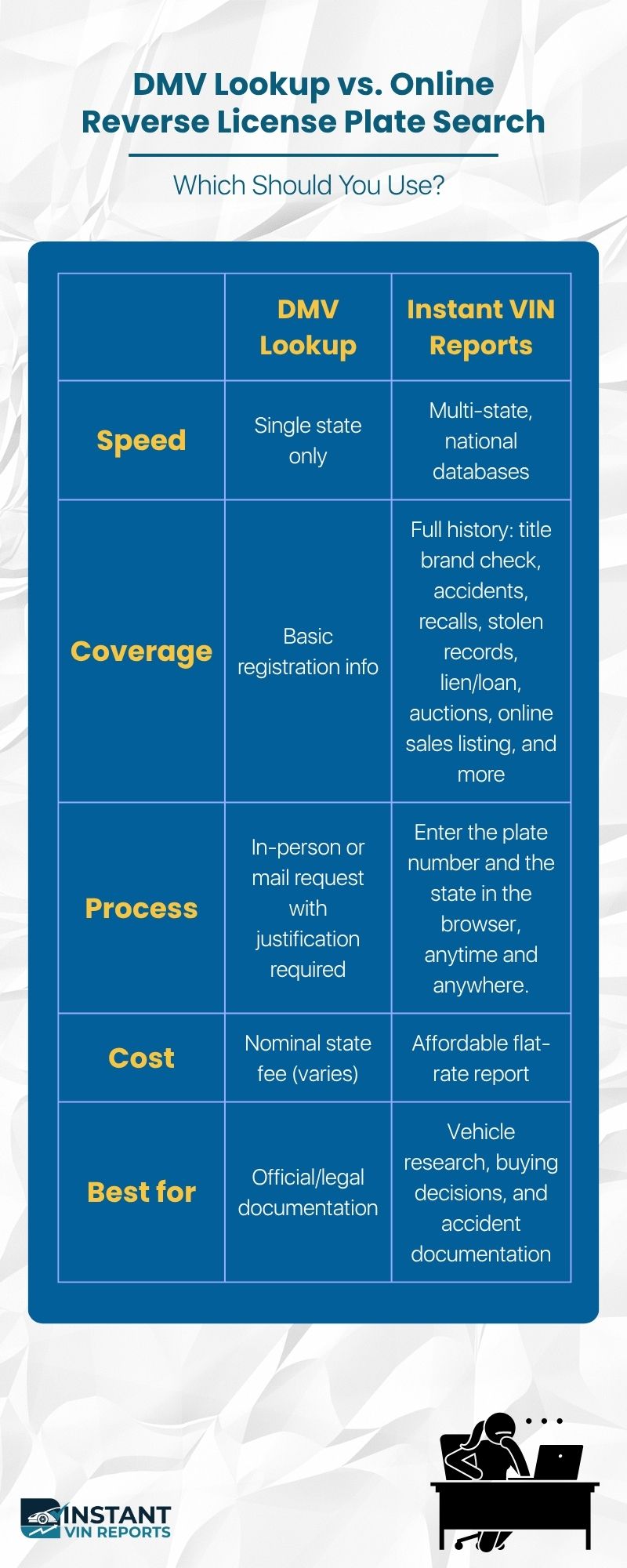
If you want to conduct an online license plate lookup, the process to obtain the vehicle information may include:
- Open a web browser
- Go to the website or use the Instant VIN Reports license plate lookup tool.
- Enter the license plate number
- Select the state listed on the license plate
Final Thoughts
A license plate is more than a string of characters on metal. It's a thread that leads directly to a vehicle's story: where it's been, what happened to it, and whether the version being sold to you today matches the reality of its past.
A reverse license plate search is the tool that pulls that thread. It gives buyers confidence, gives accident witnesses documentation, and gives anyone who needs to verify a vehicle a fast and legitimate way to do it. Used properly, it's one of the most straightforward forms of consumer protection available in the used car market.
Start your search atInstant VIN Reports. All you need is the plate.
FAQ About Reverse License Plate Number Search
What is reverse license plate search?
A reverse license plate lookup is a search that uses a license plate number as the starting point to retrieve information about the vehicle associated with that plate. Rather than looking up a person and finding their vehicle, you start with the plate and work backward to uncover the vehicle's registration history, title status, accident records, and more. It's called "reverse" because you're working from the plate number outward, rather than from a name or VIN.
What does a reverse license plate lookup show?
A reverse license plate lookup will show the vehicle's make, model, year, and trim; its title history and any title brands such as salvage, rebuilt, or flood; accident and damage records from insurance filings and law enforcement reports; odometer readings across past registrations; theft history; open safety recalls; and auction or salvage yard appearances.
It typically does not show private personal details like an owner's home address, as federal privacy law limits that kind of disclosure.
How to do a reverse license plate lookup?
To do a reverse license plate lookup with Instant VIN Reports, go to the license plate lookup page, enter the full license plate number, select the state where the plate is registered, and run the search. The system will connect the plate to the vehicle's VIN and pull a comprehensive history report. The process takes seconds and requires no prior knowledge of the VIN.
Is it legal to reverse lookup a license plate?
Yes, running a reverse license plate lookup is legal in the United States when done for a legitimate purpose. The Driver's Privacy Protection Act (DPPA), a federal law, governs the use of motor vehicle records. It permits searches for lawful purposes, including vehicle research before purchase, accident reporting, insurance inquiries, legal proceedings, and towing operations.
Using a lookup to stalk, harass, or track someone would not be a permissible use. Reputable services comply with the DPPA and present vehicle data rather than sensitive personal information.
Can you find the owner by license plate?
Public users usually cannot directly access the personal owner identity (like the owner's personal name or address). What is commonly available is vehicle-level information and VIN-linked history.
What information does license plate lookup give?
A license plate lookup gives you vehicle-centered information: title and registration history, accident records, odometer readings, theft records, open recalls, salvage or auction appearances, and the vehicle's make, model, year, and specifications.
How to get vehicle history by license plate?
To get a vehicle history by license plate, use a lookup service that connects plate numbers to VINs and pulls data from national vehicle databases, like Instant VIN Reports. On Instant VIN Reports, enter the plate number and state on the license plate lookup page.
The service retrieves the associated VIN and returns a full vehicle history report covering title status, accidents, mileage records, theft history, and more. You can view a sample report to see what the report looks like before purchasing.