
Buying a car right now isn't cheap. The average new vehicle in the U.S. is hovering around $48,000 to $50,000. Used cars are still landing in the $26,000 to $28,000 range. Add loan rates of 6-7% for new cars and often 8% or more for used, and the math starts to stretch quickly.
That's exactly why people keep asking, when is the best time to buy a car? Timing matters more than most shoppers realize. A small shift in price or financing doesn't just change the sticker number. It can mean thousands of dollars over the life of a loan.
Dealerships don't price cars randomly. They move in cycles. Quotas reset. Inventory builds up. New models arrive. Demand rises and cools throughout the year. If you understand those patterns, you can step in when the pressure is on their side, not yours.
KEY TAKEAWAYS
- December, especially the final week of the year, is statistically the strongest time to buy a new car because year-end sales pressure increases dealer flexibility.
- January is one of the best months to buy a used car, with data showing over 55% more "good deals" compared to the yearly average.
- Timing alone can save you thousands, as even a 2-4% price difference on a $45,000 vehicle can mean $1,800 or more in savings.
Why Timing Makes a Financial Difference
Let's start with scale. If you purchase a $48,000 vehicle:
- A 2% pricing difference equals $960
- A 4% difference equals $1,920
- A 6% difference equals $2,880
On higher-priced SUVs and trucks exceeding $60,000, a 5% timing swing can exceed $3,000. That does not include interest savings if incentives reduce APR.
Dealerships operate under layered financial pressure:
- Monthly sales quotas
- Quarterly performance benchmarks
- Annual manufacturer bonus programs
- Inventory aging penalties
- Model-year clearance targets
When multiple pressures converge, discounts increase.
When is the Best Month to Buy a New Car: December
December is usually the month with the biggest discounts on new cars. Sales data from across the industry shows prices tend to drop more at the end of the year. This happens because dealerships are trying to hit year-end sales goals and clear out remaining inventory before the new year begins.
December combines:
- End of month
- End of quarter
- End of calendar year
- Expiring manufacturer incentives
- Annual sales bonus deadlines
Manufacturers often offer enhanced rebates and financing incentives during year-end "Sales Events." Dealers, meanwhile, push to hit annual volume tiers that unlock substantial bonuses.
Why December 26-31 Stands Out
The final week of December is especially powerful because it concentrates all of that pressure into just a few days.
Reporting deadlines are approaching, some stores are still short of annual quotas, and any remaining inventory needs to be accounted for before the new year begins. Holiday marketing campaigns are also in full swing, which increases promotional activity.
It is the only week of the year where monthly, quarterly, and annual sales goals collide at the same time. When that happens, dealership management often has more flexibility on pricing simply because the cost of missing targets can be higher than the cost of discounting one more vehicle.
October and November: The Model-Year Clearance Window
New model years typically arrive between late summer and early fall.
When the new model hits the lot, last year's version becomes aged inventory. Even if the differences are minor, the previous model year carries psychological depreciation.
Dealerships incur "floorplan" costs to finance unsold inventory. Vehicles sitting 60 to 90 days become expensive to hold.
Why This Matters
If a redesigned model launches in September, dealerships will aggressively move remaining prior-year stock in:
- October
- November
- Early December
In many cases, buyers can secure thousands off MSRP simply because the badge year changed.
Seasonal Breakdown
| Time of Year | Deal Strength | Reasoning |
|---|---|---|
| Dec 26-31 | Very High | Year-end pushes dealers to close yearly sales targets. |
| October-November | High | Dealers begin clearing old inventory. |
| January & February (Used) | Strong | Used car deals see increased availability post-holiday. |
| Summer Months | Lower | Demand and pricing are stronger, with fewer incentives. |
Summer demand increases due to:
- College transitions
- Relocations
- Family vehicle purchases
- Travel needs
Winter demand softens, which statistically favors buyers.
READ ALSO: Don't Miss Out! Discover the Best Time to Sell Your Car
End of the Month: Quota Pressure in Action
Sales teams track performance daily. If a dealership is a few units short of its monthly quota, the value of closing one more deal increases dramatically.
Manufacturers often reward volume tiers. For example, moving from 98% to 100% of the target can trigger:
- Bonus payouts
- Increased incentive allocations
- Marketing support credits
If selling one additional vehicle grants a five-figure bonus, discounting a vehicle by $1,000 becomes rational.
Best Timing Within the Month
The strongest leverage appears:
- Final 2-3 days of the month
- Final business day before reporting closes
- Final weekend of the month
These windows do not guarantee discounts, but statistically they increase flexibility.
⚠️ Great Price ≠ Great Car
Even the best December deal can hide past accidents, theft records, or title problems.
Before you sign anything, verify the vehicle's history in just a few seconds.
Best Days of the Week to Buy a Car
Dealership traffic patterns are consistent nationwide. Saturday is typically the busiest day. Monday and Tuesday are often the quietest.
| Day | Typical Traffic | Negotiation Leverage |
|---|---|---|
| Saturday | Very High | Lower |
| Sunday | Moderate (varies by state) | Moderate |
| Monday | Low | Higher |
| Tuesday | Low | Higher |
| Wednesday | Moderate | Moderate |
| Thursday | Moderate | Moderate |
| Friday | Increasing | Moderate |
Lower traffic creates:
- More negotiation time
- Greater managerial attention
- Less competitive buyer pressure
While weekday discounts are rarely dramatic on their own, combining weekday timing with month-end timing can improve leverage.
Quarter-End Buying Windows
Dealerships report quarterly performance to manufacturers. Quarter-end dates are:
- March 31
- June 30
- September 30
- December 31
At quarter close, regional managers and manufacturers evaluate performance metrics. If a dealership is near threshold levels, pricing flexibility increases.
December is uniquely powerful because it is both quarter-end and year-end.
READ ALSO: How Much Does a Car Depreciate Each Year? ( 2026 Guide)
What are the Best Holidays for Buying a Car?
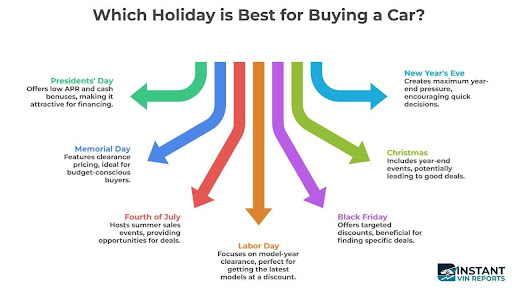
Holiday sales events are not all equal. Some are marketing-driven. Others align with actual financial pressure.
High-Impact Holidays
Some holidays you should look out for if you want to get a vehicle at a good price are:
- Presidents' Day
- Memorial Day
- Labor Day
- Black Friday
- Christmas
- New Year's Eve
The strongest holiday combination is when a major event overlaps with:
- Month-end
- Quarter-end
- Model-year clearance
- Winter demand slowdown
New Year's Eve is frequently cited because it aligns with multiple financial deadlines at once.
When Is the Best Time to Buy a Used Car?
Used car pricing follows slightly different dynamics. There are no manufacturer incentives. Supply and demand dominate.
A large-scale analysis of over 40 million used vehicle sales found measurable timing patterns.
Statistically Strong Days for Used Car Deals
- Martin Luther King Jr. Day offers 65.5% more "good deals" than average.
- New Year's Eve and New Year's Day show 58.6% more favorable deals.
- January overall shows 55.6% more good deals than the yearly average.
These are not small margins. They represent substantial shifts in listing quality and discount frequency.
Why January Is Strong
January tends to be strong because December trade-ins flood the market, demand slows after the holidays, and winter buying activity softens in many regions. With more inventory and fewer shoppers, dealers are often more flexible on pricing.
Market Forces That Influence Car Buying Timing
Picking the right month helps, but timing is also shaped by what is happening in the wider market. Inventory levels and interest rates can quietly change how much room you have to negotiate.
Why January Is Strong
Walk onto a lot packed with unsold cars, and the conversation usually feels different. When vehicles sit too long, they cost the dealer money. That often leads to more flexibility, especially on models that have not moved in weeks.
Now picture the opposite. Fewer cars. Limited choices. In that situation, pricing tends to hold firm because someone else is likely willing to pay close to asking. Trucks and SUVs often stay strong even when overall supply rises. Slower-selling sedans are usually where discounts show up first.
Interest Rates and Incentive Timing
Loan rates matter more than many buyers realize. When borrowing costs climb, automakers sometimes respond with special financing offers or extra cash incentives to keep monthly payments from scaring people away.
When rates ease and demand improves, those promotions can fade because cars sell without much help. Locking in a strong financing deal at the right time can save real money over several years, even if the sticker price does not look dramatically different.
When Is a Bad Time to Buy a Vehicle?
Some periods simply work against you.
Early summer is one of them. Demand tends to rise when people are relocating, graduating, or preparing for road trips. More shoppers usually means less flexibility. Dealers know someone else may walk in tomorrow.
Right after a full redesign is another tricky window. When a brand-new model hits the lot, excitement runs high and discounts are limited. You are paying for newness.
Inventory shortages also make negotiation harder. If supply is tight, dealers do not need to chase buyers. The same thing can happen during strong economic periods when consumer confidence is high. When demand rises quickly, pricing tends to hold firm.
Combining Timing Strategies
Instead of relying on one factor, try to stack them.
Late December is strong on its own. But if you shop during the final days of the month, at the end of the quarter, while dealers are clearing outgoing model-year inventory, your position improves further. Add a winter slowdown in demand, and the environment becomes even more buyer-friendly.
A Practical Example
Let's say you are buying a 2025 SUV with an MSRP of $45,000.
Scenario 1: Average Mid-Year Purchase (June)
- Typical discount: 2%
- 2% of $45,000 = $900
- Final price: $44,100
Scenario 2: End-of-Quarter Purchase (September 30)
- Typical discount: 4%
- 4% of $45,000 = $1,800
- Final price: $43,200
Scenario 3: December 29 (Stacked Timing)
Conditions:
- End of month
- End of quarter
- End of year
- Outgoing model-year clearance
- Winter demand slowdown
If the discount improves to 6%:
- 6% of $45,000 = $2,700
- Final price: $42,300
That is the power of stacking timing advantages.
Found a Great Deal? Make Sure It's Actually a Good Deal
December discounts. January used car deals. Holiday promotions. They all look good on paper.
But a low price only matters if the vehicle is clean.
With a vehicle history report, you can verify a vehicle's background in seconds. See past accidents, title brands, theft records, and more before committing your money.
When timing and vehicle history work together, that's when you're really in control. Check any VIN instantly and protect your purchase today.
Final Conclusion on the Best Time to Buy a Car
If selecting one statistically strongest period for a new car purchase, the evidence supports:
The final week of December.
If selecting the strongest period for used vehicles, the data highlights:
January, particularly around Martin Luther King Jr. Day, New Year's Eve, and New Year's Day.
Timing does not replace negotiation skill, but it changes the environment in which negotiation occurs. When vehicle prices approach $50,000 and loan payments exceed $700 per month, even small percentage differences matter.
So keep an eye out and choose the right window that can save you thousands rather than hundreds.
FAQ on The Best Time to Buy a Car
Is it better to buy a new or used car right now?
The best time to buy a new or used car is toward the end of the year, especially that final week of December. Dealers are trying to hit their annual numbers, so they're more flexible on price than at any other point in the year. End of month works in your favor too, for the same reason on a smaller scale.
Will car prices drop in 2026?
Prices usually ease when supply improves and borrowing costs stabilize. That said, dramatic drops are uncommon unless the economy slows sharply. Most shifts tend to be gradual, not sudden.
What is the cheapest month to buy a new car?
December is the cheapest month to buy a new car. It has historically delivered the strongest discounts, especially during the final week of the year when dealerships are closing out annual targets.
What is the 20/3/8 rule for buying a car?
The 20/3/8 rule for buying a car is a budgeting guideline. Put down 20 percent, finance for no more than three years, and keep total car payments under 8 percent of your gross monthly income. The goal is to avoid stretching your finances too thin.
What not to say to a car salesman?
Avoid saying you only care about the monthly payment. That can shift attention away from the total vehicle price and loan terms. Focus first on negotiating the purchase price.
What is the $3,000 rule for cars?
The $3,000 rule for cars suggests estimating roughly $3,000 per year in ownership costs for many used vehicles. That can include maintenance, insurance, depreciation, and repairs. The number varies by model, but the point is to think beyond the purchase price.