Is it easy to fake a VIN number? What you Need to Know!
With the increase in fraudulent activity on cars and their documents, you may be forced to wonder if a VIN is fake or not. Some car sellers go as far as carrying out odometer fraud, providing fake titles, and even using fake VINs.
According to the NHTSA, 450,000 vehicles are sold each year with false odometer readings. In this article, we will learn about VINs and what each character on a VIN represents, then discover how to spot a fake VIN number.
What Is a VIN Number and Why Does It Matter for Fraud?
A Vehicle Identification Number (VIN) or VIN number is a 17-character code that is placed on every vehicle by the manufacturer and serves as a vehicle's permanent legal identity. This code is unique to each vehicle produced and is usually a mix of numbers and letters. With this VIN, a vehicle history report can be generated containing every piece of recorded information on that vehicle. The information generated will contain auction and sales history, accident and damage records, theft records, service and maintenance records, odometer readings, lien records, salvage, junk, and rebuilt records, and other details.
A VIN usually has 17 characters, but on some occasions, you may observe that some vehicles have VIN numbers that are fewer than the standard 17 characters. Pre-1981 vehicles use manufacturer-assigned serial numbers rather than the standardized 17-digit format. These shorter chassis numbers (often 5 to 14 characters) are not fake VINs. They predate the standard. If you're researching a classic vehicle, use our classic VIN decoder specifically designed for pre-standard identification formats.
READ ALSO: How to get a Vehicle's original window sticker by VIN
Parts of a VIN number
There is more to a vehicle identification number than just a string of numbers. It can be divided into parts, each of which stands for a different piece of knowledge about the vehicle. Having knowledge of these parts would help you discover vehicles with fake VINs. These parts give the following information at a glance
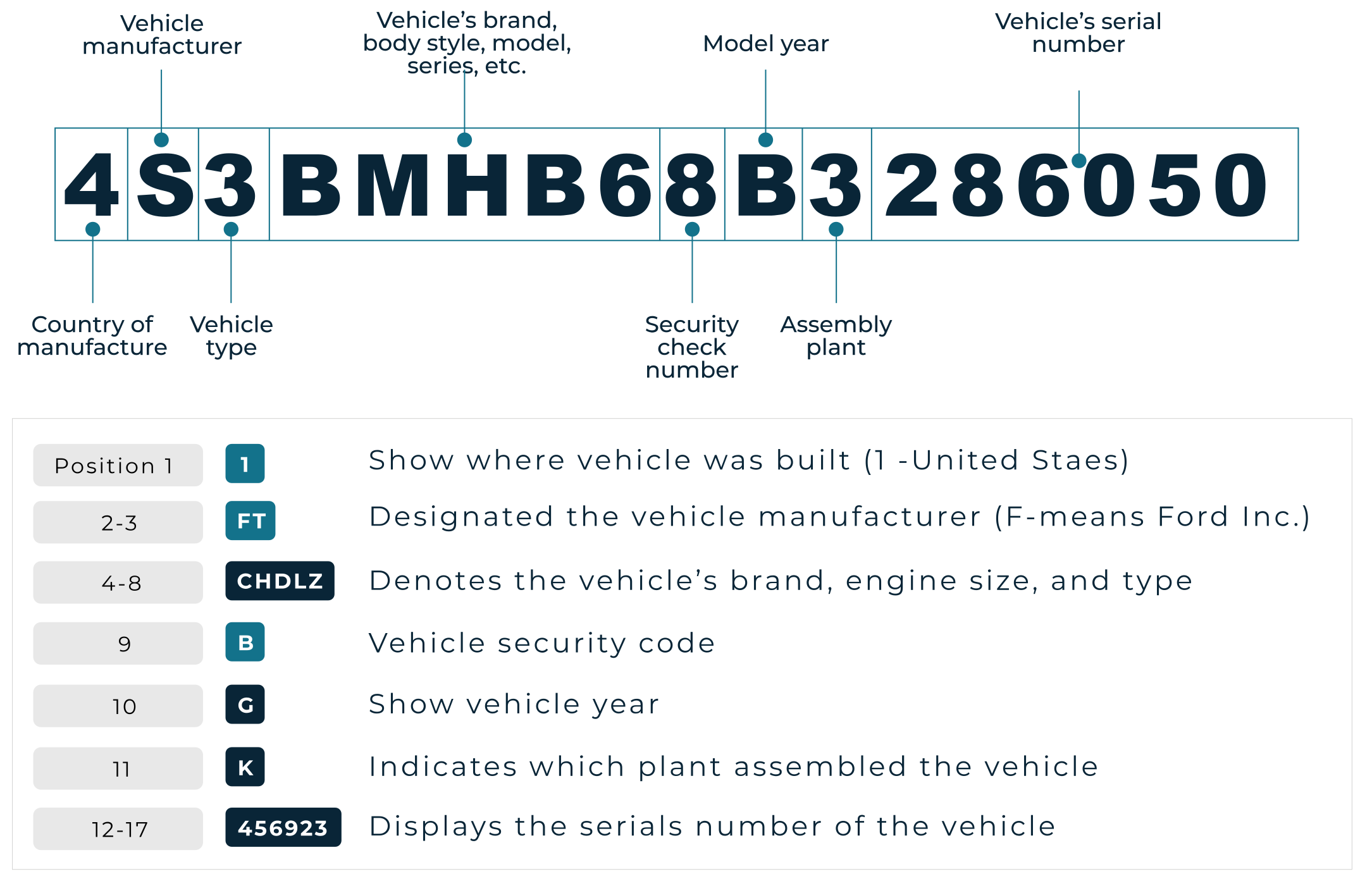
- The location (country) where the vehicle was made is denoted by the first letter or digit.
- The car's manufacturer is denoted by the next two digits.
- Vehicle specifications, such as the model, body style, engine, and trim level. This is donated by the next five digits.
- The check number is usually the ninth character that confirms that the VIN is not fake but original.
- The year of the vehicle's manufacture is encoded in the tenth character.
- The eleventh character indicates the plant where the vehicle was manufactured.
- The last six digits show the precise car serial number.
Is it easy to fake a VIN number?
Yes, it is easy to fake a VIN number. It's not as difficult as one might think. A fraudster only needs to take their time and make the VIN correct enough to fool a buyer. Then they produce new VIN plates with the fictitious VIN and install them on the parts of the vehicle where VINs are usually found.
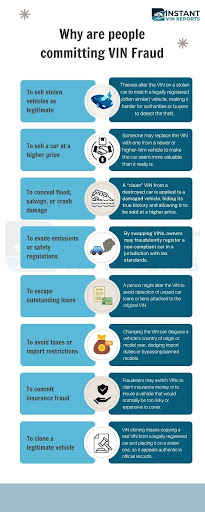
The only problem with doing this is that fake VINs are easily identified by government agencies and companies offering vehicle history reports at affordable prices, such as Instant VIN Reports.
Since 2009, it has been more difficult, but still possible, to "double-register" someone who has stolen or copied a VIN. This is due to the fact that states are currently connecting their registrations to the NMVTIS, or National Motor Vehicle Title Information System. But, if this is true, how do we detect fake VIN numbers and catch fraudsters? We will find out in the next section.
The Main Types of VIN Fraud
VIN fraud isn't a single crime. It encompasses several distinct schemes, each with different motivations and different detection methods.
VIN Cloning
VIN cloning is the most sophisticated and most common form of vehicle identity theft. Here's how it works: a fraudster identifies a legitimate vehicle of the same make, model, year, and color as a stolen car. They copy that legitimate vehicle's VIN (often by simply photographing the dashboard plate from a dealer lot or public parking area) and then manufacture replacement VIN plates, stickers, and sometimes documents using that copied number.
The result is two vehicles carrying identical VINs: the legitimate owner's car, going about its normal life, and the stolen car now wearing a borrowed identity. When a buyer runs a vehicle history check on the cloned VIN, they get clean results, because the history they're seeing belongs to the legitimate car, not the stolen one they're about to purchase.
VIN cloning is particularly common with high-value vehicles, like trucks, luxury cars, and popular models that command strong used car prices, and for which there are many examples on the road in similar configurations.
Counterfeit VIN Plates
Some fraud involves completely fabricated VINs, which are numbers that don't belong to any real vehicle, stamped onto replacement plates and installed where the originals were. These counterfeit VIN plates are designed to fool casual inspection. A glance at the dashboard plate from outside the windshield might not reveal that the plate has been swapped, incorrectly mounted, or subtly tampered with.
Completely invented VINs are easier to detect than cloned ones because the number either fails the check digit validation or doesn't return any records when run through a legitimate VIN decoder. A VIN that decodes to an impossible combination, for example, a 2019 model year code on what's supposed to be a 2015 vehicle, or a manufacturer code that doesn't match the badge on the car, is an immediate signal.
Title Washing
Title washing is a form of car title fraud that uses the inconsistencies between state titling systems to launder a vehicle's branded title history. Here's the mechanism: a vehicle with a salvage, flood, or rebuilt title in one state is transported to another state with looser titling standards, retitled there, and then retransacted (sometimes through several states) until the title history appears clean.
For example, a vehicle that was totaled in a hurricane appears on the market with a clean title and no visible record of the flood designation. The VIN is legitimate. The plates are real. The physical documentation looks fine. The fraud is in the title chain, not the physical identification.
Title washing is why a VIN check that only looks at the current title status is insufficient. A proper vehicle history report shows every title the car has ever carried in any state, including the original branded designation before the washing process began.
Odometer Fraud
Odometer rollback is one of the most financially motivated forms of vehicle fraud and often accompanies other VIN-related deception. According to the National Highway Traffic Safety Administration (NHTSA), hundreds of thousands of vehicles are sold each year in the United States with manipulated odometer readings. The financial motivation is straightforward: rolling back 50,000 miles on a vehicle can add thousands of dollars to the asking price.
Odometer fraud frequently appears alongside other forms of VIN or title manipulation because the vehicle's artificially improved appearance, like having a lower mileage and cleaner history, is part of the same fraudulent presentation.
Double Registration
Double registration, sometimes called a double-registered vehicle scheme, occurs when a stolen VIN is used to register the stolen car in a state, creating a second legal registration for a number that's already attached to a legitimate vehicle somewhere else. Since 2009, the National Motor Vehicle Title Information System (NMVTIS) has connected state registration databases to make this significantly harder to execute. But NMVTIS participation isn't universal, and gaps in the system still allow some double-registration fraud to occur in states with weaker inter-agency connectivity.
How to spot a fake VIN number: What to Look For?
When a vehicle identification number has been altered or faked, there are some tips that will help you notice. These tips are:
#1 Get a Vehicle History Report
This is the best and easiest way to prove the authenticity of a Vehicle Identification Number (VIN). A vehicle history report is a document that shows the history of a vehicle. It provides information such as accident and damage records, theft records, insurance history, salvage records, hail damage records, ownership history, auction records, loan and lien information, odometer verification, fire damage history, and others. With this information obtained from a vehicle history report, you can verify the car's specifications and also determine if the vehicle is carrying a fake VIN number.To get a vehicle history report, all you need to do is:
- Get the VIN number of the vehicle.
- Visit Instant VIN Reports and enter your VIN number.
- Decode your VIN and get your vehicle history report.
You can now confirm if the vehicle has a fake VIN number or not.
#2 Carry out a proper inspection.
The vehicle's VIN number can be found in several places, and you should begin by checking for the VIN in all these places:
- Dashboard, right under the windshield.
- Driver's side door, just by the doorpost.
- Front of the engine block.
By carrying out a proper inspection and taking note of the VIN number in different spots, you may be able to detect if the VIN is fake or not. How? Here's how. In some cases, you will observe that there are irregularities in the VIN; you might find a different VIN on the front of the engine block and another on the dashboard. When you begin to see such irregularities, you can now conclude that the VIN number is fake. Also, observe if the plates and labels are clear and do not look tampered with.
READ ALSO:Where is the VIN Number On A Car?#3 Check the vehicle registration documents.
Vehicle registration documents, such as the certificate of title and bill of sale, usually contain information about the vehicle and carry the VIN number. In addition to these documents, the window sticker often provides valuable details about the vehicle's original features and specifications, including the VIN. You can confirm the authenticity of the VIN by comparing the number on the window sticker with the one on the vehicle. If they match, it's likely that the VIN is authentic. If they don't, the VIN may be fraudulent.
#4: Perform a License Plate Lookup
A license lookup will not only confirm the authenticity of the VIN but also provide you with records that prove the reliability of a vehicle. With a license plate lookup, you can also generate a vehicle history report and be sure of accident records, damage records, theft history, and every other piece of information about the vehicle.READ ALSO:How to lookup Florida custom license plate
Conclusion
Overall, the best way to determine the authenticity of a vehicle's VIN is by generating a vehicle history report. When purchasing a used vehicle from a seller, be certain and cautious of your source. If you have any doubts, don't forget to follow the tips and steps explained above to verify the VIN number and determine if it's a fake VIN number or not.
Frequently Asked Questions About Fake VIN Numbers
How do you tell if a VIN is fake?
Check multiple VIN locations on the vehicle and verify they all match exactly. Run the VIN through a decoder and confirm that the decoded specifications match the physical vehicle. Validate the check digit (position 9). Check that the VIN contains no letters I, O, or Q (for modern standardized 17-character VIN). Run a full vehicle history check and look for records that don't correspond to the car in front of you, or no records at all.
Can VIN numbers be faked?
Yes. VIN fraud ranges from counterfeit plates with invented numbers to sophisticated VIN cloning schemes that copy a legitimate VIN from one vehicle onto a stolen one. Completely invented VINs are easier to detect because they typically fail check digit validation or return no database records. Cloned VINs are harder to catch because the stolen number belongs to a real vehicle with a legitimate history. The mismatch is between the history and the physical car, not in the number itself.
How do I check if a VIN has been tampered with?
Inspect the dashboard VIN plate for signs of removal and reinstallation: mismatched rivets, fresh adhesive, paint disturbance, or inconsistent character depth and spacing. Compare the dashboard VIN to every other location on the vehicle where the VIN appears. Run the VIN through a decoder and verify that the decoded specifications match the car. A full vehicle history report will also flag inconsistencies, including mismatched mileage timelines, location history that doesn't align with the car's described background, or theft flags.
What happens if you buy a car with a fake VIN?
The vehicle can be seized by law enforcement with no compensation, since the legal title remains with either the legitimate owner (in a cloning case) or no valid owner (in a stolen vehicle case). You remain liable for any financing on the car even after seizure. You may face investigation as law enforcement confirms your non-involvement in the fraud. The financial loss falls entirely on the buyer unless the seller can be located and prosecuted.
How to report VIN fraud?
Contact your local police department and file a report. Report the vehicle to the National Insurance Crime Bureau (NICB), they investigate VIN-related vehicle theft and fraud specifically. For title fraud and odometer manipulation, contact your state DMV fraud division and the NHTSA through nhtsa.gov. Keep all documentation related to the transaction.
Can the police check a VIN number?
Yes. Law enforcement has access to the National Crime Information Center (NCIC) database, which includes stolen vehicle records linked to VINs, and to NMVTIS, which contains title and registration history. Police can run a VIN through these systems immediately during a traffic stop or vehicle inspection. A VIN that returns a stolen flag, a mismatch between the vehicle description in the database and the physical car, or a double-registration alert triggers further investigation.
How do I verify a VIN number's authenticity?
Use a combination of physical inspection, mathematical check digit validation, and database verification. Physically, confirm the VIN matches across all locations on the vehicle and shows no signs of tampering. Mathematically, validate the ninth character using the NHTSA check digit algorithm. Our VIN decoder does this automatically. In the database, run a full vehicle history check and confirm the returned history is consistent with the vehicle's described background and physical condition. See a sample report to understand what you're looking at.
What does a fake VIN look like?
Visually, a counterfeit VIN plate may show irregular character depth, inconsistent spacing, font variations from the manufacturer's standard, or physical evidence of plate removal and replacement. Structurally, a fake VIN may contain the letters I, O, or Q (which are never used in legitimate 17 character VINs), fail the check digit test, or decode to specifications that contradict the physical vehicle. In database results, a fake VIN either returns no records or returns records that don't align with the car being sold.

About Joses Peter
66 articles published
Joses Peter is an experienced automotive writer with 70+ published articles and two academic papers. She writes for the automotive industry, covering VIN research, vehicle history, automotive technology, and topics that help car buyers better understand vehicle information. With a strong interest in technology and automobiles, Joses focuses on turning complex automotive data and technical concepts into clear, practical, and easy-to-understand content.