


Before buying any used vehicle, you want to ensure that you check if the vehicle has any previous accidents. Doing so will ensure you have peace of mind and that you are not purchasing a vehicle.
When purchasing a used vehicle, it is advisable to spend a few dollars getting a vehicle history report so you can find out if the car was previously in an accident.
This guide walks through everything: what a vehicle accident history report actually reveals, how to read it, what "free" checks can and can't show you, and why certain damage types matter far more than buyers realize. If you're buying a used car and you haven't run a VIN accident check yet, this is where to start.
How can I check if a car was in an accident?
In a country with a population exceeding 330 million, the United States has nearly four times as many car accidents as any other nation in the world. A report from Carfax indicates that approximately one in four used cars available for sale in the United States has been involved in an accident. This means that 25% of the used cars on the market have a history of collision or other types of damage.
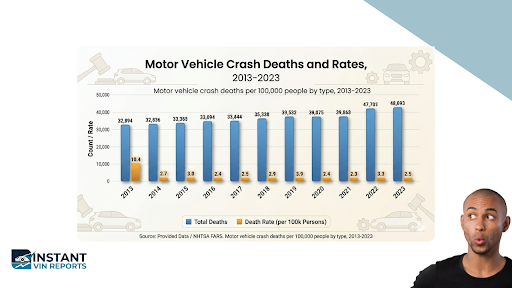
That's why it's important to check if the vehicle you want to purchase has ever been in an accident, and all you need to do is to simply do a VIN check. An online VIN check is one of the easiest ways to find out if a vehicle was involved in an accident, as it will display many checks.
Step 1: Get the VIN
Find the 17-digit VIN on the dashboard plate (visible through the windshield on the driver's side), the driver's door jamb sticker, the vehicle title, or the insurance documents. If you're evaluating a car before purchase, any legitimate seller should provide the VIN without hesitation. Reluctance to share a VIN is itself a red flag.
Step 2: Run the VIN Accident Check
Go to Instant VIN Reports and enter the VIN. Our system searches across insurance databases, state title records, auction data, and reported incident records tied to that specific VIN.
Step 3: Review the Full Report
The vehicle history report returns all accident-related records: collision events, total loss declarations, salvage and rebuilt title history, flood damage designations, airbag deployment records, hail damage reports, and any other branded title information. You can view a sample report here to understand exactly what the report looks like before you run one.
Step 4: Evaluate What You Find
A clean report with no accident records is a strong positive signal, not a guarantee, but a meaningful one. A report with a single minor accident and documented professional repair is manageable. A report showing a total loss declaration, an airbag deployment, and a salvage-to-rebuilt title chain is a vehicle that deserves extreme caution, regardless of how it looks today.
What is a Vehicle History Report?
A Vehicle History Report is a detailed history of the vehicle from the time it was first sold. It is tied to the VIN for the vehicle, since all sales, registrations, titles, and repairs include a vehicle's VIN.
As a consumer, by using the VIN, you can check to see if the car was stolen, wrecked, had any reported flood damage, issued a salvage title, or had any recalls on the vehicle.
Where to get vehicle history reports
The best place to get vehicle history reports is by using our VIN check service. Simply go to the link, type in the VIN of the car you want a vehicle history for, and the search will return the number of records found.
At that point, you have the option of purchasing a single report for the vehicle or you can buy unlimited reports.
What a Vehicle Accident History Report Shows
A full vehicle history report from Instant VIN Reports goes considerably further than a simple "accident: yes or no" answer. Here's what each category means and why it matters.
Major Accident Records
When an insurance company processes a collision claim above a certain dollar threshold, that event enters the database. The accident report by VIN number shows whether the incident was reported, roughly when it occurred, and in some cases, the severity classification used by the insurer. A car with one minor rear-end claim is a very different situation from one with a high-severity frontal collision report.
What matters as much as the presence of an accident is the absence of proper repair documentation. A car with a reported accident and documented professional repair is less concerning than one with a reported accident and no subsequent repair records, which suggests the damage may have been concealed rather than corrected.
Salvage Title Check
A salvage title is the legal record that a vehicle was declared a total loss by an insurance company. It's a permanent brand on the title history; even if the car is subsequently repaired and re-titled as rebuilt, the salvage designation remains in its history. Salvage-titled vehicles are typically ineligible for standard comprehensive and collision insurance, difficult to finance through traditional lenders, and significantly discounted in resale value.
Some sellers (particularly in private transactions) list salvage and rebuilt vehicles without disclosing the title status, relying on the buyer's failure to check. A branded title check through the VIN catches this immediately. The report shows every title status the vehicle has ever carried, not just the current one.
Airbag Deployment Check by VIN
Airbag deployment is one of the most telling indicators of collision severity. Airbags are single-use devices designed to deploy in significant frontal or side impacts. A car whose airbags deployed was involved in an accident serious enough to trigger that system, which typically means a substantial structural force event.
Checking airbag deployment by VIN matters for two reasons. First, it confirms that the collision was meaningful in severity, not just a parking lot scrape. Second, it raises the question of whether the airbags were properly replaced. Undeployed airbags in a car that should have had them replaced are a serious safety hazard. Some rebuilt vehicles are returned to the road with non-functional airbag systems or counterfeit airbag replacements.
The vehicle history report shows airbag deployment events tied to the VIN. If airbags are shown as deployed and there's no documentation of professional airbag system replacement in subsequent service records, that's a significant red flag.
Hail Damage Check
Hail damage is common in states across the Great Plains and Midwest corridor — areas prone to severe thunderstorms produce thousands of hail-damaged vehicles every year. Unlike flood or collision damage, hail damage is often cosmetic: dents across the hood, roof, and trunk lid without affecting the vehicle's mechanical systems or structural integrity.
Hail-damaged vehicles that aren't repaired — or that are repaired at lower-cost facilities using paintless dent removal — often enter the used car market at discounted prices. The issue is when sellers price them at full market value without disclosing the damage history. The VIN accident report shows whether a hail damage record was logged against the vehicle, giving you the information to price accordingly or ask for documentation of professional repair.
Branded Title Check
Beyond salvage and flood, vehicles can carry a range of other title brands depending on the circumstances of their history. These include:
- Flood Damage Title Check: Flood damage is one of the most insidious problems in the used car market. A flood damage check by VIN surfaces vehicles that were titled or reported as flood-damaged in any US state. This matters because flood vehicles are frequently transported across state lines after disasters.
- Rebuilt Title: The vehicle was previously salvage-titled, has been repaired, and has passed a state inspection to return to road use. The rebuilt designation stays in the VIN history permanently.
- Lemon Law Buyback: The manufacturer was required to buy back the vehicle under state lemon law provisions because of persistent defects that couldn't be corrected after a reasonable number of repair attempts. Lemon law buybacks are disclosed differently by state, but a lemon law check by VIN will surface these records where they were reported.
- Junk Title: The vehicle was deemed unrepairable and designated for parts or scrap. A junk-titled vehicle that somehow reappears in the used car market is a serious concern.
- Odometer Rollback Brand: The state has recorded evidence of odometer tampering or rollback on the title. This is relatively rare as a formal brand, but it does appear in some state records.
Each of these brands affects value, insurability, and legal disclosure obligations. A branded title check by VIN pulls all of these designations across every state in which the vehicle was ever titled.
Vehicle history reports also include such information as:
- Vehicle specification
- Multiple ownership history
- Total loss
- Recall information
- Warranty information
- Sales and Auction History records
- Lien/loan records
- Service & maintenance History, and
- Theft records
Red Flags to Watch for Beyond the VIN Report
The VIN accident check is the primary tool, but experienced used car buyers also look for physical signs that corroborate or contradict the report's findings.
Mismatched paint between body panels suggests repair work. Panel gaps that are uneven, particularly around doors, fenders, or the trunk lid, can indicate structural realignment after impact. Overspray on rubber seals, trim pieces, or under-hood components suggests a respray that wasn't professionally masked. New bolts on old brackets, fresh undercoating in isolated areas, and recently replaced structural components without documentation all warrant follow-up questions.
These physical signals don't replace the VIN accident history check; they supplement it. A clean report with suspicious physical signs means the damage may not have been reported. A report with accident records but clear physical evidence means the repair was done properly. Both pieces of information matter.
Conclusion
Checking a car's accident history by VIN isn't just a "nice to have"; it's the single most important step you can take before buying any used vehicle. A complete VIN history report reveals hidden damage that a clean paint job and a smooth-talking seller can easily hide: salvage titles, flood damage, airbag deployment, total loss declarations, branded titles (lemon, hail, fire, rebuilt, junk), and odometer rollback.
A paid report from a trusted service like Instant VIN Reports gives you the full picture, and that small investment can save you thousands in unexpected repairs, resale value loss, or even safety risks.
Don't gamble on a used car. Run the VIN check first.
FAQ about How To Check Accident History by VIN
What does a VIN Number contain?
The VIN number, which is also known as the chassis number or serial number of the vehicle, is a 17-character alphanumeric code. This alphanumeric code differs from vehicle to vehicle and is assigned by the manufacturer to each vehicle. The VIN number is then used to store information about the vehicle.
How do I check if a car has been in an accident?
Run a VIN accident check using the vehicle's 17-digit VIN at instantvinreports.com. The vehicle history report searches insurance records, state title databases, auction data, and reported incident records tied to that VIN, returning any accident history that was formally documented.
How do I check accident history on a car for free?
The NHTSA maintains a free database at nhtsa.gov that covers safety recalls and some reported complaints by VIN. The NMVTIS system provides some title history through approved providers. However, free sources typically don't include private insurance claim data, which is where most accident records live. A full paid vehicle history report provides significantly more comprehensive accident coverage.
Does a VIN number show accident history?
Not directly — the VIN is an identifier, not a data storage system. But when you run a VIN check, the report retrieves all records tied to that VIN from insurance databases, state title agencies, and auction systems. If an accident was reported through any of those channels, it will appear.
How do I find out if a car was in an accident?
The most reliable method is running a full vehicle accident history report by VIN through a service that accesses insurance claim data, state title records, and auction records. Visual inspection for paint mismatches and uneven panel gaps is a useful supplement, but not a substitute for documented records.
Can you check accident history by VIN?
Yes. The VIN is the standard identifier used across all US vehicle records systems. To retrieve a car's accident and damage history, enter the VIN into our VIN decoder, and you will get recorded accident, damage reports, severity & impact details, and structural / frame alerts.
What does a vehicle history report show?
A full vehicle history report shows: accident records and collision severity, total loss declarations, salvage and rebuilt title history, flood damage records, airbag deployment events, hail damage reports, odometer readings over time, ownership transfers, lemon law buyback records, and any other branded title designations. You can view a sample report to see the full format before running one.
How do I check if a car was totaled by VIN?
Enter the VIN at our decoder tools and review the title history and damage records sections of the vehicle history report. A total loss declaration appears as a distinct record, typically showing the date it was declared, the state of record, and whether the vehicle was subsequently rebuilt. Salvage and rebuilt title brands in the title history chain are the permanent indicators of a prior total loss.
How do I check airbag deployment by VIN?
To check airbag deployment by VIN, enter the VIN from Instant VIN Reports, and get a full vehicle history report, which includes airbag deployment records where they were reported through insurance or inspection systems.
If airbags are shown as deployed, the follow-up question is whether there's documentation of professional airbag system replacement at a qualified repair facility.