

You'd think the best-selling car in America would change every few years. Markets move. Tastes shift. Gas prices spike. New tech rolls out.
But here's the strange thing.
The same vehicle, the Ford F-Series, has been sitting at the top for nearly fifty years.
That kind of dominance doesn't just happen because something is good. It happens because it fits how people live. How they work. Where they live. What they tow. What they haul. What they value.
Still, if you zoom out and look at the bigger picture, the market beneath that headline is changing faster than it has in decades with rising competition from the Toyota RAV4 and Tesla Model Y. So, let's take a look at the best-selling cars in the US today.
Key Takeaways
- The Ford F-Series remains the best-selling car in America, but the distance between trucks and SUVs is shrinking.
- Long-term U.S. vehicle sales trends show Americans steadily moving away from traditional sedans.
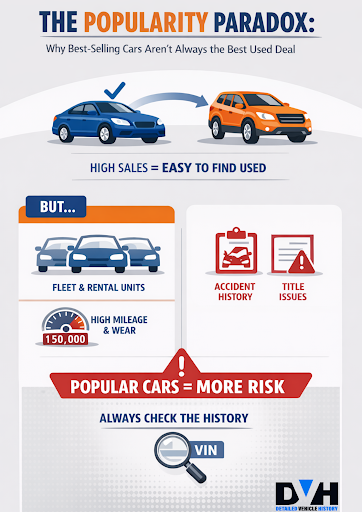
- High sales volume makes popular models easy to buy used, but that popularity also increases the risk of fleet or high-mileage examples.
So What Is the best-selling car in America Right Now?
It's the Ford F-Series. Again.
About 750,000 units in 2025. Give or take.
That's an enormous number when you consider the entire U.S. light vehicle market sits somewhere in the mid-teens of millions annually. One model line accounting for that much volume is unusual.
But here's the part that doesn't always make headlines. If you combine Chevrolet Silverado and GMC Sierra sales, General Motors actually edges out Ford in total full-size truck volume in certain years.
That doesn't change the official ranking. Ford still wins individually. But it does tell you something important about the top-selling vehicles in the United States. The truck segment is not just dominant. It's fiercely competitive.
And that competition keeps pricing, incentives, and feature upgrades moving quickly.
Top 10 Best Selling Vehicles in the United States (2025 Data)
Here's how the market stacked up in 2025:
| Rank | Model | Units Sold (2025) | Segment / Vehicle Type |
|---|---|---|---|
| 1 | Ford F-Series | 828,832 | Full-Size Pickup Truck |
| 2 | Chevrolet Silverado | 558,709 | Full-Size Pickup Truck |
| 3 | Toyota RAV4 | 479,288 | Compact SUV / Crossover |
| 4 | Honda CR-V | 403,768 | Compact SUV / Crossover |
| 5 | Ram Pick-Up | 374,059 | Full-Size Pickup Truck |
| 6 | GMC Sierra | 356,218 | Full-Size Pickup Truck |
| 7 | Chevrolet Equinox | ~330,000* | Compact SUV / Crossover |
| 8 | Tesla Model Y | ~300,000* | Electric Compact SUV |
| 9 | Toyota Camry | 316,185 | Midsize Sedan |
| 10 | Toyota Tacoma | 274,638 | Midsize Pickup Truck |
Now pause for a second and look at that mix.
- Five trucks.
- Four crossovers or SUVs.
- One traditional sedan.
- One fully electric model.
That distribution tells you almost everything you need to know about vehicle popularity in the U.S. market.
Model-by-Model Breakdown: Why These Vehicles Win
Let's see why these vehicles are at the top of the market:
Ford F-Series
The F-Series dominates for several reasons.
First, commercial fleet demand. Construction companies, municipalities, and contractors purchase trucks in bulk. That creates a strong base of guaranteed volume.
Second, lifestyle demand. Modern pickups are no longer stripped-down work machines. Many buyers choose higher trims that offer luxury interiors, advanced driver assistance systems, and hybrid powertrains.
Third, resale value. Trucks tend to retain value better than most passenger cars. That matters when buyers consider total ownership cost.
This combination keeps the F-Series at the top of the best-selling cars in America list year after year.
Chevrolet Silverado
The Silverado competes aggressively on price and fleet penetration.
It benefits from strong rural demand and brand loyalty across multiple states. When paired with GMC Sierra numbers, GM's total pickup dominance becomes even clearer.
In other words, while Ford wins individually, GM quietly moves more total full-size trucks in some years. That competitive dynamic shapes overall vehicle popularity in the U.S. market.
Toyota RAV4
The RAV4 succeeds because it covers the middle ground extremely well.
First, practicality. It offers enough space for families without feeling oversized.
Second, efficiency. Hybrid variants give buyers strong fuel economy without full EV commitment.
Third, reliability perception. Toyota's long-standing reputation continues to influence purchase decisions.
Honda CR-V
The CR-V follows a similar formula to the RAV4. Reliability perception, spacious interior design, and competitive pricing keep it strong. It also benefits from hybrid availability and steady refinement rather than dramatic redesigns.
That consistency makes it one of the safest volume performers among the most popular cars in the U.S. year after year.
Ram Pickup
Ram trucks maintain strong positioning through performance and cabin refinement. The brand emphasizes torque capability and interior quality, appealing to both work and lifestyle buyers.
Although annual totals fluctuate slightly, regional loyalty remains steady. That stability secures its place among the best-selling trucks in America.
GMC Sierra
The Sierra strengthens GM's overall pickup presence. It often attracts buyers seeking a more premium feel within the full-size truck category. Higher trims offer upscale interiors while maintaining towing capability.
Combined with Silverado sales, it reinforces GM's influence within current U.S. vehicle sales trends.
Chevrolet Equinox
The Equinox represents the steady strength of the compact crossover segment. It competes primarily on affordability and broad availability, making it accessible to a wide range of buyers.
For many households, it offers SUV practicality without the price jump into larger midsize models. That balance of cost, space, and familiarity keeps it firmly positioned among the top-selling vehicles.
Tesla Model Y
The Tesla Model Y is arguably the most disruptive entry among the most popular car models in America.
Just a few years ago, EVs barely appeared in top rankings. Now, the Model Y consistently places near the top three.
Why?
- Crossover body style
- Competitive driving range
- Expanding charging infrastructure
- Strong brand identity
It shows how quickly U.S. vehicle sales trends can shift when technology meets consumer convenience.
Toyota Camry
The Camry stands out as one of the last traditional sedan leaders. Sedan sales have declined significantly over the past decade, yet the Camry continues to deliver substantial annual volume.
Fleet demand supports part of that number, but long-term brand loyalty plays an equally important role. Its durability in the rankings keeps it among the highest-selling cars by year, even as many competitors exit the segment.
Toyota Tacoma
The Tacoma highlights continued demand for midsize pickups in a market dominated by full-size trucks. Not every buyer needs maximum towing capacity, and many prefer a more manageable size for daily driving.
Its reputation for durability and off-road capability gives it appeal beyond traditional work use.
Why Trucks Dominate the Best-Selling Cars in America
The best-selling trucks in America are not just popular because people like them. They are popular because they solve problems.
- Contractors need towing capacity.
- Farmers need durability.
- Small businesses need utility.
- Families in rural areas need flexibility.
And here's something people don't talk about enough. Trucks often hold value better than sedans. When buyers know resale will be strong in three or five years, that affects purchase decisions.
Also, fleet contracts matter. A city government ordering 2,000 trucks at once moves the needle in ways retail sales never could.
So yes, the Ford F-Series dominates. But it dominates for layered reasons that are economic, cultural, and practical.
The SUV Takeover: How Crossovers Changed the Market
Now let's talk about something that's been happening slowly but steadily.
SUVs have taken over.
In the early 2000s, sedans were everywhere. Camrys. Accords. Civics. Impalas.
Today? Walk through any parking lot.
It's crossovers. Compact SUVs. Midsize SUVs.
The Toyota RAV4 and Honda CR-V are textbook examples. Why?
The reasons are straightforward:
- Higher seating position improves visibility.
- Flexible cargo space supports family needs.
- Fuel efficiency improved significantly compared to older SUV designs.
And then there's the Tesla Model Y. Which is basically an electric crossover. And it sits comfortably in the top three among the most popular cars in the U.S..
What Happened to Sedans?
Sedans didn't suddenly become bad cars. They just stopped fitting how most Americans live.
Higher seating positions feel safer to many buyers. Cargo flexibility matters more. And fuel economy between modern crossovers and sedans is not dramatically different anymore.
The Toyota Camry remains one of the highest-selling cars by year, but it's one of the last traditional sedans still consistently near the top.
That should tell you something.
Now let's talk about something that's been happening slowly but steadily.
SUVs have taken over.
In the early 2000s, sedans were everywhere. Camrys. Accords. Civics. Impalas.
Today? Walk through any parking lot.
It's crossovers. Compact SUVs. Midsize SUVs.
The Toyota RAV4 and Honda CR-V are textbook examples. Why?
The reasons are straightforward:
- Higher seating position improves visibility.
- Flexible cargo space supports family needs.
- Fuel efficiency improved significantly compared to older SUV designs.
And then there's the Tesla Model Y. Which is basically an electric crossover. And it sits comfortably in the top three among the most popular cars in the U.S..
A 30-Year Look at the Highest-Selling Cars by Year
Let's take a straightforward look at the highest selling cars by year over the past 30 years and see how the leaders have changed:
1990s: Sedans Were the Main Event
In the early 1990s, the battle for "America's car" was mostly a sedan fight, and the numbers were huge. The Honda Accord cracked 400,000 units in 1990, and the Ford Taurus had its own run mid-decade. Then the Toyota Camry took over by the late 1990s.
Best-selling passenger car examples (1990s):
| Year | Best-selling passenger car | Units sold |
|---|---|---|
| 1990 | Honda Accord | 417,179 |
| 1991 | Honda Accord | 399,297 |
| 1992 | Ford Taurus | 409,751 |
| 1996 | Ford Taurus | 401,049 |
| 1997 | Toyota Camry | 397,156 |
What this tells us is simple. In the 1990s, sedans were still mass-market kings. Fuel efficiency mattered, affordability mattered, and family-car shopping was centered on cars, not crossovers.
2000s: Trucks Took Over the Center of the Market
The 2000s are where the U.S. market starts looking like the U.S. market we recognize today.
Pickups didn't just sell well. They became the default "do-everything" vehicle for a lot of households. More suburbs, more long commutes, more recreational towing, more people wanting one vehicle that could handle everything.
And the Ford F-Series sales numbers in the early 2000s were enormous, pushing into the 900,000 range in some years.
2010s: Crossovers Go From "Nice Option" to "Mainstream Standard"
The 2010s are when crossovers stop being the alternative and start being the default.
This is also when you see compact and midsize crossovers steadily climb, year after year. Not always taking the overall crown from trucks, but taking mindshare from sedans in a big way. And once that shift happens, it's hard to reverse.
Meanwhile, the F-Series kept posting huge annual totals, often in the 700,000 to 900,000 range across the decade.
2020 to 2025: EVs Become Normal, Not Novel
This is the part that still surprises people.
EVs are not just "growing." They've shown they can sit near the top of the overall market rankings. In 2025, the Tesla Model Y is estimated to have around 300,000 U.S. sales and appears in the overall top 10 list.
And 2025 also gives us a clean "snapshot year" for what the modern market looks like:
- Ford F-Series: 828,832
- Silverado: 558,709
- RAV4: 479,288
- CR-V: 403,768
- Camry: 316,185
- Model Y: about 300,000 (estimate)
READ ALSO: High Profile Vehicles: Meaning, Risks & Safety Tips
Buying a Top-Selling Vehicle Used: What Most Buyers Overlook
Here's where things get practical.
When a vehicle is a best seller, you'll find tons of them used. That's great. More choice. More pricing competition.
But volume also means:
- More fleet vehicles entering resale
- Higher accident exposure simply due to scale
- Wider condition variation
Popular vehicles are easier to find used, but that popularity comes with variation. High-volume models often cycle through rental fleets, lease programs, and multiple owners before reaching the resale market.
That's why running a VIN Check makes sense. A vehicle history report can flag accidents, title issues, prior fleet use, theft records, sales history, auctions, owner records, and odometer concerns in minutes.
When millions of the same model are on the road, history is what separates a smart buy from an expensive mistake.
Do Best-Selling Cars Always Hold Their Value?
Not always.
Trucks tend to retain value well because demand stays strong.
- SUVs often hold steady, especially hybrid versions.
- Sedans can depreciate faster if segment demand continues shrinking.
- EV resale is more complicated. It depends on battery improvements and incentive structures.
So while popularity helps liquidity in resale markets, it doesn't guarantee price stability.
2026 Predictions: What Could Become the Next Best-Selling Car in America
Now here's the interesting part.
If hybrid adoption keeps increasing, the RAV4 hybrid could push even higher. If EV charging expands further, the Model Y might close the gap with trucks.
If fuel prices spike, smaller crossovers could benefit.
The point is this. The best-selling car in America might not always be a truck forever. It has been for decades. But markets evolve.
And right now, the market feels more fluid than it has in a long time.
Final Thoughts on Best-Selling Vehicles in America
The best-selling car in America tells you what millions of people decided made sense for their lives this year.
It doesn't automatically tell you what makes sense for yours. Trucks dominate because they are versatile. SUVs rise because they balance comfort and space. EVs climb because technology improves.
The rankings are interesting, but the patterns behind them are more important.
And if you're buying used, remember that popularity creates abundance. But every vehicle still has its own story, which a vehicle history report exposes.
What is the number one best-selling car in America?
What is the number one best-selling car in America?
The number one best-selling car in America is the Ford F-Series. It has led U.S. vehicle sales for nearly 50 consecutive years. That dominance comes from a mix of commercial fleet demand, strong resale value, and consistent appeal across both work and personal use segments.
Are best-selling cars more reliable?
No, best-selling cars are not automatically more reliable. High sales volume usually reflects market fit, pricing, availability, and brand loyalty rather than guaranteed durability. While some popular models have strong reliability reputations, others sell well because of incentives or fleet contracts.
Do popular cars have better resale value?
Yes, popular cars often have stronger resale value because demand remains steady in the used market. However, resale performance still depends on production levels, segment demand, and long-term reputation. Full-size trucks, for example, tend to retain value well, while some sedans depreciate faster due to shifting buyer preferences.
Should I check the VIN of a best-selling car?
Yes, you should check the VIN of a best-selling car because high-volume models often have more varied ownership histories. Popular vehicles frequently cycle through rental fleets, lease programs, or multiple private owners before resale. A VIN check helps confirm accident history, title status, and prior usage before you commit to a purchase.