

Ask ten analysts who runs the auto industry today, and you will likely hear ten different answers. Some will point to production numbers and global sales. Others will highlight market capitalization or advances in software and autonomy. The truth sits somewhere in between.
This breakdown of the top 10 automobile companies in the world shows how volume, technology, and regional power all intersect in 2026.
Key Takeaways
- Toyota leads the world in sales volume, but Tesla leads in market value.
- China’s automakers are gaining power fast because they control battery supply and EV scale.
- Brand reputation is not enough for buyers, so a VIN history check still matters.
The Dual Leaderboard: Sales Volume vs. Market Value
Ask a factory executive who leads the world, and you’ll hear one name. Ask Wall Street, and you’ll hear another. Both answers are correct, and that’s the strange part. Both Toyota and Tesla are taking control of the market today.
Let’s look closely:
Volume Leader: Toyota Motor Corporation
Toyota Motor Corporation remains the largest car manufacturer in the world by annual output, delivering more than 11 million vehicles globally. That scale is the result of decades of operational discipline, supplier integration, and regional flexibility.
Toyota’s strategy avoids extremes. It:
- Produces hybrids at enormous volume
- Continues building efficient gasoline vehicles for developing markets
- Expands battery electric models under its bZ lineup
- And maintains long-term research into hydrogen fuel cell technology.
At the same time, the company invests heavily in solid-state battery development, which many analysts consider a potential breakthrough for range and charging speed.
There’s discipline in that approach. While others bet everything on one path, Toyota spreads risk across continents and technologies.
In Southeast Asia, combustion engines still dominate. In Europe, EV mandates accelerate. In the U.S., hybrids and trucks carry weight. Toyota shows up in all three places with something viable.
That flexibility keeps it at the top of the largest car manufacturers by volume.
Valuation Leader: Tesla, Inc.
Tesla, Inc. sells fewer vehicles than Toyota.
Yet its valuation floats around $1.4 trillion.
That gap isn’t about cars. It’s about belief.
Investors see Tesla as an AI company wrapped in sheet metal. Full Self-Driving is treated like a future platform, not a feature. The Megapack energy business is growing fast enough to stand on its own. The robotaxi vision, whether you agree with it or not, keeps capital interested.
Spend time around Tesla owners, and you’ll notice something else. They talk about updates. Software improvements. Versions. Releases. That language feels closer to tech than traditional automotive.
That perception matters. It places Tesla among the most influential leading automotive corporations, even when it’s not leading in raw volume.
The 10 Most Influential Automobile Companies of 2026
Influence isn’t clean math. Some companies move millions of vehicles, some move markets, and others move margins. Here’s how the field looks right now:
📊 Auto Industry Snapshot Ranked by Market Capitalization (2026)
| Company | Market Cap (2026 est.) | 2025 Global Sales (est.) | Global Market Share (approx.) | Positioning Insight |
|---|---|---|---|---|
| Tesla, Inc. | ~$1.4T+ | ~1.6–1.8M | ~2–3% (overall) | Highest valuation; software-driven narrative |
| Toyota Motor Corporation | ~$300B+ | ~11.2M | ~12–13% | Global volume leader |
| BYD Company | ~$120B+ | ~4.6M | ~4–5% | Rapid EV growth and exports |
| Hyundai Motor Group | ~$80B+ | ~7.3M | ~7–8% | Balanced global presence |
| General Motors | ~$70B+ | ~6.2M | ~6% | Strong U.S. market base |
| Ford Motor Company | ~$65B+ | ~4.4M | ~4% | Truck dominance, EV transition |
| BMW Group | ~$60B+ | ~2.5–3M | ~2–3% | Premium segment strength |
| Ferrari | ~$60B+ | ~14K | <0.1% | Industry-leading profit per vehicle |
| Volkswagen Group | ~$60B+ | ~8.7M | ~8–9% | Large European footprint |
| Stellantis | ~$20B+ | ~5.5M | ~5% | Multi-brand scale advantage |
1. Toyota Motor Corporation (Japan)
Toyota continues to provide stability within a volatile industry. Its hybrid lineup spans nearly every major segment, and in many markets those models still outsell pure electric vehicles due to infrastructure limitations.
The company’s supplier ecosystem and production network span continents, creating resilience during supply disruptions. When analysts evaluate major automobile makers, Toyota frequently serves as the benchmark for operational excellence.
2. Tesla, Inc. (USA)
Tesla remains one of the most influential companies in the sector. The Model Y has ranked among the world’s best-selling vehicles across all categories, not just electric models.
Beyond vehicles, Tesla’s ambitions in autonomy, AI training infrastructure, and energy storage continue to reshape how investors view the company. If scalable Level 4 autonomy becomes commercially viable, Tesla’s revenue model could evolve significantly toward recurring mobility services.
That possibility secures Tesla’s position among the top vehicle manufacturers by influence and future positioning.
3. Volkswagen Group (Germany)
Running a company with Porsche, Audi, Skoda, SEAT, and the core VW brand under one roof is either an enormous strategic advantage or a management nightmare. For Volkswagen Group, it’s been periods of both.
Porsche continues to generate the kind of margins that luxury automakers dream about. Audi maintains genuine credibility in the premium segment. The base VW brand handles the volume.
Through its PowerCo subsidiary, the group is pushing to bring battery cell production under its own control in Europe. This is an expensive bet that reflects how seriously it takes supply chain exposure.
European regulations forced acceleration toward electrification. Volkswagen responded by consolidating platforms and scaling production. That kind of structural engineering keeps it among the biggest auto companies by sales.
4. BYD Company (China)
BYD Company represents the global expansion of Chinese automotive influence.
- It builds its own Blade batteries.
- It controls large parts of its semiconductor supply.
- It manufactures buses, trucks, and passenger EVs at scale.
Vertical integration gives BYD pricing power. That shows up clearly in Southeast Asia and Latin America, where expansion is moving quickly.
BYD surpassed Tesla in total EV unit sales in several recent quarters. That’s not theoretical. It happened.
When people talk about the future of top vehicle manufacturers, BYD is firmly in the conversation.
5. Hyundai Motor Group (South Korea)
Hyundai Motor Group doesn’t rely on hype. Its E-GMP platform delivers strong charging speeds and real-world range. Kia and Genesis give it brand diversity across price segments.
Design has sharpened. Interiors feel intentional. Pricing lands in competitive territory without feeling cheap.
Hyundai’s growth feels methodical. That quiet execution keeps it climbing among the largest car manufacturers globally.
🔎 Thinking of Buying One of These Top Brands?
Even vehicles from the top automobile companies in the world can hide accident history, salvage titles, or mileage issues.
Before you commit, run a quick VIN check and see the full vehicle history in seconds.
6. Ford Motor Company (USA)
Ford remains one of the most influential names in the global auto industry, especially in North America. Its F-Series trucks continue to dominate U.S. sales, giving the company a strong revenue base and loyal customer following.
At the same time, Ford is investing heavily in electrification through models like the Mustang Mach-E and F-150 Lightning. The challenge is balancing its profitable truck business with the costs of scaling EV production. If it manages that shift carefully, Ford will remain firmly positioned among the major automobile makers.
7. General Motors (USA)
GM is doing something difficult: extracting enough profit from full-size trucks and SUVs, which it does exceptionally well, to fund an electric transition whose financial returns are still years away.
The Ultium battery platform has produced credible vehicles across Chevrolet and Cadillac. The business case for all of it depends on scale that hasn’t fully arrived yet.
The company’s challenge isn’t engineering competence. It’s executing a transition while keeping investors, dealers, and workers on board simultaneously. That’s a political and organizational problem as much as a technical one.
8. Stellantis
Stellantis is a group that exists because mergers made it necessary. Combining Fiat Chrysler and PSA created geographic diversity and a portfolio that includes Jeep, Ram, Peugeot, and Fiat, among others.
Geographic diversity is real insurance against regional downturns. Managing that many brands without diluting any of them is the harder ongoing challenge.
Platform sharing is where the group’s future competitiveness will be determined. Do it well, and the cost efficiencies are substantial. Do it poorly, and the brands start feeling interchangeable.
9. BMW Group (Germany)
BMW has spent years arguing that electrification and driving character are not mutually exclusive. Its upcoming Neue Klasse platform is where that argument gets stress tested against actual products.
The luxury segment has more tolerance for transition costs than the mass market auto; buyers paying a premium expect refinement and distinctiveness in exchange. BMW’s strategy banks on those buyers valuing the experience of the car itself, not just its efficiency numbers.
If the Neue Klasse delivers, that argument looks vindicated. If it doesn’t, the gap between BMW’s premium positioning and its EV execution will become a competitive liability.
10. Ferrari (Italy)
Ferrari sells dramatically fewer vehicles than everyone else on this list. It also generates higher profit per vehicle than anyone else on this list, by a wide margin.
Controlled production, deliberate scarcity, and careful brand management have created something most automakers can’t replicate through engineering alone: a product whose desirability is partly a function of how hard it is to obtain.
Ferrari’s approach to electrification has been appropriately cautious; the company clearly believes the identity of the car matters as much as its powertrain, and so far that caution has cost it nothing with the customers who matter most.
Regional Dominance: How the Map is Shifting
For a long time, the automotive world had a comfortable hierarchy. Japan built reliably. Germany built precisely. The United States built big. Everyone else was catching up.
That era is over. Growth is no longer evenly distributed, and companies positioned in the right regions with the right strategies are climbing faster than legacy market share would suggest. China’s acceleration in EVs and India’s expanding domestic market are quietly redrawing the map.
The Rise of China’s Big Three
China is not just catching up. It is pulling ahead in ways that are structural, not cyclical.
Battery Control as Strategic Power
The most important shift is not simply that China sells a lot of cars. It is that China now controls much of the supply chain underneath the vehicles everyone else is trying to sell.
Chinese companies process a dominant share of the world’s lithium and manufacture a majority of its battery cells. That advantage took years to build and will take years to challenge.
BYD, Geely, and Xiaomi sit inside that ecosystem and benefit from it every time they price a vehicle against a Western competitor.
Export Acceleration and Global Expansion
Chinese manufacturers are no longer focused only on domestic growth. They are expanding into Southeast Asia, South America, and parts of Europe. In several emerging markets, Chinese EVs have become the first genuinely affordable electric option for middle-class buyers. That is large-scale market entry in regions without deep loyalty to Western brands.
China is no longer reacting to Western automakers. It is setting its own agenda.
Why India Is the New Automotive Frontier
India’s story is quieter, but the long-term potential is difficult to ignore.
Demographic Momentum
India is young, rapidly urbanizing, and still in the early stages of mass car ownership. As incomes rise, the volume of first-time buyers entering the market over the next decade will be significant. Tata Motors and Mahindra & Mahindra are building domestic credibility before foreign competition fully establishes itself.
Policy Support and Electrification Push
Government incentives for local manufacturing and EV adoption are reinforcing that domestic base. Infrastructure investment and sourcing policies aim to keep more of the supply chain within the country as the market expands.
India may not dominate this year’s rankings. But ignoring its trajectory now would make the next ranking update feel sudden.
How the Top 10 Automobile Companies in World Are Really Evaluated
When people look at the top 10 automobile companies in the world, they often think it is just about sales. It is not that simple.
Volume matters, but so do margins, innovation, investor confidence, and customer trust. A company can sell millions of cars and still struggle financially. Another can sell fewer vehicles and be worth far more because the market believes in its future.
Market Value
Market value reflects expectations. That is why Tesla can trail Toyota in output and still lead in valuation. Investors are betting on software and long-term technology plays, not just factories.
Production and Sales
Production and sales still count. They show operational strength and demand. But some of the biggest auto companies by sales operate on thin profits, while others earn more per vehicle with lower volume.
Innovation
Innovation has become a dividing line. Electrification, battery development, and connected vehicle systems are reshaping the global car brand ranking. Companies that move faster tend to climb.
Consumer Trust
Consumer trust also plays a role. Reliability, safety, and ownership costs now influence buyers more than brand nostalgia. Automakers that maintain strong reputations often remain among the best-selling car companies.
Regional Strategy
Regional strategy matters as well. China leads in battery scale. Europe pushes regulation. The United States moves at its own pace. The strongest top vehicle manufacturers adjust to each market rather than forcing one global formula.
Before You Buy from a Top Brand, Check the Vehicle’s History!
A brand’s global reputation does not automatically guarantee that the specific vehicle in front of you is clean. Even cars from the largest car manufacturers can have hidden accident damage, salvage titles, flood exposure, or odometer rollbacks.
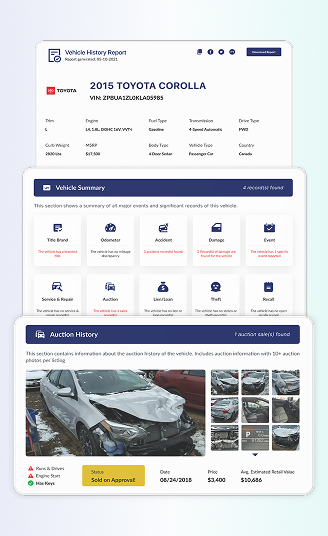
That is where a VIN check becomes essential. With a vehicle history report, you can access:
- Accident history
- Title status
- Salvage and flood records
- Odometer readings
- Auction and damage reports
- Ownership history, and more
A few minutes of research can save thousands in unexpected repairs. If you are considering a Toyota, Ford, BMW, Tesla, or any other model mentioned in this ranking, check the VIN first. Brand strength does not replace vehicle history.
Final Thoughts: What Defines a “Top” Automaker in 2026
The companies at the top of the auto industry in 2026 do not share a single formula for success. Toyota’s strength comes from operational scale and technical range. Tesla’s advantage lies in investor confidence and deep software integration. Ferrari relies on enforced exclusivity. BYD competes through cost structure and vertical control.
What most of them do share is a recognition that the vehicle is no longer just a physical product. It is increasingly a connected, updatable, data-generating platform. The companies that understood this early are building advantages that traditional assembly capacity alone cannot match.
The regional picture matters just as much. China is now both the world’s largest auto market and its dominant EV battery producer. That gives companies like BYD and Xiaomi structural advantages that Western competitors are still trying to counter.
India is also emerging as a serious growth frontier, with Tata Motors and Mahindra building for a middle class that is only beginning its mass vehicle ownership cycle.
Rankings like this will likely look different within five years. The more important question is not which brand is the biggest today. It is which companies are building ecosystems strong enough that customers struggle to imagine switching to anything else.
FAQ About the Top 10 Automobile Companies in the World
Which car company is the most profitable per vehicle sold?
Ferrari is widely considered the most profitable automaker on a per-vehicle basis. While it produces fewer than 15,000 cars annually, its limited production strategy and premium pricing allow it to generate significantly higher margins per unit than mass-market manufacturers.
Ferrari proves that scale is not the only path to financial success in the automotive industry.
Who are the "Big Three" car companies in India for 2026?
The leading players in India for 2026 are generally recognized as Tata Motors, Mahindra & Mahindra, and Maruti Suzuki.
Maruti Suzuki remains dominant in overall passenger vehicle sales, while Tata Motors and Mahindra are expanding aggressively in SUVs and electric vehicles. Together, they shape the direction of India’s growing automotive market.
Is Xiaomi considered a top 10 automobile company?
Xiaomi has entered the automotive space with strong early momentum, but it is not yet among the global leaders by production volume. Its influence comes more from ecosystem integration and technology positioning than from large-scale vehicle output.
At this stage, Xiaomi is viewed as a fast-rising player rather than a core member of the traditional largest car manufacturers.
Has BYD surpassed Tesla in global sales?
BYD Company has surpassed Tesla, Inc. in total electric vehicle unit sales in multiple recent quarters.
However, Tesla still holds a significantly higher market valuation. So while BYD leads in EV volume in certain periods, Tesla remains ahead in financial market perception
Which is the No. 1 car company in the world in 2026?
The answer depends on how “No. 1” is defined. By total vehicle sales, Toyota Motor Corporation remains the global leader, selling over 11 million vehicles annually.
By market capitalization, Tesla, Inc. holds the top position. In 2026, leadership is split between scale and valuation, which reflects how the auto industry itself has changed.