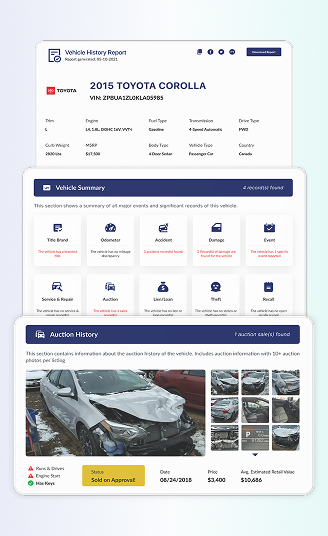



Classic car VINs are one of the most misunderstood topics in the vintage vehicle world. Modern VIN lookup tools work seamlessly for anything built after 1981, but for a 1967 Mustang, a 1970 Chevelle, or a 1955 Thunderbird, the rules are entirely different. The numbers are shorter, the locations are less standardized, and most mainstream decoders simply can’t read them.
Sometimes the VIN number has 5 characters, 7 characters, 10 characters, 13 characters, or 14 characters. All of the characters in VIN are uniquely identified and provide detailed information about the history of the vehicle.
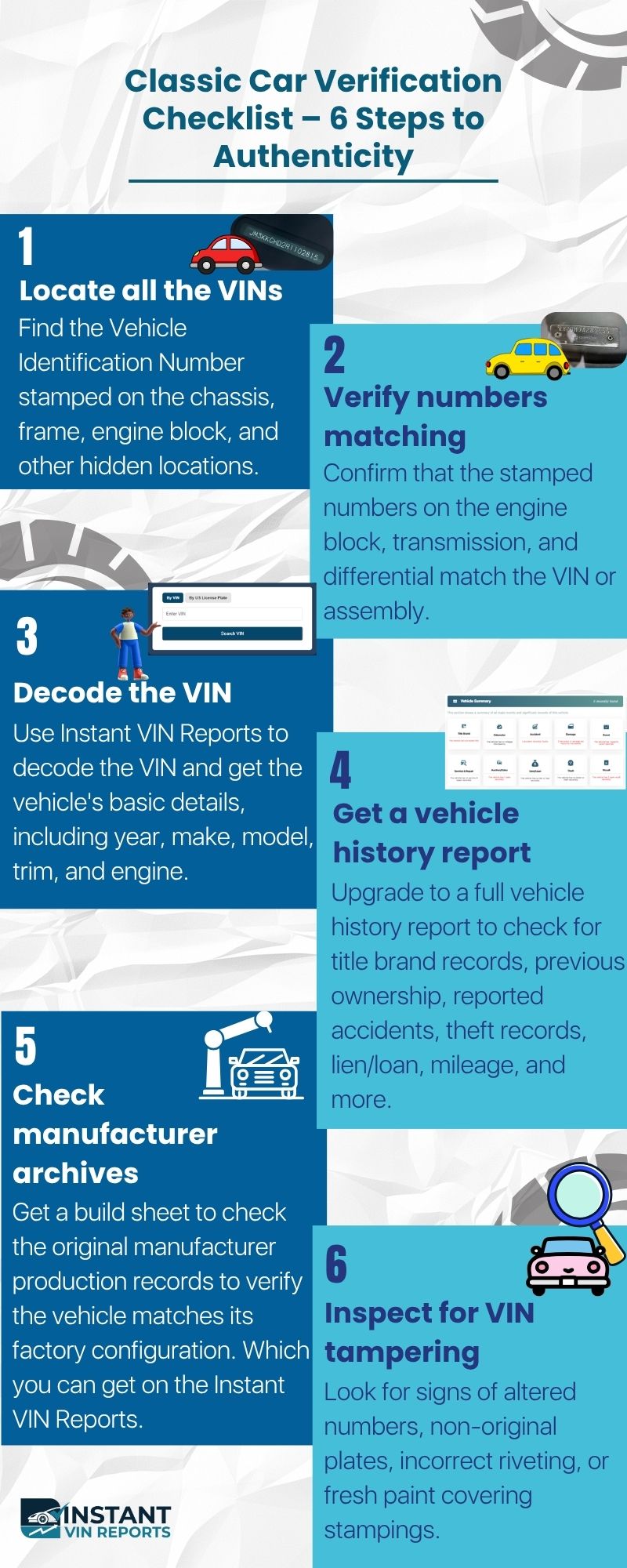
In this article, we will be looking at where to find the VIN number in a classic vehicle and how to Check a classic car VIN number to verify history, authenticity, and matching numbers before you buy or sell.
Key Takeaways
- Classic cars do have VIN numbers, but they predate the 1981 standardization and use shorter, manufacturer-specific formats (typically 9–14 digits)
- VIN location on pre-1981 cars varies by manufacturer and era. Check the dashboard, door jamb, firewall, frame rails, and engine block
- Standard VIN check tools don’t work for classics; use a specialized classic VIN decoder lookup tool that handles pre-1981 formats
- VIN fraud is real in the classic car market; title washing, VIN swapping, and cloning all exist. A thorough history check is the best defense
Do Classic Cars Have VIN Numbers?
Yes, but not the way modern cars do. The format, length, and location were not standardized until 1981, when the National Highway Traffic Safety Administration (NHTSA) mandated the current 17-character system.
Before 1981, each manufacturer used its own proprietary coding system. The result is a patchwork of different formats:
- Some manufacturers used 13 digit or 14 digit VINs
- Others used 11 digit or 9 digit sequences
- A handful of very early vehicles used 5 to 7 character chassis numbers
- The information encoded in each position varied by manufacturer, make, and model year
This is why you can’t just plug a 1968 Camaro VIN into Carfax or a standard modern decoder and expect useful results. Those tools are built for 17-digit formats. Classic car VIN numbers require a specialized antique car VIN decoder that understands pre-1981 manufacturer-specific coding systems.
The other complication: VIN location on classic cars was not uniform. While modern vehicles always have the VIN visible through the driver’s side windshield, pre-1981 vehicles placed their identification numbers in a variety of locations, some of which require knowing the specific make and model year to find.
Where Is the VIN on a Classic Car?
Finding the classic car VIN location requires knowing where manufacturers stamped or riveted identification numbers during the era your vehicle was built. Here are the most common locations, organized by type.
Common Classic Car VIN Locations
When looking for the VIN number in your classic car, here are some common locations that you can check
1. Dashboard / Instrument Panel (Driver’s Side)
Starting in 1968, federal regulations required automakers to mount the VIN on a plate visible through the windshield on the driver’s side. For vehicles from 1968 through 1980, this is typically the first place to look. The plate is usually a small metal tag affixed to the top of the dash, visible from outside the car.
For vehicles built before 1968, this plate may or may not be present depending on the manufacturer and whether the dash has been modified during restoration.
2. Driver’s Side Door Jamb
A second identification sticker or stamped plate is commonly found on the edge of the driver’s door or on the door jamb pillar. This location became more standardized through the 1970s. It often includes additional data codes beyond the VIN (e.g., trim codes, paint codes, and build information), making it one of the most information-rich spots on the entire vehicle.
3. Firewall (Engine Compartment)
The firewall is the metal wall separating the engine bay from the passenger cabin. It frequently carries a stamped VIN or partial VIN on American-made classics. Open the hood and look at the front face of the firewall on the driver’s side. On many muscle cars from the 1960s and 1970s, this is where the primary chassis stamp is located.
4. Engine Block / Transmission
Many manufacturers also stamped a partial VIN or a derivative number on the engine block and transmission. This is critical for numbers matching verification — confirming that the engine in the car is the original engine the car left the factory with. For high-value muscle cars and collector vehicles, matching numbers can dramatically affect value.
5. Frame Rails (Body-on-Frame Vehicles)
On trucks, full-size American cars, and older rear-wheel drive vehicles with a separate body and frame, the VIN or chassis number is often stamped directly into the frame rail. Check both the driver’s side and passenger’s side frame rails near the front of the vehicle. Look for stamped digits, not a plate — the stamp may be partially obscured by undercoating or surface rust.
6. Trunk Floor / Rear Wheel Wells
On some makes — particularly GM vehicles from the 1960s — a secondary VIN stamp can be found on the trunk floor or inside the rear wheel wells. This secondary stamp served as an anti-theft verification point.
7. Under the Hood — Radiator Support
Some manufacturers placed VIN tags on the radiator support or on a plate attached to the top of the engine bay. This is especially common on Ford products from the late 1960s and early 1970s.
How to Decode a Classic VIN Number
A classic VIN number is a 13-digit number that is unique to a particular car. Here is how to decode a classic VIN number
Step 1
Look at the first digit of the VIN number to see the manufacturer’s country of origin. Vehicles manufactured in the United States will have a 1, 4 or 5 as the first digit in the VIN number code
Step 2
The second digit in the sequence is used to determine the manufacturer of the vehicle. For example, Jaguar is represented by the letter “A,”
Step 3
The third character in the VIN number sequence to find out the vehicle type. For example, a passenger sedan would have a number of “3”
Step 4
Examine the fourth to eighth characters to find out the identification of the engine type, brake system model, restraint system, and body style. The ninth character of the VIN number series is known as the VIN number “check digit” verification, which checks the previous VIN numbers for accuracy.
Step 5
Read the tenth character of the VIN number sequence to determine the model year of the vehicle. If the vehicle was manufactured between 2001 and 2009, the digits will appear as 0-9.
Step 6
Find and examine the eleventh character of the VIN number sequence to determine the manufacturing plant of your vehicle. Unlike the manufacturer’s country of origin, this number represents where the vehicle was assembled.
Classic Car Identification: Numbers Matching and Why It Matters
For anyone buying or selling a high-value vintage vehicle, numbers matching is one of the most important concepts in classic car identification. It refers to whether the major drivetrain components (e.g., engine, transmission, and sometimes the rear axle) are the original units the car left the factory with.
A numbers-matching classic car is worth significantly more than an identical vehicle with a replacement engine, even if the replacement is the same type. This is because:
- Numbers matching confirms the vehicle’s provenance and authenticity
- It verifies that the car hasn’t been stripped and rebuilt with non-original components
- It supports higher insurance valuations for collector car coverage
- It provides confidence for show judging and concours evaluation
What Classic Car VIN Records Can Reveal
Running a classic car VIN number lookup tool does more than decode factory specs. Depending on the vehicle’s documented history, it can reveal:
- Title history across states: Classic cars often changed hands and registrations across many states over 50+ years
- Salvage or junk designations: A car that was totaled and rebuilt decades ago may carry that history
- Theft records: Including active theft records (vehicle not recovered) and historical theft with recovery
- Auction history: Appearance at salvage auctions, insurance auctions, or collector car auctions
- Mileage records: Odometer readings from past registrations and inspections
You can view a sample report to understand exactly what a full vehicle history report contains before purchasing one.
Classic Car VIN Fraud: What to Watch For
High-value classic cars, particularly desirable muscle cars, Shelby variants, and rare factory options cars, attract VIN fraud. The most common schemes involve:
VIN swapping
Taking the VIN plate from a less valuable version of a car (say, a base V6 model) and attaching it to a clone built to resemble a high-value variant (like a matching-numbers V8 performance model). The VIN appears legitimate, but the car is not what it claims to be.
Cloning
Creating a replica of a rare, high-value vehicle using a common donor car, then falsifying documentation to claim it’s the rare vehicle. Without cross-referencing the VIN against the firewall stamp, engine stamp, and body tag, a clone can be difficult to detect visually.
Title washing
Running a vehicle with a salvage or branded title through multiple state re-registrations to emerge with a seemingly clean title. A VIN check that accesses NMVTIS data can detect title washing attempts by showing the complete state-by-state registration history.
Altered or re-stamped VINs
Physically grinding off or re-stamping VIN plates and firewall stamps. This is a federal crime, but it happens with high-value cars. Mismatched stamping depth, font inconsistencies, or unusual tool marks around the VIN area are warning signs.
The simplest protection
Verify every VIN location, run a full history check, and if the numbers don’t all agree. Walk away.
Using the Window Sticker for Classic Car Verification
For vehicles built in the 1970s and some late-1960s models, a window sticker lookup can provide the original factory option list. The same information that appeared on the sticker in the dealer’s window when the car was new.
This is valuable for:
- Confirming factory-installed equipment (original radio, AC, power windows, etc.)
- Verifying original MSRP and option pricing
- Supporting insurance valuations for agreed-value collector car policies
- Authenticating claims about rare factory options (special paint, performance packages, etc.)
Combined with the body tag data and the VIN decoder output, the window sticker creates a three-way verification of what the car was built as. An important layer of due diligence on any significant purchase.
For very early classics or vehicles without a standard 17-digit VIN, our classic VIN decoder is the appropriate starting point. For 1981 and newer vehicles, our standard VIN decoder handles the modern 17-digit format.
Conclusion
Knowing where to find the VIN on classic cars and understanding each character helps owners verify important details like model year, manufacturer, and specific features. By performing a classic VIN lookup, you gain valuable insights that support restoration, maintenance, and authenticity for vintage vehicles.
Frequently Asked Questions About How to Check the VIN on a Classic Car
What does a classic car VIN mean?
A classic car VIN (Vehicle Identification Number) encodes specific factory information about the vehicle. Depending on the manufacturer, it can reveal the country of origin, manufacturer/division, model year, body style, engine type, assembly plant, and production sequence number. On high-value collector cars, the VIN also anchors the numbers-matching verification, confirming that the engine and transmission are original to the car as it left the factory.
Do classic cars have VIN numbers?
Yes, all mass-produced American vehicles from the 1950s onward were assigned identification numbers by their manufacturers. However, before 1981, these were not standardized; they varied in length (typically 5–14 digits) and format by manufacturer. They’re still called VINs, but they require specialized tools to decode. Very early vehicles (pre-1950s) may have chassis numbers or serial numbers rather than formal VINs.
How to find VIN on an antique car?
For antique cars (generally pre-1960), focus on the firewall, frame rails, and any data plates on the dashboard or door area. Very old vehicles may have serial numbers stamped into the frame itself rather than a separate VIN plate.
Check under the hood first (firewall and engine bay stampings), then the frame. If the vehicle predates formal VIN systems, manufacturer-specific registries and marque clubs can help decode the serial number format used by that particular make and year.
Where is the VIN on a 1960s car?
On 1960s cars, the VIN location depends heavily on the manufacturer and year. Before 1968, VINs were often found on the firewall (engine compartment), frame rails, or door jambs. After federal regulations in 1968, a dashboard plate became standard.
For 1960s muscle cars specifically, GM vehicles typically have firewall stamps; Ford products often have door jamb plates; Mopar vehicles often have a distinctive fender tag or firewall stamp. Always check multiple locations and compare them.
How to decode a classic car VIN?
Classic car VINs require a manufacturer-specific decoder because there was no standardized format before 1981. Each character position’s meaning varies by make, model, and year. Use our classic VIN Number decoder tool, it’s built specifically for pre-1981 formats, including 13-digit, 11-digit, and 9-digit VINs, to get the engine code, body style, assembly plant, and production sequence for your vehicle.
How to read a 13-digit VIN?
A 13-digit VIN is a pre-1981 format used by many American manufacturers. The positions typically encode the manufacturer/division (position 1), model year (position 2), body style and series (positions 3–5), engine code (position 6), check digit or plant code (position 7–8), and sequential production number (positions 9–13).
The exact meaning of each position varies by manufacturer. Use a specialized classic VIN decoder for accurate results.