
We often see buyers thinking they're getting a high-quality sedan from Munich, only to discover it was made elsewhere. Badges can be misleading; the real story is in the VIN. Since the early '80s, the VIN has provided a standardized, definitive proof of a vehicle's origin. Understanding the VIN country codes is crucial, especially when considering imports or vehicles with questionable histories.
In this article, we'll decode the initial digits, explain what each VIN country code means, and highlight the importance of checking these codes.
Key Takeaways:
- The very first digit or letter in your 17-character VIN always identifies the country of origin.
- The current system was locked in by the NHTSA in 1981 to stop the chaos of manufacturer-specific codes.
- A vehicle's manufacturing origin can genuinely affect its insurance premiums, parts availability, and resale value, so checking the VIN country codes is an important step before buying a used car.
Brief History of The VIN Number
Before 1981, reading a VIN was like trying to read handwriting in the dark. Because there was no standardized format. Manufacturers just did their own thing; some VIN numbers were 5 digits, while others could have 8, 10, 11, 13, 14, and the codes shifted depending on the year, making it impossible to consistently track vehicle history, ownership changes, or safety recalls.
Finally, the National Highway Traffic Safety Administration (NHTSA) stepped in to clean up the mess, mandating the 17-character format we use today. This change made tracking cleaner and enabled more precise identification of where each vehicle was produced, which is crucial when dealing with international safety compliance.
READ ALSO: How To Decode a 13 Digit VIN Number (Step by Step Guide)
What are The VIN Country Codes?
When you look at that long code stamped on the dashboard or riveted to the door jamb, you are looking at the Vehicle Identification Number (VIN), a unique string assigned to every car, truck, and motorcycle. The first three characters of the VIN form the World Manufacturer Identifier (WMI). This part tells you the country, manufacturer, and specific type of vehicle.
Think of it as the vehicle's birth certificate. While the later sections (the VDS and VIS) tell us about the engine type and which factory plant tightened the bolts, that first digit is the headline. It adheres to standards set by the International Organization for Standardization (ISO), meaning a "J" on a Toyota in Texas means the same thing as a "J" on a Honda in London: it was made in Japan.
Structure of a VIN
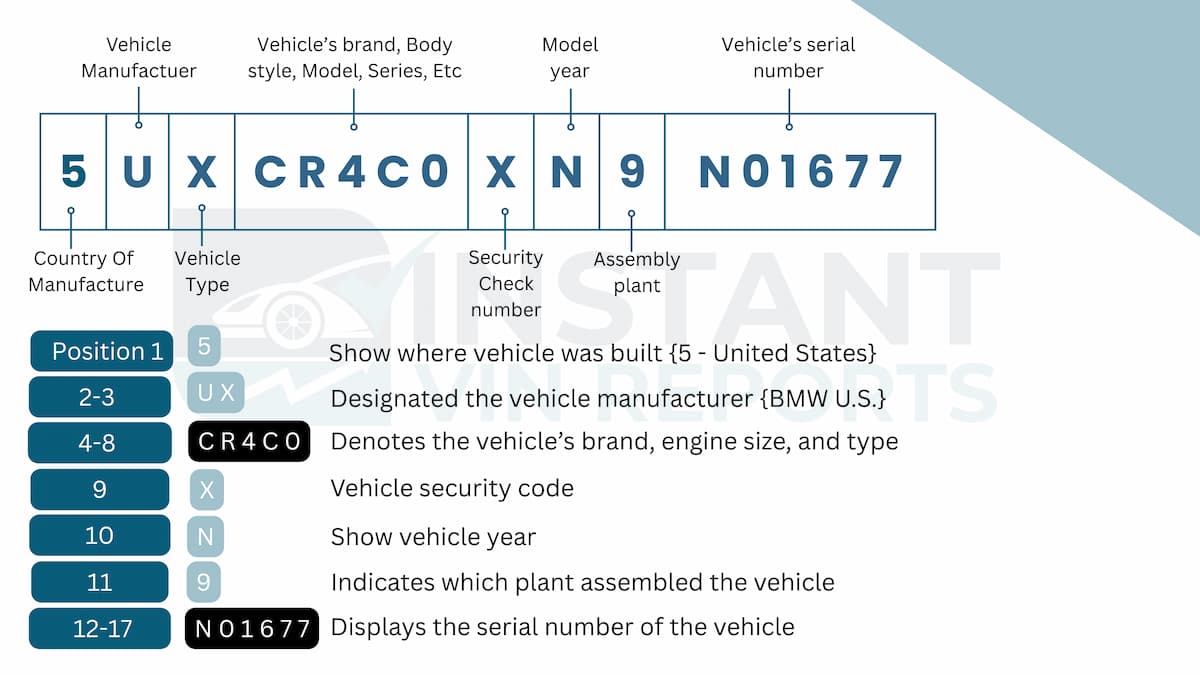
A VIN is given to every vehicle when it is made. This code serves as a fingerprint for the vehicle, providing key details on its features, history, and safety compliance. The VIN has three main parts: the World Manufacturer Identifier (WMI), the Vehicle Descriptor Section (VDS), and the Vehicle Identifier Section (VIS).
World manufacturer identifier (WMI)
The first three characters of the VIN constitute the WMI, which identifies the vehicle's
manufacturer and the country where the vehicle was produced. The first character
denotes the country of origin, while the subsequent characters represent the manufacturer and specific vehicle types.
WMI Regions
Vehicle Identification Number (VIN) country codes provide essential information about the manufacturing origin of vehicles. The first character of a VIN indicates the country where the vehicle was manufactured, adhering to a standardized system established by the International Organization for Standardization (ISO).
- Africa Codes
While vehicles built for the US market often hail from North America, Europe, or Asia, we still see codes originating from Africa, particularly for niche imports or specialty models. The region uses the beginning range of the alphabet.
| WMI | Region | Code | Notes |
|---|---|---|---|
| A-D | Africa | AA-AH | South Africa |
| BF-BG | Kenya | ||
| BU | Uganda | ||
| CA-CB | Egypt | ||
| DF-DK | Morocco |
- Asia Codes
Knowing the VIN country of origin list for Asia helps you understand what you're buying. For instance, a VIN starting with "L" indicates Chinese origin, which is becoming more relevant as global partnerships expand.
| WMI | Region | Code | Notes |
|---|---|---|---|
| H-R | Asia | H | China |
| J | Japan | ||
| KL-KR | South Korea | ||
| L | China | ||
| MA-ME | India | ||
| MF-MK | Indonesia | ||
| MS | Myanmar | ||
| NF-NG | Pakistan | ||
| NL-NR | Turkey | ||
| NS-NT | Uzbekistan | ||
| PA-PC | Philippines | ||
| PF-PG | Singapore | ||
| PL-PR | Malaysia | ||
| PS-PT | Bangladesh | ||
| PV | Cambodia | ||
| RF-RK | Taiwan | ||
| RL-RN | Vietnam |
- Europe Codes
European Origin Codes can be trickier because borders and ownership groups shift, but the ISO codes remain steady. If you are paying a premium for German engineering, you generally want to see a "W" at the start of that VIN.
Here is a quick breakdown of the common European codes we see:
| WMI | Region | Code | Notes |
|---|---|---|---|
| S-Z | Europe | SA-SM | United Kingdom |
| SU-SZ | Poland | ||
| TA-TH | Switzerland | ||
| TW-T2 | Portugal | ||
| UH-UM | Denmark | ||
| UN-UR | Ireland | ||
| VA-VE | Austria | ||
| VF-VR | France | ||
| VS-VW | Spain | ||
| W | Germany (formerly West Germany) | ||
| XA-XC | Bulgaria | ||
| XF-XH | Greece | ||
| XL-XR | The Netherlands | ||
| XX-XY | Luxembourg | ||
| XZ-X0 | Russia | ||
| YA-YE | Belgium | ||
| YF-YK | Finland | ||
| YS-YW | Sweden | ||
| Y6-Y8 | Ukraine | ||
| ZA-ZU | Italy | ||
| Z6-Z0 | Russia |
- America CodesThis is the block most buyers in the US interact with daily, whether they realize it or not. The first digit being a number almost always means the vehicle was assembled somewhere in the Americas.
| WMI | Region | Code | Notes |
|---|---|---|---|
| 1-5 | North America | 1, 4, 5 | United States |
| 2 | Canada | ||
| 3 | Mexico | ||
| 8-9 | South America | 8A-8E | Argentina |
| 8F-8G | Chile | ||
| 8L-8N | Ecuador | ||
| 8S-8T | Peru | ||
| 8X-8Z | Venezuela | ||
| 82 | Bolivia | ||
| 84 | Costa Rica | ||
| 9A-9E, 90-91 | Brazil | ||
| 9F-9G | Colombia | ||
| 9S-9V | Uruguay |
- Oceania - Codes
The Oceania codes cover the island nations of Australia and New Zealand. The codes from this region are:
| WMI | Region | Code | Notes |
|---|---|---|---|
| 6-7 | Oceania | 6A-6W | Australia |
| 7A-7E | New Zealand |
Vehicle Descriptor Section (VDS)
The next six characters, from the 4th to the 9th position, form the VDS, which provides details about the vehicle's model, body style, engine type, and safety features. This section varies by manufacturer, as they encode information differently. But it generally includes mandatory details for passenger cars and multipurpose vehicles.
Vehicle Identifier Section (VIS)
The final eight characters of the VIN, called the VIS, indicate the model year (10th character), assembly plant (11th character), and a unique serial number (12th-17th character). This system ensures each VIN is unique, essential for tracking vehicle history, recalls, and registrations.
Understanding the structure of a VIN is critical for vehicle tracking, compliance checks, and efficient asset management, especially for fleet operators. But you don't need to remember all of these; just type the VIN into the VIN check page, and in seconds, you will know the origin of the vehicle
Why Do You Need to Verify a VIN's Country?
While knowing the VIN country of manufacture seems like a simple geography lesson, its implications for a used car buyer are far-reaching. The country of origin is tied directly to the regulatory environment the vehicle was initially built to satisfy.
Importance for Consumers
For you, the buyer, this is about confidence and avoiding headaches. If the vehicle is supposed to be a US-market truck, but the VIN starts with a 'K', we need to stop and ask questions.
Verifying Compliance
The country of assembly dictates the initial safety and emission standards the vehicle was built to meet. A VIN from a non-North American country may mean the vehicle is a grey market import that doesn't meet Federal Motor Vehicle Safety Standards (FMVSS).
Parts Availability
The specific assembly plant (indicated in part by the country code) often dictates subtle variations in parts, like wiring harness configurations or specific bolt sizes. Knowing the origin ensures you order the right part the first time.
Informed Purchasing Decisions
The country code also plays a crucial role in informed purchasing decisions. Different countries have varying manufacturing quality, safety standards, and compliance with environmental regulations.
Different regions, like Europe or parts of Asia, operate under safety standards that may differ from the NHTSA requirements in the U.S. and Canada. This can affect everything from crash protection to lighting systems.
A vehicle manufactured exclusively for a market with less stringent emissions laws might struggle to pass compliance inspections in a region like California. We've seen buyers skip this and regret it every time, facing expensive modifications just to get a license plate.
If you're checking a newer used car, the original window sticker (or Monroney label in the U.S.) will often clearly list the final assembly point. It's an extra layer of verification. If the VIN's WMI says Japan and the Monroney label says Japan, you're good. If they conflict, stop the process.
Importance for Sellers and Dealers
If you are selling a vehicle, especially a classic or an imported high-performance model, transparency is the easiest way to build trust and command a higher price.
Building Buyer Confidence
Being able to instantly confirm the VIN country of origin list and point out that the German-engineered sedan actually rolled off the line in Bremen (a 'W' VIN) provides instant credibility that a car built in another region may not.
Managing Import Paperwork
For dealers handling specialty imports, the WMI is ground zero for ensuring all the necessary customs and import duty paperwork is squared away. You need that proof of origin for legal title transfer.
Accurate Valuation
A car's origin can influence its market segment and its perceived quality. Knowing this detail upfront prevents you from mis-listing the vehicle and having buyers question the valuation later on.
The Influence on Market Value and Collectability
VIN country codes play a significant role in determining a vehicle's market value and collectability. The first character of a VIN indicates the country of manufacture, which can directly impact various aspects of a vehicle's desirability among buyers.
Market Value Implications
The country of manufacture often influences consumer perceptions of quality, reliability, and prestige. For example, vehicles manufactured in countries known for their engineering excellence, such as Germany or Japan, may command higher resale prices due to their reputation for durability and performance.
Understanding the VIN country code can help buyers and collectors assess a vehicle's historical significance and rarity. Certain countries produce limited runs of specific models, enhancing their collectability.
For instance, vintage models from iconic manufacturers might have a more substantial following in collector circles if they are associated with particular manufacturing origins.
Impact of Trade Agreements on VIN Standards
The United States-Mexico-Canada Agreement (USMCA) has introduced additional guidelines that indirectly affect VIN regulations, particularly concerning the automotive sector. The agreement emphasizes stringent rules of origin (ROO) that require a significant percentage of materials to be sourced from North America, impacting how vehicles are identified and classified.
These changes aim to bolster domestic production and ensure compliance with new trade standards, thereby influencing the overall landscape of vehicle identification and compliance.
Collectability Factors
The country of manufacture also affects a vehicle's collectability. Enthusiasts often seek vehicles that represent the pinnacle of automotive design and engineering from renowned manufacturers.
The origin indicated by the VIN can thus enhance a vehicle's status as a collectible item. Vehicles from certain countries may be perceived as more desirable due to cultural factors or historical significance, leading to increased interest and demand within the collector community.
Moreover, vehicles that meet specific standards set by their country of origin may also have implications for compliance with safety regulations and emissions controls. This can further affect their marketability and value, especially in regions where regulatory compliance is a critical consideration for potential buyers.
Conclusion about the VIN Country Codes
Buying a car without checking the VIN country code is like buying a house without looking at the foundation. It tells you where the vehicle was born, which dictates everything from build quality to resale value. Don't let a shiny paint job distract you from the data.
If you want to buy a used vehicle, run a full VIN check and get the full report today to verify the car's origin and other hidden history and records like accident history, auction and sales records, service & maintenance records, lien/loan, or a true market value before you sign the paperwork.
FAQ about the VIN Country Codes of the Vehicles
How do we decode the full VIN?
To decode the full VIN, you don't have to break out the VIN yourself; the fastest, most accurate way is to use a VIN number decoder. This immediately cross-checks the entire VIN, whether it's a 17-digit sequence or a classic pre-1980s VIN number, and shows you the model, year, engine, and other core specs instantly.
How to find the country of origin of manufacture from the VIN?
To find the VIN country of assembly, focus on the first three characters of the VIN. This is the World Manufacturer Identifier (WMI). The first character identifies the region, and the first two or three characters together specify the country and the manufacturer.
For instance, if you see the sequence '1G' in a VIN, it indicates that the vehicle was assembled by General Motors in the U.S. On the other hand, a 'J' followed by an 'H' signifies that the vehicle was made in Japan by Honda. Instead of memorizing all these codes, you can simply enter the VIN into our tools, and we will quickly decode it for you in just seconds.
What country code is 4 on a VIN?
The digit '4' in the first position means the vehicle was assembled in the United States. It is part of the North American block, which uses the numbers 1, 4, and 5 for the US, 2 for Canada, and 3 for Mexico. This range exists to allow enough unique codes for all North American manufacturers.
What country is 3 in VIN number?
The digit '3' at the beginning of a VIN means the vehicle was assembled in Mexico. Many major global manufacturers utilize large assembly plants in Mexico to produce specific models, often trucks and smaller passenger vehicles, for the North American market.
What does the 8th digit of the VIN tell you?
The 8th digit of the VIN usually tells you the engine code. Most manufacturers use this specific digit to identify the exact engine type, size, and fuel specification (e.g., V6, turbo, hybrid). This detail is essential for things like ordering correct replacement parts and confirming that the engine matches the car's original trim specifications.