


Need to touch up a scratch or replace a leather seat panel? To get a perfect match, you need more than just "grey" or "blue"; you need the factory color code. While you won't find the color name stamped directly on the chassis, you can use your VIN to get the information on the specific color codes, like interior and exterior.
The VIN is a great starting point, but you'll need to dig deeper, usually into a specific window sticker of the vehicle you are checking, by using an online VIN decoder tool that can get you the window sticker.
Key Takeaways
- Check the Service Parts Identification (SPID) label or RPO tag to see the colour codes
- You can locate this crucial tag in one of a few key places: the driver's side door jamb, the glove box, or occasionally the trunk lid or under the driver's seat.
- Decode the VIN and get the window sticker to check the vehicle's interior and exterior colours.
What a VIN Can and Cannot Tell You About Paint Color?
A Vehicle Identification Number (VIN) is a powerful tool, but it has limits when it comes to paint color. In most cases, a VIN can tell you the original factory paint color of a vehicle.
When decoded through the manufacturer's database or a trusted VIN decoder, it shows the interior and exterior colors assigned when the car was built. This is especially helpful for repairs, repainting, or verifying originality.
However, a VIN cannot confirm the car's current paint color. If the vehicle has been repainted, wrapped, or partially resprayed after leaving the factory, the VIN will not reflect those changes. It also won't show aftermarket paint jobs or fading due to age and wear.
To be certain, always cross-check the VIN results with the paint code sticker, door jamb label, or manufacturer records for the most accurate information.
Where Can I Find the VIN?
The VIN (Vehicle Identification Number) is important to identify your vehicle, especially when you want to look up some important information about the vehicle. It also holds important details about your car's maintenance and history.
You can locate the VIN in these locations:
- On your insurance card or policy
- On your vehicle's title and registration
- On the dashboard, on the driver's side
- On the vehicle's paperwork, like the registration, bill of sale, or owner's manual.
How to Use the VIN to Find the Car's Exact Paint?
You can use the VIN to find a car's paint colours by getting a window sticker first. On a window sticker, you can find the detailed initial information of the vehicle when it was out from the factory for the first time.
Here's how you can get a window sticker to view both interior and exterior colours:
Find the VIN
First of all, find the VIN of your vehicle. Check the vehicle's paperwork, like the bill of sale, to get the VIN.
Go to an Online VIN Decoder
Secondly, you should go to an online VIN decoder service that can get you the window sticker by VIN. Then, click on the form and fill it out the form.
Get the Window Sticker
Wait for a few seconds to get the window sticker generated by the system. Then, download the full window sticker to examine the vehicle's initial interior colours.
Read also: Importance Of Accurate Car Reports To Used Car Buyers
Locate the Factory ID Sticker or Plate
This is where the interior colour code lives, alongside the exterior paint code, axle ratios, and sometimes even the type of radio it left the factory with. Different manufacturers call this tag different things; it could be the SPID label (General Motors), the Certification Label (Ford), or a simple VIN Plate.
The location varies, and you'll need to do a little searching. Here's the location where you can examine the sticker:
Check the driver's side door jamb
This is the most common spot, look for a sticker or plate with a barcode and lots of small print, usually near the latch or hinge.
Inspect the glove compartment
Many GM vehicles (Chevrolet, GMC, Cadillac) use the glove box interior as the home for the SPID label, which lists all RPO codes (Regular Production Options).
Look under the spare tire cover or in the trunk
Older vehicles, especially some imports, sometimes hid this metal tag here or bolted it to the trunk floor.
Don't forget the owner's manual
Sometimes, a duplicate sticker is placed on the manual's cover or inside the maintenance section.
Identify the Interior Color Code Segment
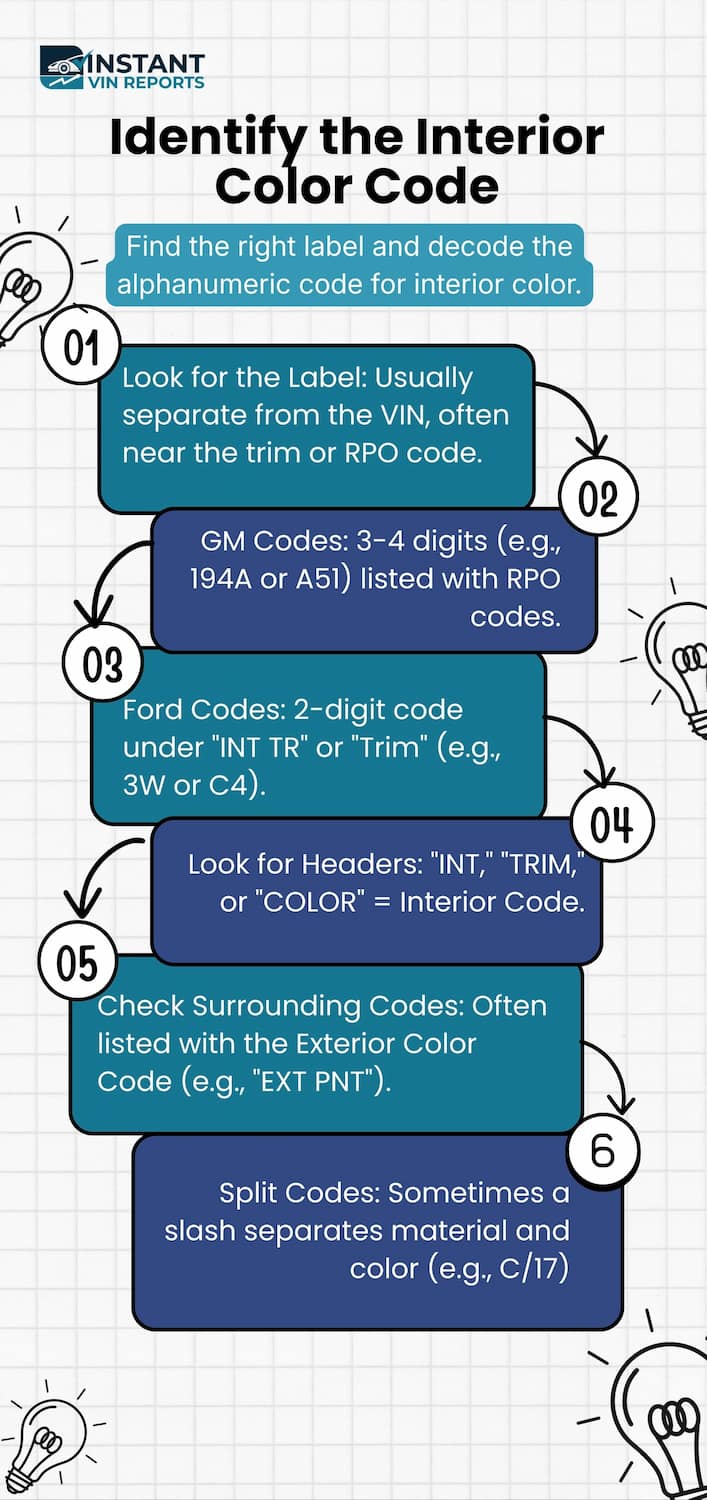
This is often an alphanumeric code that sits separate from the main VIN. This part might be hard to read because every manufacturer has a different format on their labels.
For GM, you're looking for a 3- or 4-digit code listed amongst the RPO codes on the SPID label. It'll often start with an 'A' or 'B' (for trim materials). For example, you might see 194A or A51.
For Ford, the color is often integrated into a two-digit code under the "INT TR" or "Trim" heading, like 3W or C4.
- Look for a header like "INT," "TRIM," or "COLOR." This is the clearest sign that you've found the correct information block.
- Note the surrounding characters. The interior code is almost always listed with the exterior color code, which may be labeled "EXT PNT."
- The code is typically 2 to 4 digits or letters. If you see a long, 17-character number, you're likely just looking at the VIN again.
- Pay attention to any split codes. Many modern cars use a code that lists both the material and the color, sometimes separated by a slash (e.g., C/17).
Read also: How to Look up Vehicle Specs by VIN Number
Decode the Manufacturer's Specific Reference
Finding the code is only half the battle; knowing what T7 or 23C actually means is the real trick. Unlike VIN decoding, which is globally standardized, interior color codes are manufacturer-specific and even model-year-specific.
You'll need a parts catalog or an online color code database that specifically cross-references that 2- to 4-digit code to a plain-language color name (like Pewter, Tan, or Black Onyx).
- Use a reputable VIN decoder tool that includes an option for "Build Sheet" or "RPO Codes" lookup, as these tools often pull the interior data.
- Search for your specific make, model, and year along with the code you found (e.g., 2015 Honda CR-V interior color code YR258L).
- Verify the code against known factory colors. Make sure to check the real name of the color; if the name is vague, like "Gray," it might just be a trim code and not the color itself.
Please be aware of the matter. A code like 194A might mean "Black Leather," while 194B could mean "Black Cloth" for the same year and model; the color is the same, but the material is different.
How to Work Around Missing or Confusing Interior Color Labels?
When you no longer have the window sticker, you will need to find another clue to identify the vehicle's interior color code. If you have the original window sticker or a copy of the build sheet from the dealer, the color and trim are always listed there.
- Look for part numbers: If you find a tag on the seat itself or on a specific panel, the number you find there is likely the part number, not the color code. You can still cross-reference this part number with a dealer to get the color information.
- Factor in wear and fade. The original color may have faded over time, especially with older cloth or vinyl interiors. Bottom line, any replacement part you get might look slightly darker than the existing, faded trim.
Final Thought: Finding Paint Code by VIN
Remember, the VIN is the ID card for the vehicle, but the SPID label or Certification Label is the ID card for its specific factory build details, and that's where the interior color code lives.
Your path is simple: locate the right sticker, find the specific TRIM or INT code, and then cross-reference that code using a reliable database. Buying blind is like revving without oil, a messy end, so make sure you verify this detail before you order those replacement parts.
Get a window sticker and check the door jamb tag before committing to a purchase or ordering any interior components.
FAQ About How to Find Interior Colors
What is the difference between an RPO code and a color code?
RPO stands for Regular Production Option. RPO codes are 3-digit codes that specify all features, while the specific interior color code is just one of the RPO codes on the list.
Can I find the color code by calling the dealership?
Yes, you can. You'll need to provide your VIN to the parts department. They have access to the vehicle's original build data and can pull the exact interior color name and code for you.
Why is my interior trim code two numbers and a letter?
That's a very common format, particularly with Ford vehicles. It's an internal manufacturer code that represents a combination of the material (e.g., cloth or leather) and the actual color hue.
Does a full interior color change show up on a VIN report?
No, it won't. The VIN report only shows the factory-installed color. If a previous owner changed the interior, it won't be reflected, which is why a careful visual inspection is also necessary.