
Check Car Fuel Economy by VIN
Check any vehicle’s fuel economy by VIN before you buy. One quick search shows the real EPA mpg ratings matched to the specific trim and engine configuration.
What is Fuel Economy by VIN?
Fuel economy tells you how many miles a car drives on one gallon of gas. The EPA tests every new vehicle and prints the numbers on its window sticker.
Knowing the estimated mpg by VIN helps you budget for gas, compare cars fairly, and avoid sellers who round up the numbers to make an old car sound cheaper to run.
Why Verify Fuel Economy Ratings before Buying a Used Car
Some used car listings might not always tell the truth about gas mileage. Here are some reasons to verify EPA fuel economy by VIN before you buy.
Accurate Budgeting
Accurate estimated EPA ratings help you plan monthly gas costs correctly, so surprise fuel bills don't wreck your budget after you drive the car home.
Fair Price Comparison
Comparing verified mpg ratings between two cars helps you pick the better deal, instead of trusting a seller's rounded-up fuel economy claims.
Spot Exaggerated Claims
Some sellers boast about mpg the car never actually earned. Checking the VIN reveals the true EPA rating straight from the factory.
Protects Resale Value
Cars with strong, verified fuel economy hold their value better and sell faster, so knowing the real numbers helps your next resale too.
How to Check Fuel Economy by VIN
Checking a car's fuel economy is simple. Just pull up the original window sticker by VIN to view the complete EPA ratings.
Here are the steps to follow:
Enter the VIN
Type in the 17-character VIN, or search by license plate if you're in the US. You can also search using the year, make, and model.
Confirm Vehicle Specs
Get a free preview showing the year, make, model, trim, engine size, and transmission, so you know it's the right car.
Get the Vehicle Window Sticker
Make the necessary payment to download the full window sticker to see EPA fuel economy ratings and other important factory build details for the vehicle.
What Fuel Economy Estimates & Information are Included in the Window Sticker
A window sticker holds more than just mpg numbers. Here's every fuel economy detail you'll find when you check fuel economy by VIN.
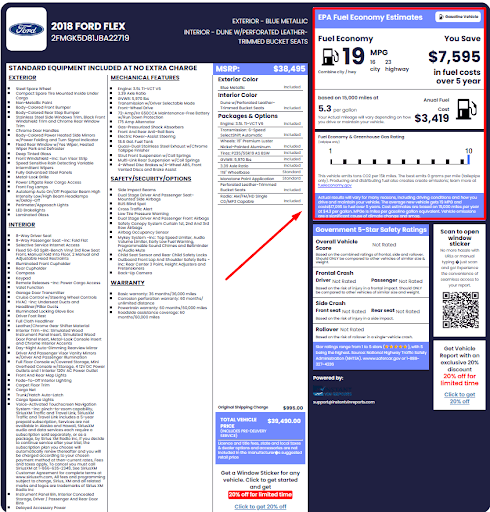
- EPA city MPG rating – how far the car goes per gallon in stop-and-go traffic
- EPA highway MPG rating – mileage at steady, open-road speeds
- EPA combined MPG rating – a blended average of city and highway driving
- Greenhouse gas rating – a score from 1 to 10 based on CO2 output per mile
- Annual fuel cost – estimated cost based on 15,000 miles a year
- 5-year fuel cost savings – how the car compares to an average new vehicle
- Fuel type – petrol, diesel, hybrid, or electric
- Fuel tank size – listed in gallons
Real Story: How Fuel Economy Data Revealed a Seller's Exaggeration
Mark wanted a 2015 Nissan Rogue. The seller said it got the same fuel economy as a 2022 Toyota Corolla Cross, 32 MPG. Before paying, Mark checked and compared the two vehicles’ window stickers. The actual EPA number was 24 MPG, not 32 ❌.
The MPG Numbers Side by Side
Information | 2015 Nissan Rogue | 2022 Toyota Corolla Cross |
|---|---|---|
Combined MPG | 24 | 32 |
Annual Fuel Cost | $2,709 | $2,000 |
Sample Window Sticker |
The gap showed the seller's claim did not match the facts.
How the Window Sticker Helped Him Negotiate
Mark used the real MPG to talk the price down from $11,500 to $11,000 ✅ . He also learned his yearly fuel cost would be $2,709 ⛽, so he could plan.
Why Choose Our Fuel Economy by VIN Tool?
Our VIN lookup tool is built for accuracy and reliability. Here's why buyers and sellers trust Instant VIN Reports for accurate official fuel economy data every time.
Accurate & Trusted Data
We pull detailed vehicle specs and records from trusted sources, so every piece of information stays accurate and reliable.
Easy Window Sticker Upgrade
Easily upgrade in one click to retrieve the complete window sticker with full EPA fuel economy details.
All Brands Supported
From economy cars to luxury SUVs, we support every brand and model on the US roads today.
24/7 Customer Support
Questions about our tool? Our support team is available around the clock to help.
Factors Affecting a Car's Fuel Economy?
Many things affect how many miles your car gets per gallon. Here are key factors that can raise or lower your fuel economy.
Driving Habits
Hard braking, quick acceleration, and speeding all burn extra fuel. Smooth, steady driving keeps your engine running efficiently and can boost mileage noticeably over time.
Vehicle Weight and Aerodynamics
Heavier vehicles and boxy shapes require more energy to move through the air. Extra cargo, roof racks, or towing all add drag and lower fuel economy.
Engine Size and Type
Larger engines and more cylinders often burn more fuel per mile. Smaller turbocharged engines or hybrids typically deliver better fuel economy for everyday driving.
Tire Pressure and Maintenance
Underinflated tires, dirty air filters, and worn spark plugs make your engine work harder. Regular maintenance keeps fuel economy closer to its rated EPA number.
How to Maintain Your Car's Fuel Efficiency?
Small changes in how you drive and maintain your car can add up to real fuel savings. Here are some easy ways to improve efficiency.
Drive Smoothly and Slow Down
Avoid quick acceleration and hard braking, and stick closer to posted speed limits. Steady, predictable driving uses less fuel than aggressive stop-and-go habits, especially on highways.
Keep Up With Maintenance
Regular oil changes, clean air filters, and properly inflated tires all help your engine run efficiently. Skipping maintenance forces the engine to work harder and burn more fuel.
Reduce Extra Weight and Drag
Remove unused roof racks, clear out unnecessary cargo, and avoid unnecessary idling. Less weight and less wind resistance both mean fewer miles lost to wasted fuel.
EPA Fuel Economy for Electric Cars
Electric cars don't use MPG; they use MPGe, or miles per gallon equivalent. The EPA converts electricity use into this familiar unit, treating 33.7 kilowatt-hours as equal to one gallon of gas.
The most efficient EVs on the road today rate near 140 MPGe or higher, far beyond any gas-powered car. You can look up the official EPA fuel economy rating for any EV using our VIN tool.
Choosing the Best Fuel-Efficient Car
Picking a fuel-efficient car takes more than checking one MPG number. Keep the following things in mind before you decide.
- Compare Combined MPG or MPGe Ratings: Look past city or highway numbers alone, and check the combined rating for a true picture of everyday use.
- Think About Your Driving Habits: A hybrid may save more in stop-and-go city traffic, while a diesel could be more efficient for steady highway commuting.
- Factor In Fuel or Charging Costs: Compare local gas prices against electricity rates, since a high MPGe doesn't always mean the cheapest car to actually run.
- Check Long-Term Ownership Costs: Weigh maintenance, insurance, and battery or engine longevity, not just the sticker's fuel economy number, before making a final decision.
Instantly Verify any Car’s Fuel Economy by VIN
Verify the exact EPA fuel economy ratings by getting the window sticker today. Save money at the pump by knowing a vehicle’s estimated MPG before buying!
Frequently Asked Questions About Checking Fuel Economy by VIN
How do I check fuel economy by VIN?
You can check fuel economy by VIN by entering the 17-digit VIN into our VIN lookup tool, then pulling up the vehicle's original window sticker for EPA ratings and other factory features.
Can I find MPG by VIN number?
Yes, you can find MPG by VIN number, since every window sticker records the EPA city, highway, and combined mpg for that exact vehicle.
How accurate is EPA fuel economy data by VIN?
EPA fuel economy data by VIN is highly accurate because it comes from official lab tests the automaker submitted before the car was sold new.
What does MPG by VIN tell me about a used car?
MPG by VIN tells you the exact fuel efficiency the vehicle earned at the factory, helping you spot sellers who exaggerate a used car's gas mileage.
Does a VIN show the original EPA fuel economy rating?
Not really. Decoding the VIN doesn’t directly show the original EPA fuel economy rating, but it can be used to retrieve the window sticker, which provides every MPG rating assigned before the car ever left the factory.
What vehicles have EPA fuel economy data available by VIN?
Most vehicles sold since the mid-1970s have EPA fuel economy data available by VIN, including cars, trucks, SUVs, and hybrids.
Can I check fuel economy for an electric vehicle by VIN?
Yes, you can check fuel economy for an electric vehicle by VIN, though EVs show MPGe and estimated driving range instead of standard gas mileage.
What is the difference between city and highway MPG?
City MPG measures mileage during stop-and-go driving, while highway MPG measures mileage at steady speeds, which is usually higher due to less braking.
How does engine size affect fuel economy?
Engine size affects fuel economy because larger engines burn more fuel per mile, so two trims of the same model can show different mpg.
Why does the same model have different MPG?
The same model can have different MPG because trim level, engine size, transmission, and drivetrain all change how much fuel the car uses.
What is MPGe and how does it compare to MPG?
MPGe measures how far an electric vehicle travels using energy equal to one gallon of gas, letting you compare EVs and gas cars fairly.