
Ferrari VIN Decoder – Decode Classic and Modern Models
Purchasing a used luxury car like a Ferrari requires extra attention. Use Instant VIN Reports’ Ferrari VIN Decoder to check the detailed specifications like engine type, engine info, fuel type, MSRP, and the current market value.
What is a Ferrari VIN Decoder
A Ferrari VIN decoder is a tool that decodes a Vehicle Identification Number (VIN) and shows complete information about the vehicle. By decoding the VIN, you can verify important details such as the model, model year, engine, manufacturing information, and other factory specifications.
For modern Ferraris, the VIN follows the standardized 17-character format introduced in 1981. Earlier Ferrari models often used shorter, manufacturer-specific serial numbers because VIN standards had not yet been established. Instant VIN Reports supports both modern and classic VIN formats.
Why Do You Need to Decode a Ferrari VIN?
Decoding a Ferrari VIN is one of the most important steps to take before you decide to purchase it used. This step is especially important because you need to make sure that the specifications are correct and match the market value.
Verify the Ferrari's Authenticity
A Ferrari VIN decoder helps confirm that the vehicle's identity matches official factory records. Always match the listing description and the seller's claim to actual information.
Confirm Original Factory Specifications
Verifies details such as the model year, engine configuration, body style, transmission, and factory-installed equipment, where optional equipment, limited-production variants, and special editions can significantly influence value.
Protect Your Investment
Ferraris often command premium prices. Decoding the VIN helps ensure the vehicle's specifications align with its market value.
Make a More Informed Purchase
Access to verified factory specifications and market value insights allows you to evaluate the vehicle with better accuracy, especially when you plan to purchase the car from a private dealer.
What Information Can Be Obtained From a Ferrari VIN Decoder?
Our free Ferrari VIN decoder supports both modern and many classic Ferrari VIN formats, helping you verify factory specifications and identify details about the car.
Manufacturer
View the manufacturer and production details.
Vehicle Origin
Verify where the Ferrari was manufactured and assembled.
Model Type & Year
Examine the actual model type and year.
Engine Specifications
Access engine information such as configuration, displacement, and fuel type.
Transmission Setup
Check if the vehicle has a manual or automatic transmission.
Body Style
Identify the body configuration, including Coupé, Spider, Targa, or other body styles.
Trims
Check the exact trim level and factory-equipped features.
MSRP & Market Value
Compare the MSRP with the motorcycle's current estimated market value.
How to Use the Ferrari VIN Decoder
To use the Ferrari VIN decoder is easy, you just need to follow these simple steps and get he result in under a minute.
Enter the VIN
Click the form above and write the VIN of any classic or modern Ferrari model.
Submit the Form
Then, click on the button to submit the form.
Check the Vehicle Specs
Check the preview page to see the complete vehicle’s specifications, like engine, transmission, model year, and country of origin.
How to Read Ferrari Modern VIN
A modern Ferrari VIN has 17 digits of code consisting of numbers and letters. These codes are classified into three different categories: WMI, VDS, and VIS. Take a look at the example below to see how to read a modern Ferrari VIN.
World Manufacturer Identifier (WMI)
Digits 1 to 3 = ZFF
- Z = Country of origin (Italy)
- FF = Ferrari
Vehicle Descriptor Section (VDS)
Digit 4 to 9 = 89FPA0
- 8 = Model line (V8 mid-engine platform)
- 89 = Model code (likely Ferrari F8 Spider)
- F = Body type/engine indicator
- P = Restraint/safety system type
- 0 = Check digit
Vehicle Identifier Section (VIS )
Digit 10 to 17: M0259265
- M = Model year (2021)
- 0 = Assembly plant in Maranello
- 259265 = Production sequence number
Decoding Classic Ferrari VIN
On the other hand, the classic Ferrari VIN has fewer than 17 digits. Take a look at the section below to see how to read a classic Ferrari VIN.
Sample VIN: 06978
Model Series
Digits 1–2: 06
06 = Dino 246 Series
Chassis Number Section
Digits 3–5: 978
978 = Sequential chassis number
Vehicle Identification
Chassis 06978
1973 Dino 246 GTS
Where to Find the VIN on a Ferrari?
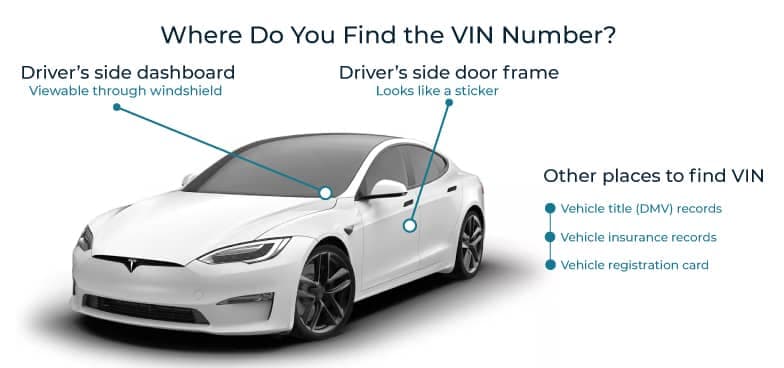
Most Ferrari VIN locations follow the same “common sense” pattern as other cars. Start where it’s easiest to see through the glass, then move to the door area, and then check the documents.
- Driver’s side dashboard (visible through the windshield): Usually the quickest spot to check when you’re standing outside the car.
- Driver’s side door jamb/door pillar label: Common on modern vehicles for ID and build labels.
- Under the hood/engine bay area: Some vehicles display VIN labels or plates in the engine compartment.
- Vehicle documents: Title, registration, and insurance paperwork also list the VIN.
- Frame/front-end areas (vary by vehicle): Some VINs can appear on frame sections depending on design and regulation.
Need More Than the VIN? Get a Ferrari Vehicle History Report
A Ferrari VIN decoder helps verify the vehicle's original factory specifications. However, a full Ferrari vehicle history report shows more information, such as ownership records, title history, accidents, and other records.
Vehicle Specifications
Review Ferrari's original factory configuration, including the model, engine type, body style, drivetrain, manufacturing details, fuel system, and other specifications.
Ownership History
Access ownership records, including the number of previous owners, registration history, and ownership duration. Personal information, such as names and addresses, is not included in the report.
Title Status & Branding Records
Check the legal status of the vehicle's title to determine whether it has ever been issued a clean, salvage, rebuilt, flood, junk, or other branded title.
Lien & Financial Records
Verify whether any financial institution currently holds, or previously held, a lien against the vehicle. This helps ensure the car can be transferred without unexpected financial obligations.
Theft & Recovery Records
Search available databases to determine whether the Ferrari has ever been reported stolen or recovered. When available, reports include incident dates, locations, and record sources.
Safety Recall Information
Review manufacturer-issued and regulatory recall information associated with the VIN, including affected components, recall dates, and available repair status.
Service & Maintenance History
A high-performing car like a Ferrari must be serviced regularly to make sure it performs at its best. Check the report to see details like date, location, and kind of service it has had.
Accident & Damage History
Review reported incidents involving the vehicle, including collision damage, flood damage, fire, hail, or structural repairs. Available records show dates, locations, and severity information.
Odometer Readings & Mileage Timeline
Track recorded mileage over time to identify consistent usage patterns and detect potential discrepancies. Unusual gaps or unexpected decreases may warrant further investigation before purchase.
Auction & Sales Records
Check if the vehicle has ever been sold at an auction. See the auction date, location, title, and the final price of the car. You’ll also get up to ten photos of the vehicle during the auction.
Free Ferrari VIN Decoder vs. Paid VIN Check
The Ferrari VIN decoder comes at no cost. However, if you need to get deeper insight, such as its records on accidents, auctions, damage, previous ownership, and the complete odometer history, you can use our paid VIN check.
Feature | Free VIN Decoder | History Report (Paid) |
|---|---|---|
VIN decoding for all vehicle types | ||
Year, make, model, trim | ||
Full vehicle specifications / detailed car specs | ||
Market value snapshot | ||
Sales listings (current/online ads) | ||
Sales history (timeline of past listings/sales) | ||
Auction records (when available) | ||
Auction history with photos | ||
Mileage during auction/sales (when available) | ||
Odometer rollback checks | ||
Ownership history | ||
Vehicle usage type (personal, fleet, rental, commercial) | ||
Title brand records (salvage, rebuilt, flood, lemon, etc.) | ||
Lien & loan records | ||
Accident & damage history | ||
Theft / stolen records | ||
Flood/hail/fire damage checks | ||
Service/repair records | ||
Warranty status & coverage | ||
Recall information |
How Does a Ferrari VIN Decoder Help a Buyer
Emilia wanted to purchase a used 2021 Ferrari Portofino from a private seller in Manhattan. The car looks nice, and it shows a little bit of scratches on its body; however, the salesman insists that it has no additional bad record.
First Impression
Emilia examined the car and found a little scratch. After negotiating with the seller, the seller agreed to lower the price. However, she decided to run a quick check to see its records.
What Emilia Sees on the Report
After she downloaded the Ferrari history report, this is what she saw on the report.
- The car has an odometer rollback
- 1 specific event reported
- 1 sales record
- 5 lien or loan record
The Outcome
Emilia decided not to purchase the car because it has additional bad records that the seller refuses to disclose.
Why Use Instant VIN Reports to Decode a Ferrari VIN?
Instant VIN Reports helps Ferrari owners, buyers, sellers, and collectors quickly verify important vehicle information in one place. Be sure to thoroughly research the car with a trusted service like Instant VIN Reports.
Frequently Updated Data
Vehicle information is regularly updated using trusted automotive databases like Vehicle Databases.
Valuable Price
The Ferrari VIN decoder is completely free to use. If you need more insights, use our VIN check tool.
24/7 Customer Support
Our support team is available around the clock to assist whenever needed.
Fast Results
Enter the Ferrari VIN to access specifications, market value, and vehicle records in less than a minute.
Who Can Benefit From the Ferrari VIN Decoder?
Whether you're purchasing a Ferrari, selling one, managing an exotic car inventory, or verifying the authenticity of a collector vehicle, a Ferrari VIN decoder provides valuable information that supports more informed decisions.
Buyers
Verify the vehicle's model, year, engine, body style, factory equipment, and other original specifications before completing a purchase. VIN decoding also helps confirm that the Ferrari matches the seller's description.
Sellers
Provide verified vehicle information to prospective buyers, helping increase transparency, strengthen buyer confidence, and support a smoother sales process.
Dealers & Exotic Car Brokers
Quickly verify Ferrari specifications, confirm inventory details, evaluate trade-ins, and ensure vehicles are accurately represented before being offered for sale.
Ferrari Collectors
Authenticate rare, limited-production, and classic Ferrari models by verifying factory specifications, production details, and other information that contributes to provenance, originality, and collector value.
Restoration Specialists
Access original factory build information to help preserve authenticity and ensure restoration work remains faithful to the vehicle's original configuration.
Insurance Companies & Vehicle Appraisers
Decode the VIN to obtain correct information to support vehicle valuations, underwriting decisions, claims assessments, and documentation requirements for high-value and collectible Ferrari vehicles.
Decode Modern and Classic Ferrari VIN
Our report can be used to decode the modern and classic VINs of Ferrari vehicles.
| 360 Modena | 456m | 575m | Enzo | Challenge Stradale |
| 612 Scaglietti | F430 | 599 GTB Fiorano | California | 458 Italia |
| 458 Spider | FF | 125 S (1947) | 166 Inter (1948) | 212 Inter (1951) |
| 250 GT California Spyder (1957) | 250 GT Berlinetta (1958) | 250 GTO (1962) | 275 GTB/4 (1966) | 365 GTB/4 "Daytona" (1968) |
FAQs on Ferrari VIN Decoder
How do I decode my Ferrari VIN for free?
To decode the Ferrari VIN for free, you can use a free Ferrari VIN lookup tool by Instant VIN Reports. Enter the VIN and review the identity basics. For deeper history (title brands, mileage records, liens), you can upgrade to the full report when needed.
Where is the VIN located on a Ferrari supercar?
To locate the VIN on a Ferrari supercar, you can start at the driver-side dashboard area near the windshield, then check the driver door jamb label and the vehicle paperwork. Use Instant VIN Reports after you find it to confirm the VIN is readable and valid.
What information can I get from a Ferrari VIN number decoder?
Instant VIN Reports helps confirm a Ferrari’s identity and screen for potential risks using VIN-linked records like title brands, mileage records, lien flags, theft indicators, and sales or auction history when available. It gives buyers and collectors an early warning system before deeper inspections or documentation review.
How do I find my Ferrari’s production number using the VIN?
To find the Ferrari’s production number using the VIN, you can look at the last part of a modern VIN, which includes a serial sequence assigned by the manufacturer. Instant VIN Reports can show the VIN’s structure and serial portion, but an “exact production number in the model run” is not always publicly available from the VIN alone.
Can I get Ferrari factory options and special series information from the VIN?
Yes, you can get Ferrari factory options and special series information from the VIN. With Instant VIN Reports, by decoding the VIN, then use documentation, build sheets, or official records for option-level confirmation.
How can I tell what engine and transmission my Ferrari has from the VIN?
To find the engine and transmission your Ferrari has from the VIN, you can use Instant VIN Reports for the decoded structure, then confirm using build documentation, service records, or a professional inspection. Because a VIN can hint at configuration, but exact engine and transmission details are not always fully exposed in public VIN decoding.
Does Ferrari have different VIN systems for different markets?
Not really. The VIN standards are broadly structured, but manufacturers may encode details differently depending on market rules and production practices. If you are dealing with imports or classics, Instant VIN Reports helps by supporting modern 17-digit VINs and many older pre-1981 formats.
Which Ferrari models are considered classics?
Ferrari's classic lineup spans some of the most celebrated sports cars ever produced, from legendary grand tourers of the 1950s and 1960s to limited-production supercars introduced in later decades. Models such as the 250 GTO, 250 GT California Spyder, 288 GTO, and F40 are highly sought after for their rarity, engineering excellence, motorsport heritage, and enduring collector appeal.
How to check a Ferrari VIN?
Checking a Ferrari VIN begins by locating the vehicle's 17-character VIN, which is typically found on the dashboard, driver's door jamb, or within the engine compartment. Once identified, the VIN can be decoded using a trusted Ferrari VIN decoder or vehicle history service to verify the vehicle's identity, factory specifications, production details, and available history records.
How to decode a classic car VIN number?
Decoding a classic Ferrari identifier requires a different approach than decoding a modern VIN. Before the 17-character international VIN standard was introduced in 1981, Ferrari used manufacturer-specific chassis or serial numbers that varied in both length and format. Interpreting these earlier identifiers typically requires specialized Ferrari references or a decoder that supports classic VIN formats.