


Finding the title number on a car is easy; you may find it on the vehicle's certificate of titles, vehicle registration, and renewal document, or at the local DMV of the state where you live. If the title number is lost, you can find the title number on the insurance or loan documents, or you may also request a duplicate form from the DMV.
A title number is crucial to confirm ownership, helps prevent fraud, tracks liens and records, and is required for legal transfers, registration, and insurance.
Key Takeaways
- The original Certificate of Title is the first place to look; the number is usually clearly labelled in the upper half of the document, often under "Title No."
- The VIN identifies the vehicle; the Title Number identifies the specific document recording ownership and liens, and a new one is often issued with a change in ownership or lien status.
- Decode the VIN to find out the vehicle's title before you decide to purchase it.
What is a Title Number? Is it Different With the VIN?
We all know the Vehicle Identification Number, or VIN; it's the car's unique fingerprint, a 17-character code stamped right into the metal. But when it comes to the legal act of selling, transferring ownership, or sorting out lien issues, what the states require is the vehicle's title number.
A title number is the unique identifier for the paper document itself, the Certificate of Title, and it's what keeps the whole chain of custody honest. Honestly, after decades of digging through these documents, we've learned that checking this number is your bedrock of due diligence.
The Title Number Complication in Each State
The complication is that finding this number isn't a standardised process. The title number might be 7 digits in one state and an 11-character alphanumeric string in another. It might be called a "Control No." in Alaska or simply a "Document Number" in Texas.
That said, knowing where this number lives is non-negotiable for a smooth transaction. This deep dive will ensure you're looking in the right spot, no matter where your paperwork originated.
Find the Title Number on Your Certificate of Title
If you have the physical Certificate of Title in hand, you are starting in the best possible position. This document is the legal core of your vehicle's ownership, and the state-issued title number is printed directly on it for tracking. Secure this document; keep it in a safe deposit box or a fireproof safe, not in your glovebox, where it's vulnerable to theft.
How to Find the Title Number?
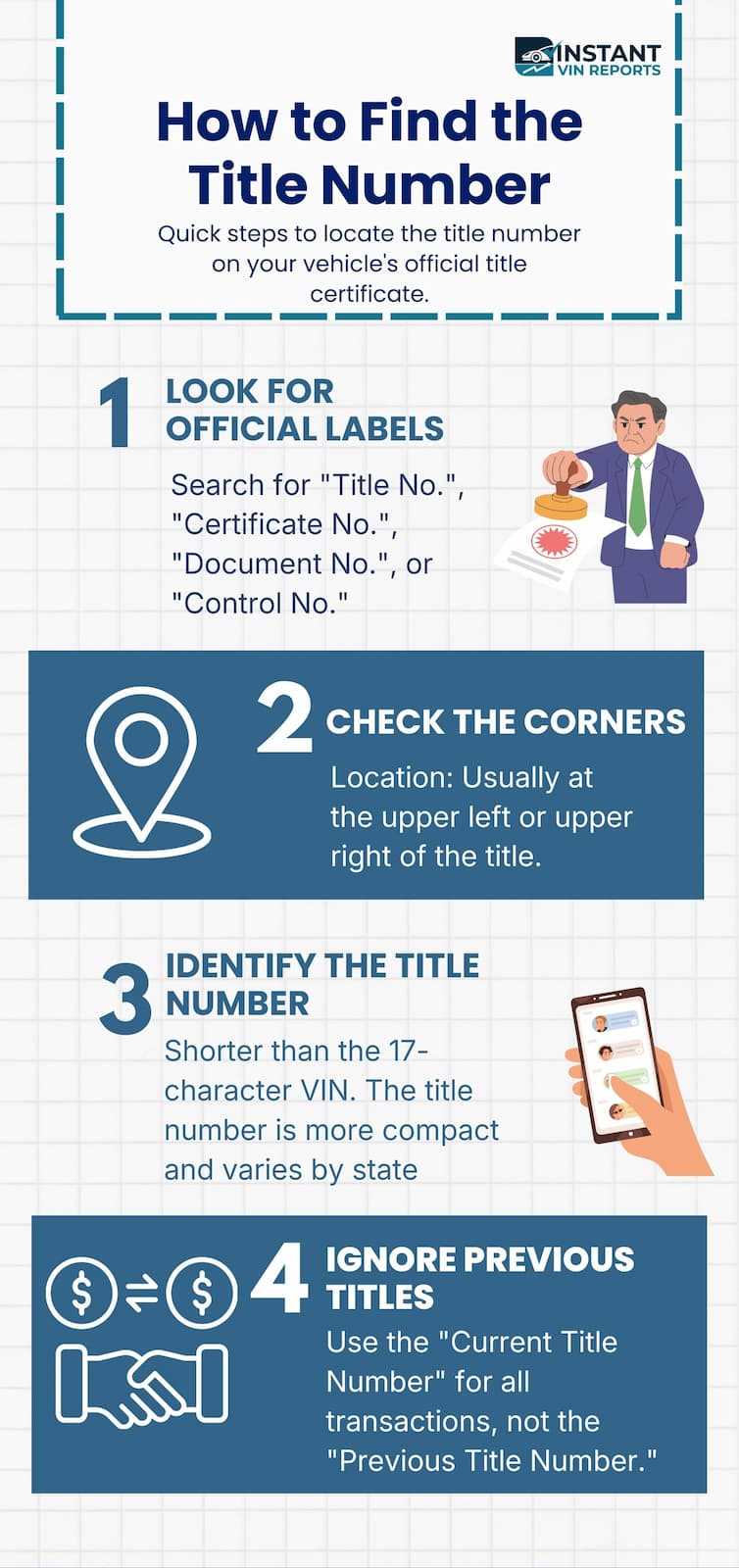
Finding the title number is easy. Look at the official title certificate and follow the instructions:
- Look for Official Labels: Search for fields marked specifically as "Title No.," "Certificate Number," "Document Number," or sometimes the slightly older "Control No." or "Title/Document Number."
- Focus on the Corners: In the vast majority of states, this number is situated in a high-visibility location, typically the upper left or upper right section of the document, often near, but distinctly separate from, the VIN field.
- The Length Difference is Key: If you see a 17-character code, that's the VIN. The Title Number will be a shorter, more compact series of numbers and letters, varying widely by state.
- Beware of Old Data: Pay close attention if your title lists a "Previous Title Number." This field tracks the document before the current one, which is useful for historical records, but for any current transaction, you must use the one labelled Current Title Number.
Read also:How Car Report Services Protect Car Buyers from Buying Lemons
Did You Know?
Title numbers are critical for catching fraud. Sometimes, the odometer discrepancy wasn't the first flag; it was a suspiciously new title number on an old vehicle, indicating the owner had applied for a "duplicate" title just to try and wash the odometer reading during the new print.
Check Backup Documents: Registration and Renewal Slips
Most responsible owners keep their title stored safely away. If you need the number quickly, perhaps for an insurance claim or a quick registration renewal, your vehicle registration card or the annual renewal notice from the state is your next best bet.
Checking the Registration Documents
- Look for "Document" or "Control": On the registration card, the title number is frequently listed under a generic heading such as "Document Number," "Control Number," or sometimes simply "ID Number." It may also be near the VIN and the license plate number grouping.
- The Renewal Notice Trick: Since this data is pulled directly from the state's title database, the title number is often printed here to simplify the renewal process.
- Insurance Papers: Give your policy paperwork a look, or call your agent. It's a long shot, but worth checking before you start calling the DMV.
It's important to remember that not every state includes the title number on the registration card. They figure you have the title somewhere.
Finding the Vehicle's Title Number in Each State?
Every state's DMV handles its vehicle documents slightly differently, and this variation is where buyers and sellers often stumble. We've compiled a list of different state title placements below:
| State / Region | Title Number Name | Key Identification Detail |
|---|---|---|
| Most States (TX, GA, FL, CO, etc.) | Title No., Certificate Number, Control No. | Clear numeric/alphanumeric code near the top. |
| California (CA) | N/A (No dedicated number) | Use the Title Issue Date (YYYYMMDD format). A title dated 05/27/2018 is entered as 20180527. |
| New York (NY) | N/A (No dedicated number) | Often uses the Plate Number and Year of Issue for a national database cross-reference. |
| Arizona (AZ) | Title Number | Be sure not to use the "Previous Title Number" or the "Film Number." |
| New Jersey (NJ) | Control Number | It's often an 11-character string preceded by a 2-letter prefix, typically in the bottom right. |
When an out-of-state buyer or a financing company asks for the title number, they are asking for the specific format that ties to the physical document in your state's database.
Read also:What Is a Branded Title Vehicle? Find Out if Your Car Is Safe
The Last Resort: Retrieving the Number from the DMV
If your title is lost, damaged, or held by a lienholder, you will have to go through the state system. Don't panic; this is a common occurrence. You have the option to pull the data directly from the governmental source.
Steps for DMV Retrieval When Paper is Lost
If the title paper is missing, the DMV can issue a replacement. You'll need to provide identification, basic vehicle details, and sometimes a small fee. Once the request is processed, the DMV will send a new copy so you can continue with registration or ownership tasks.
Start with the Online Portal
Many state DMVs have an online records lookup tool. You can often enter your VIN and license plate number and sometimes your driver's license number for verification, to view basic vehicle data, including the current title number. Be ready to pay a small processing fee.
Call the Regional Service Centre
If the online service is vague, call your local DMV office. You must provide the VIN and, crucially, verify that you are the registered owner.
The Duplicate Title Route
If the title is truly missing, you must apply for a duplicate or certified copy. This is done by completing an Application for Duplicate Title (the form name varies by state; for example, it's Form VTR-34 in Texas).
- Required Items: You will need your VIN, owner details, and a valid photo ID. If you have a lien, the lienholder often needs to sign the application or request the duplicate themselves.
- The Wait Time: States like New York or Texas will print the new title in a secure facility and mail it to you, which usually takes 7-10 business days. The new paper title will arrive with the current, valid title number clearly printed on it.
Title Number and Its Role in Liens
A critical point we often see overlooked is how the title number changes when a loan is involved.
Title Number and the Lienholder
Lien Recorded
When you take out a loan, the lender becomes the Lienholder. The state issues a title (often an electronic title, or e-title) that lists the lienholder. This act typically generates a new title number to track the updated document that now includes the financial interest.
Lien Released
Once you pay off the loan, the lienholder sends the state a Lien Release. The state then issues a new title, physically or electronically, removing the lienholder's name. This transition usually triggers the issuance of another new title number because the ownership status has fundamentally changed.
The Buyer's Protection
As a buyer, if you see a title number that is only a few weeks old on a car that hasn't been recently sold, that's a flag to check the lien status. It often means the owner just paid off their loan and received the clean title, which is fine, but you must verify the lien is properly recorded as satisfied and removed from the state's system.
Read also: Common mistakes to avoid when buying a car in 2025
Title Number Mistakes to Watch Out For
A title number may look simple, but small slips can create problems with ownership or paperwork. Here are issues people often run into:
- Skipping Ownership Updates: Make sure the title details are changed after a sale or purchase.
- Missing Lien Checks: A clean-looking title can still have an active lien, so always confirm with a VIN or title search.
- Overlooking State Rules: DMVs across states use different formats and steps, so check the requirements where you live.
- Misplacing the Paper Copy: Keep the original title in a safe spot because some procedures still need the physical document.
Conclusion on Where to Find the Title Number
Whether you are selling, registering, or updating your insurance, it's important to know where the title number is. Start by checking the original Certificate of Title, then look at your registration card or insurance papers. If you can't find it, contact the DMV for a certified copy. Don't let a missing title number delay your plans to register or to sell the vehicle.
FAQ About Where to Find the Title Number?
Is the Title Number the same as the VIN?
No, absolutely not. The VIN is a unique 17-character code stamped on the car that identifies the vehicle itself. The title number is a shorter, state-issued number that identifies the specific Certificate of Title document.
What should I do if my title is lost or destroyed?
You must apply to your state's DMV for a duplicate or replacement title. You'll need to provide the VIN and proof of identity, and you will receive a new physical document with the current title number.
Can I find the Title Number on my insurance card?
It's rare, but possible. Most insurance policies only require the VIN. Call your agent; they might have the title number on file, as some states or lenders request it for comprehensive coverage paperwork.
What is the "Issue Date" used for in California titles?
Since California doesn't use a standardized title number, its systems and national databases often substitute the Issue Date of the title in the format YYYYMMDD (e.g., 20250115) when a title number is requested.
Why does my title number change?
The title number changes whenever a new Certificate of Title is issued by the state. This commonly happens after an ownership transfer, when a lien is added or removed, or if you apply for a corrected or duplicate title.