To decode the VIN, you can use an online VIN decoder tool like Instant VIN Reports. When you use the online VIN decoder, you'll get the detailed information about the vehicle, including the accident report, auction history, and even the real odometer reading.
On the other hand, you can do a manual decoding by checking the VIN, each digit one by one. The first three digits identify the manufacturer and country of origin. Digits 4-9 outline the vehicle features, such as the engine and body style. The 10th digit shows the model year, while the last six digits (12-17) serve as the vehicle's unique serial number.
Key Takeaways
- Every VIN is broken into three main sections: the WMI, VDS, and VIS, which identify the manufacturer, vehicle characteristics, and production details, respectively.
- To check the vehicle's serial number, check the last six digits (12-17).
- Decode the VIN and get the vehicle history report to find out what has happened to it, like accidents or title issues.
What is a VIN Number?
The Vehicle Identification Number, or VIN, is an identifier of a car. It's a unique identifier assigned by the manufacturer and permanently affixed to the vehicle. Every car, truck, and motorcycle has one, and by law, no two vehicles can share the same VIN-even though they have the same year, make, model, and trim.
It's a standardized 17-character sequence of letters and numbers, a system put in place globally back in 1981. Before that, the VIN only consisted of 5 to 14 digits, and sometimes, different manufacturers had different VIN lengths before it was standardized.
Where to Find the VIN?
The VIN is usually placed in a few spots, sometimes stamped into the metal, sometimes printed on a sticker that is placed on the driver's door or dashboard. You can check on the vehicle's paperwork and on the owner's manual.
Common VIN Locations to Check
Here's the location where you can check where the VIN is located.
Dashboard (Driver's Side)
Look through the windshield on the driver's side where the dash meets the glass. This is the most common and easiest spot.
Driver's Side Door Jamb
There's a sticker or plate, usually where the door latches, that lists manufacturing information and the VIN.
Engine Block/Firewall
Open the hood, then examine the engine block as the VIN is usually stamped on it.
Official Documentation
Aside from finding the VIN on the vehicle's body. You can find the VIN on the vehicle registration, title documents, service records, insurance cards, and the owner's manual.
How to Decode the VIN By Digits
Knowing how to decode a car VIN is all about breaking the 17 characters into three distinct sections. Think of it as reading a highly detailed code, where each position answers a critical question about the vehicle's birth.
Let's use a sample VIN for illustration: 1C4HJXEG2MW503370.
Characters 1-3: WMI (World Manufacturer Identifier)
The first three characters tell us exactly who made the car and where they're based. It's the global stamp of origin.
Character 1 (Country of Origin)
Identifies the country where the vehicle was assembled. (e.g., '1' or '4' for the United States, 'J' for Japan, 'W' for Germany).
Character 2 (Manufacturer)
Identifies the specific vehicle manufacturer. (e.g., 'C' for Chevrolet, 'H' for Honda).
Character 3 (Vehicle Type/Division)
Designates the vehicle type or manufacturing division.
Characters 4-8: VDS (Vehicle Descriptor Section)
This is the technical heart of the VIN. These five characters describe the physical attributes and inner workings of the vehicle. This is where you verify that the engine under the hood actually matches what the factory installed.
- Body Type and Series: Details the model, series, or trim level (like a sedan, SUV, or pickup).
- Engine Type: Specifies the engine size and fuel type (crucial for buying the right parts later).
- Transmission and Safety Systems: It can denote features like airbags, restraint systems, and transmission type.
Character 9: Check Digit
The ninth digit is a mathematically calculated value based on all the other characters in the VIN. If someone tries to re-stamp a VIN or switch a few numbers, the check digit will usually be wrong, immediately flagging the VIN as invalid or cloned.
Characters 10-17: VIS (Vehicle Identifier Section)
The final eight characters, the Vehicle Identifier Section, are used by the manufacturer to identify specific factory details and the sequential order in which the vehicle rolled off the assembly line.
Character 10 (Model Year)
This is one of the most critical pieces of data for buyers. It tells you the exact model year (not the calendar year it was built).
Character 11 (Assembly Plant)
Identifies the specific factory where the car was assembled.
Characters 12-17 (Production Sequence Number)
This is the unique sequence number of the vehicle's production. It's what makes the VIN truly unique.
Back in '09, we caught 3,200 rolled-back odometers in one quarter alone, and a quick check of the sequence number against known production data was often the first hint that something wasn't right.
How to Decode a VIN with an Online VIN Decoder
You know, you can decode a VIN by using an online VIN decoder tool and get the vehicle history report, where you can find the necessary information about the vehicle, like the specifications, MSRP, records, and other information.
Find the VIN
First of all, you will need to find the VIN of the vehicle you are checking. Examine the driver's side doorjamb or the bill of sale.
Go to an online VIN Decoder
Go to the VIN decoder page, click on the form, and write down the VIN. Wait for a few seconds to get the report generated.
Get the Report
After it's done, you will need to check the preview page. Then, you may proceed to payment to get the full vehicle history report.
VIN to Year Chart Reference
Character 10 in the VIN indicates the model year. Since 1981, it alternates between letters and numbers, excluding certain letters to avoid confusion with numbers.
| Character (Position 10) | Model Year | Character (Position 10) | Model Year |
|---|---|---|---|
| A | 1980 | T | 1996 |
| B | 1981 | V | 1997 |
| C | 1982 | W | 1998 |
| D | 1983 | X | 1999 |
| E | 1984 | Y | 2000 |
| F | 1985 | 1 | 2001 |
| G | 1986 | 2 | 2002 |
| H | 1987 | 3 | 2003 |
| J | 1988 | 4 | 2004 |
| K | 1989 | 5 | 2005 |
| L | 1990 | 6 | 2006 |
| M | 1991 | 7 | 2007 |
| N | 1992 | 8 | 2008 |
| P | 1993 | 9 | 2009 |
| R | 1994 | A | 2010 |
| S | 1995 | ... and so on |
Read also: Importance of Accurate Car Reports to Used Car Buyers
What Information Can You Get From a VIN
When you decode a vehicle VIN, you will get a vehicle history report that shows you the detailed information of the vehicle, like the specifications and records like accident, auction, mileage, warranty records, and many more.
- Make, Model, and Trim: The precise vehicle name and trim level (e.g., Ford F-150 Lariat).
- Engine Size & Type: Verification of the powertrain installed at the factory.
- Body Style: Sedan, coupe, convertible, etc.
- Factory-Installed Safety Systems: Confirmation of airbags or ABS type.
- Production Year and Plant Location: The model year and where it was built.
- Accident History: Check if the vehicle was ever involved in an accident.
- Mileage History: Our report highlights the detailed mileage record of the vehicle from the first time it was driven
- Auction History: Check if the vehicle was sold at auction, also you can also check if the vehicle was ever sold at an auction. Also, get up to ten pictures of the vehicle's condition during the auction.
Read also: Where Can I Find My VIN Number Online Without a Car
Why Decoding a VIN Is Important
The simple truth is, decoding a VIN is the first step in protecting your investment. Buying blind is like revving without oil; it's going to end messily.
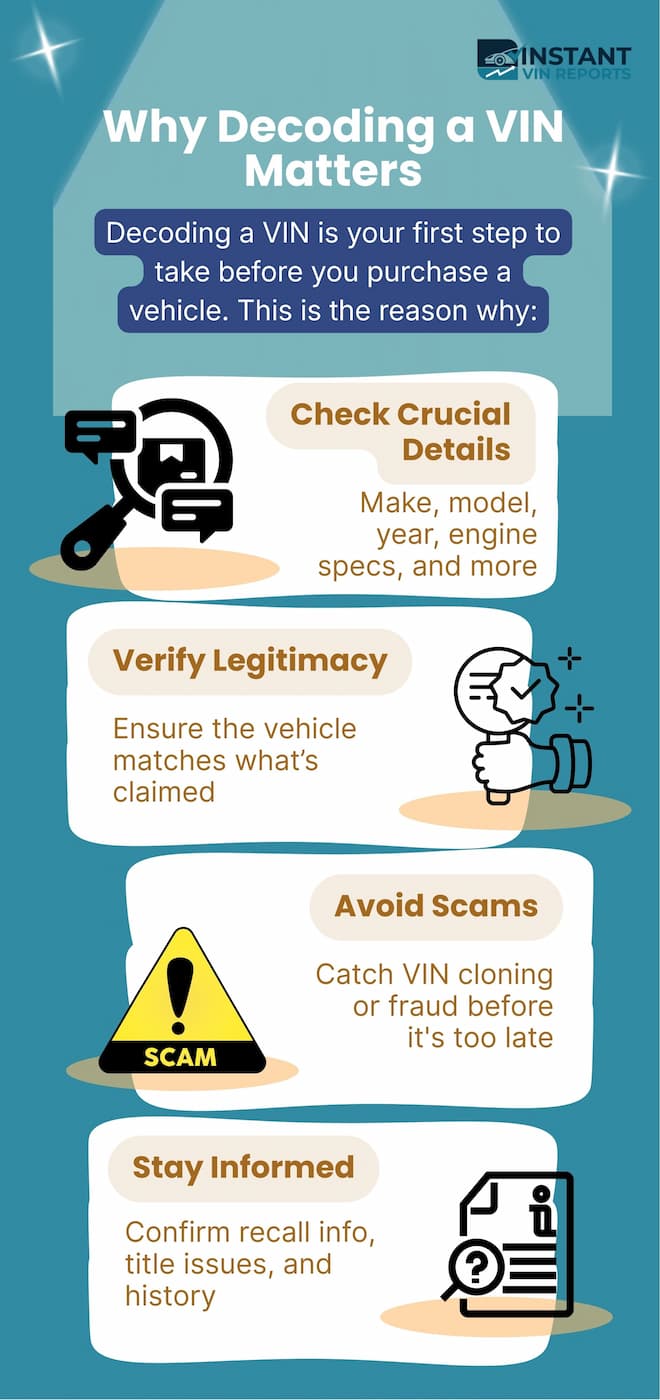
- Verifying Vehicle Legitimacy: Do the specifications and last recorded mileage match the seller's claim? Check the vehicle's specifications and the last recorded mileage on the vehicle.
- Spotting Fraud or VIN Cloning: If the decoded information (e.g., it decodes as a sedan, but you are looking at a truck) does not match the physical car, it is better to find the other vehicle/
- Matching Engine Type When Buying Parts: You must know the exact engine code when buying anything from a filter to a water pump.
- Ensuring the Correct Model Year: Title washing often targets model years. Character 10 is the objective truth.
- Checking Recalls: Manufacturers issue recalls based on VIN ranges, not just model years.
Read also: How to Check Market Value of Salvage Cars
Why Knowing How to Decode a VIN is Crucial?
Knowing how to decode a VIN is one of the important steps you need to take before purchasing a used vehicle. It's the difference between driving off in a vehicle that matches its paperwork and one that hides a history of issues. Check the VIN and then get that history report. Don't let a clean title hide bigger issues. Trust the code, and trust your instincts.
FAQs About How to Decode the VIN
What do the 17 digits of a VIN mean?
They are grouped into three main sections: the WMI (manufacturer and country), the VDS (vehicle characteristics and features), and the VIS (model year, plant, and production sequence).
Can two cars have the same VIN?
No. The last six digits are the unique production sequence number, meaning no two vehicles rolling off the assembly line will ever have the exact same 17-digit VIN, making it a true fingerprint.
Is it free to decode a VIN?
Yes. You can use free online decoders to break down the factory-installed specifications, but a full vehicle history report to check for accidents or title brands is generally a paid service.
Why do older cars have shorter VINs?
Before 1981, the VIN system wasn't standardized. Manufacturers used various formats and lengths, which is why older classics often have VINs that are fewer than the current standard of 17 characters.
Can a VIN tell me if a car is stolen?
Yes, a VIN is crucial to check the car's stolen status, especially through an online VIN check tool like the Instant VIN Report. It helps you check the VIN and get the vehicle report, where you can see if the vehicle was stolen or has its VIN swapped. Always check the VIN in multiple locations and cross-reference with official reports like registration title or bill of sale.
What if my VIN is not 17 characters?
If the vehicle was made before 1981, a shorter VIN is normal. If it's a newer car and the VIN is short or contains unusual characters, that's a serious red flag for potential fraud.