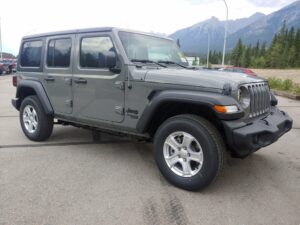


A high-profile vehicle is basically any vehicle that sits tall and presents a lot of side area to the wind. That includes a lot of SUVs, pickup trucks, vans, RVs, buses, and vehicles towing large trailers.
They behave differently on the road, especially when wind or sudden steering comes into play. Their height and large side panels allow wind to push them more easily, increasing stability risks.
While these vehicles offer space, visibility, and capability, they also come with trade-offs. Understanding what makes a vehicle “high profile,” you’ll drive it smarter and buy it with fewer surprises.
Key Takeaways
- High-profile vehicles are tall, boxy trucks, SUVs, RVs, vans, and trailers with large sides that catch more wind and pose a higher rollover risk.
- Strong crosswinds and abrupt steering can destabilize these vehicles more quickly than low-profile cars. Check the window sticker on your vehicle for its weight and configuration to drive it safely.
- Before buying a used high-profile vehicle, check the vehicle history report for accident damage, title brands, or modifications that could affect stability, insurance costs, and safety.
What is a High Profile Vehicle? Definition and Meaning
If you have to step up to get in rather than sit down, you’re likely dealing with a high-profile vehicle. These vehicles are defined by height relative to width and weight, not by a single legal measurement.
There isn’t a single height or measurement where a vehicle suddenly becomes “high profile.” In practice, agencies and insurers look at the whole picture, including size, weight, balance, and how the vehicle actually behaves in wind or emergency situations. Those traits make trucks, vans, and RVs more vulnerable to stability issues than low-profile cars.
Key Characteristics That Define a High Profile Vehicle
The definition of a high-profile vehicle isn’t just a label on a highway sign; it’s a direct result of several engineering compromises and physical characteristics. When we inspect a vehicle for its suitability as a safe hauler or reliable family transporter, we’re checking these core traits. Ignoring them is like ignoring a cracked manifold; you’ll pay for it eventually.
Height, Cross-Section, and Center of Gravity
This is where the rubber meets the road, quite literally. High-profile vehicles inherently have physics working against them, especially under pressure.
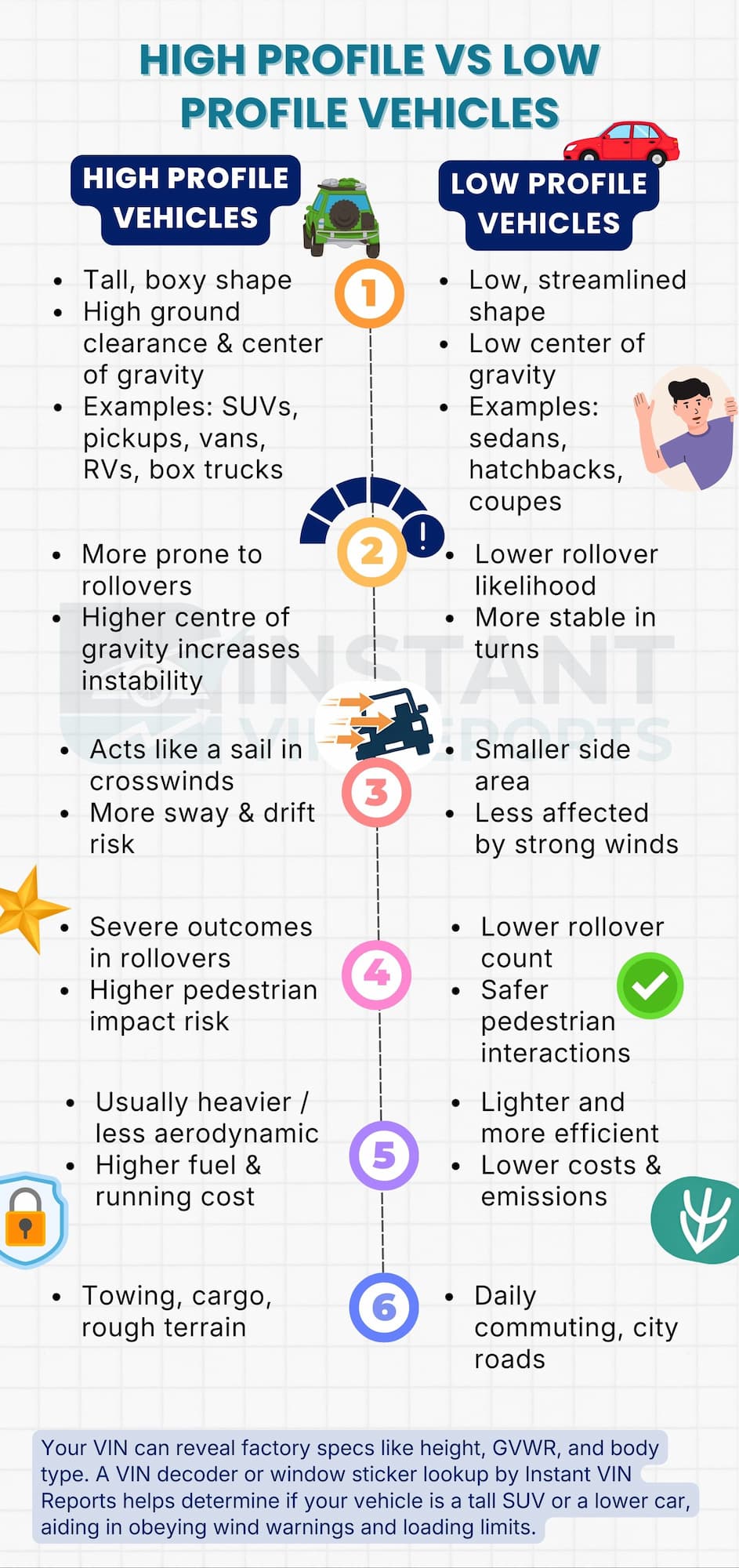
- Catching the Wind: A tall body with a large, flat side (the cross-section) acts exactly like the sail on a ship. This means when a strong crosswind hits, it pushes the vehicle sideways, creating a risk of lane drift and driver fatigue as you constantly fight the wheel.
- The Tipping Point: The most critical factor is the center of gravity (CG). Because these vehicles have a high CG, they are more susceptible to the tipping forces created by wind or aggressive maneuvering.
A high CG combined with strong centrifugal force (like turning too fast) increases the potential for a rollover, and frankly, that’s the risk we worry about the most.
Weight, Load, and GVWR
Weight might seem like a simple factor, but it’s nuanced, especially concerning high-profile instability. Understanding your vehicle’s weight limits is non-negotiable; don’t skip this. Heavier vehicles generally resist wind better, which is why those empty box trucks are the first to be restricted.
- Curb Weight: This is your vehicle’s base weight, full of fluids, but empty of people and cargo. It’s your starting point.
- GVWR: The Gross Vehicle Weight Rating is the maximum total weight the manufacturer says your vehicle can safely handle, including its curb weight, all passengers, and all cargo. You must never exceed this.
- Payload Capacity: The difference between the GVWR and your curb weight is what you can actually put into the vehicle. A tall, light truck with a high payload is the most vulnerable to wind when empty, but stable when properly loaded.
Knowing your vehicle’s exact GVWR and curb weight is crucial for safety and compliance. A VIN decoder from Instant VIN Reports can reveal this factory data for any specific truck or RV, helping you understand its capabilities and limitations the way the manufacturer intended.
The Impact of Modifications
The truck you buy isn’t always the truck the manufacturer built. Aftermarket parts are everywhere, and sometimes, those modifications unintentionally push a stable ride into the dangerous high-profile category.
- Lift Kits and Tires: Installing a lift kit or large, heavy tires directly raises the vehicle’s center of gravity. While this looks good and improves off-road clearance, it exponentially increases the risk of body roll and tipping during sharp, high-speed maneuvers on the road.
- Added Surface Area: Throwing a large roof rack, a camper shell, or an oversized rooftop tent on an already tall SUV adds weight and surface area right where the wind can grab it most effectively.
If buying used, a vehicle history report may reveal prior modifications that affect handling or insurance eligibility.
Popular High-Profile SUVs in 2025
When most people think about high-profile vehicles, full-size SUVs are usually the first thing that comes to mind. Their tall ride height, wide side panels, and upright shape make them more affected by wind and sudden steering than smaller cars or crossovers.
- Chevrolet Tahoe / Suburban
- Ford Expedition
- Toyota Sequoia
- Nissan Armada
- GMC Yukon / Yukon XL
Popular High-Profile Pickup Trucks in 2025
Pickup trucks are classic high-profile vehicles, especially full-size models. Their tall ride height, wide body panels, and variable loading conditions mean they can behave very differently, depending on whether the bed is empty or carrying weight, something many drivers only notice once they hit open highways or strong crosswinds.
- Ford F-150 (especially 4×4 and lifted trims)
- Chevrolet Silverado 1500
- RAM 1500
- Toyota Tundra
- Ford Super Duty (F-250 / F-350)
Popular Vans and RVs in 2025
Here are some of the popular Vans and RVs on the road. Vans and RVs push height and surface area to the limit. Their tall, flat sides make them comfortable for hauling people or living space but also make them some of the most wind-affected vehicles on the road.
- Ford Transit (Cargo and Passenger)
- Mercedes-Benz Sprinter
- RAM ProMaster
- Class C Motorhomes (Ford E-Series or Transit chassis)
- Class A Motorhomes
Why Model Identification Matters
Knowing whether a specific model is considered a high-profile vehicle helps drivers set realistic expectations about handling, insurance costs, and travel limitations in windy conditions. Height, curb weight, wheelbase, and factory safety equipment can vary significantly even within the
High-Profile Vehicles in Wind: Understanding the Risks
You can equip a high-profile vehicle with modern stability systems, but physics still sets the limits. The greatest hazard these vehicles face, and the reason for frequent highway warnings and closures, is wind. Transportation safety investigations consistently show that strong crosswinds are a major factor in serious crashes involving tall vehicles.
How Crosswinds Affect Stability
Crosswinds are the wind hitting your vehicle perpendicular to its travel direction. On a standard sedan with a low center of gravity, a gust might feel like a momentary nudge. On a high-sided RV, that gust turns into a powerful, sustained lateral force. Crosswinds act on a high-profile vehicle in three main ways:
- Side push: The wind literally tries to shove the vehicle out of its lane.
- Tipping moment: Because the vehicle is tall, that force acts high above the ground. This creates leverage that tries to roll the vehicle over.
- Gust loading: Sudden, jerky gusts can upset traction and trigger dangerous overcorrection from the driver.
Safety agencies note that strong winds can make driving “very difficult, especially for high-profile vehicles,” because those forces are constantly fighting the driver’s steering input.
When Wind Becomes Dangerous
Wind is one of the most significant external factors affecting high-profile vehicles.
- Moderate Wind (20–30 mph): You’ll likely notice steering corrections. Slow down and stay focused.
- High Wind Advisories (30–45 mph): This is where tall, lightly loaded vehicles can start feeling unsettled. Reducing speed and avoiding exposed routes helps.
- Extreme Wind Warnings (50+ mph): Park it. Seriously. We’ve seen semi-trailers laid over on their sides like sleeping elephants in Wyoming winds. If you’re in a high-profile rig, you have no business being on the highway.
Case Study: High Profile Vehicles in Wyoming
If you want a real-world example of how severe the high-profile problem can be, look no further than Interstate 80 in Wyoming. Its combination of open terrain, high altitude, and lack of windbreaks creates a frequent blow-over crash hotspot.
The Wyoming Department of Transportation (WYDOT) has, frankly, had to become one of the most sophisticated agencies in the country at managing wind risk. They use predictive modelling and real-time sensors to issue Weight-Based Wind Closures.
- Instead of a blanket “No Light, High-Profile Vehicles”, they now often post clear warnings like “Closed to all high-profile vehicles under 40,000 GVW due to gusting winds.”
Vehicles,” - They’ve also implemented high fines and penalties for drivers (primarily commercial drivers) who ignore these legally binding restrictions.
If you’re towing a camper or driving an empty box truck across I-80, don’t try to guess your GVWR. Check WYDOT alerts, monitor the weather closely, and know your rig’s loaded weight. Our RV VIN lookup can provide the foundational weight data for your specific model, which is essential for complying with these modern, weight-specific closures.
Because wind risk can’t be eliminated entirely, managing it comes down to how you drive and what safety systems your high-profile vehicle is equipped with.
Safety Tips for Driving a High-Profile Vehicle
When you have to drive a high-profile vehicle in windy weather, small habits make a big difference:
Slow down
Lower speeds reduce the sideways force from gusts and give you more time to correct. Trucking safety guides recommend backing off well below the posted limit as winds climb.
Use both hands and smooth inputs
Keep a firm, relaxed grip on the wheel and avoid sudden steering or braking; jerky corrections can start the kind of oscillation that leads to loss of control.
Watch for exposed areas
Bridges, open plains, cuttings, and gaps in tree lines are all places where gusts can hit harder than you expect. Ease off the throttle before you reach them.
Avoid travelling alongside big trucks
If a tractor-trailer gets hit by a strong gust, you don’t want to be right beside it. Drop back or pass decisively in good conditions.
If warnings escalate, seriously consider stopping
When authorities are closing roads or posting “Extreme Blowover Risk” notices, as Wyoming often does for light, high-profile vehicles, the safest option is usually to wait it out.
Essential Safety Features to Look For
If you’re shopping for a high-profile vehicle, safety tech isn’t just a nice-to-have. It’s your backup when physics and real-world conditions stack the odds against you. Focus on these:
- Electronic Stability Control (ESC): This is a big deal for tall vehicles. ESC helps prevent loss of control by applying selective braking and reducing engine power when needed. It’s widely credited by safety organizations with reducing loss-of-control crashes and rollovers.
- Side-curtain airbags with rollover sensors: Improve occupant protection during rollovers.
- Roll Stability Control systems: Actively reduce rollover risk in trucks, vans, and RVs.
- Modern ADAS features: AEB, Lane-Keeping Assist, and Blind-Spot Monitoring reduce crash risk but do not eliminate wind sensitivity.
Pros and Cons of High-Profile Vehicles
Big vehicles have real advantages; that’s why people buy them. But they also come with trade-offs that don’t always show up on a spec sheet.
The Advantages of Going Big
We’ve logged thousands of miles in these beasts, and frankly, the appeal is obvious.
- Improved Visibility: You can see over the traffic ahead. That extra sightline lets you spot brake lights five cars up. A huge safety bonus.
- Utility and Space: You simply can’t fit a soccer team or a sheet of plywood in a coupe. The vertical cargo space is unbeatable.
- Towing and Utility: The frame strength and suspension height of high-profile trucks make them the undisputed workhorses of the road.
The Inherent Disadvantages
But you pay for that utility in other ways.
- Wind Sensitivity: As we’ve noted before, crosswinds are a constant battle that requires active, focused driving.
- Higher Rollover Risk: It’s just physics. If you hit a curb sideways or swerve too hard, the risk of tipping is exponentially higher than in a sedan.
- Increased Costs: Between the “aerodynamics of a brick” hurting fuel economy and the extra wear on heavy-duty brakes, these vehicles cost more to keep on the road.
Buying a High-Profile Vehicle
Shopping for a high profile Vehicle, like a tall SUV, truck, van, or RV, isn’t the same as buying a small car. A lot of the things that don’t matter much with a hatchback, like height, weight, and how it reacts to wind, suddenly matter a lot. That’s why it pays to slow down a bit and look past the surface details before you commit.
Calculating the True Cost of Ownership
It’s easy to focus on the purchase price and ignore the running costs that follow you around for years. But with high-profile vehicles, those ongoing costs are where the real spread shows up compared with low-slung cars. Before you sign anything, consider:
- Fuel use: See how your candidate truck or SUV compares to smaller vehicles and to other big rigs you’re considering.
- Tires, brakes, and maintenance: Heavy-duty tires and big brake components are simply more expensive to replace, and RVs have extra systems (slides, generators, HVAC) that need care.
- Insurance: As we covered earlier, tall, heavy vehicles with complex bodywork and ADAS can cost more to insure.
- Depreciation: Fuel-hungry models can fall out of favour faster when fuel prices spike.
Real numbers help here. The original window sticker or a VIN decode can show how the vehicle left the factory, including the engine, drivetrain, towing setup, and other details that affect how it drives and what it costs to run.
The Critical Role of a Vehicle History and VIN Checks
This is an area where buyers can run into trouble, especially with tall vehicles. A serious accident or rollover can cause damage that isn’t always obvious once the bodywork is cleaned up. But shadier sellers might patch the bodywork and hide the frame stress.
Run the VIN
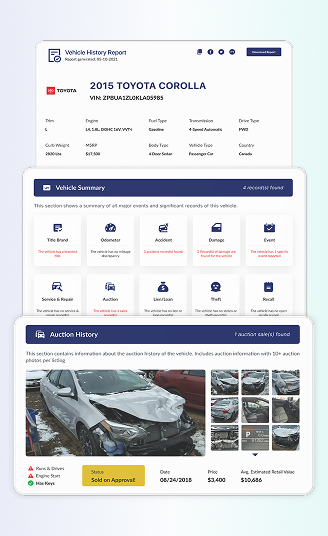
For high-profile vehicles, especially work trucks, box vans, and RVs that might have been heavily loaded or even involved in a rollover, this is even more important. Our report can show:
- Title brands like salvage, rebuilt, or flood
- Reported accidents and airbag deployments
- Odometer discrepancies or suspicious mileage jumps
- Prior commercial or rental use, which often means harder duty cycles
Check the Window Sticker
Use a Window Sticker Lookup to verify the original equipment. Did it come with the heavy-duty tow package and stability control, or were those aftermarket add-ons?
Instant VIN Reports pull this data from multiple sources and combine it with a full VIN decoder, so you see both the vehicle’s past and its factory build in one place. Starting with a VIN check on a candidate, especially if you’re unsure about the story a seller is telling you, lets you weed out problem vehicles before you waste time on inspections or financing talks.
The Hands-On Inspection and Test Drive
Paperwork only tells part of the story. A tall truck or RV can look fine in photos and still feel unsettled once you’re on the road.
Take a slow walk around the vehicle before you drive it. Uneven gaps, ripples in the roof, or mismatched paint can hint at past structural repairs. On the test drive, pay attention to how it feels at highway speed. Steering corrections in light wind or a vague, twitchy feel are worth taking seriously.
Conclusion about High-Profile vehicle
High-profile vehicles (e.g., tall trucks, SUVs, vans, RVs, and trailers) offer serious capability, but they come with unique wind, stability, and cost trade-offs. Height, weight, and loading all matter, especially when conditions aren’t ideal. Knowing that and planning around it goes a long way toward safer driving and fewer surprises.
Before your next purchase, road trip, or tow, get the full story. Decode your VIN or pull a sample vehicle history report with Instant VIN Reports so you know exactly what you’re driving, then hit the road with confidence, not guesswork.
FAQs About High-Profile Vehicles
What are high-profile vehicles?
High-profile vehicles are taller, more boxy vehicles with a large side surface area and a higher center of gravity than normal cars. Think of trucks, buses, RVs, vans, and many SUVs that sit high off the ground and present a big “sail” to the wind.
Because of their height and shape, they’re more sensitive to crosswinds, sudden steering, and poor loading than low-slung sedans or hatchbacks.
What does high profile mean?
In this article context, “high profile” means tall and wind-sensitive. A high-profile vehicle has more height and more vertical bodywork than a typical passenger car, so side winds hit it harder and create a stronger tipping force. The term doesn’t refer to luxury or status here, it’s all about vehicle height, shape, and stability, especially on open highways and bridges.
What is a low-profile vehicle?
A low-profile vehicle is the opposite: lower to the ground with a smaller side area, like most sedans, hatchbacks, and many coupes. They usually handle better in sharp turns, feel more stable in crosswinds, and are often more fuel-efficient, but they can’t match the space and towing ability of bigger trucks and SUVs.
Is an SUV a high-profile vehicle?
Many SUVs, especially mid-size and full-size models, are treated as high-profile vehicles because they’re tall, sit higher off the ground, and have upright sides. Compact crossovers may be borderline, but from a safety point of view, it’s smart to treat most SUVs as high-profile and follow the same wind-safety advice.
Is a Honda Odyssey a high-profile vehicle?
Yes, the Honda Odyssey and similar minivans are often considered high profile. They have a tall roofline and large side panels, so they’re more affected by strong crosswinds than a low sedan. You don’t need to panic in normal weather, but you should be extra cautious on open highways in high-wind conditions.
What should I consider when buying a high-profile vehicle?
When you’re shopping for a high-profile vehicle, focus on safety, history, and running costs. Check crash and rollover ratings, confirm it has stability control and modern safety tech, review fuel and insurance costs, and always pull a VIN-based history report and window sticker to uncover past damage, title issues, and the exact equipment it left the factory with.